
The fastest way to raise HRV naturally is to cut evening alcohol first, then fix sleep timing, then build easy aerobic volume, and layer in daily slow breathing. Alcohol removal shows overnight results. Sleep regularity moves your averages within one to two weeks. Aerobic base work needs six to twelve weeks. Breathing practice shifts your baseline over two to four weeks. Track your own rolling average, not a population number.
TL;DR:
- Removing or moving evening alcohol results in immediate overnight HRV improvements, with effects potentially lasting into the next day, especially with higher doses.
- Consistent sleep timing within 30 minutes and 7 to 9 hours of sleep lead to measurable HRV increases within one to two weeks.
- Building aerobic base training over six to twelve weeks at conversational pace significantly shifts baseline HRV, but stacking hard workouts without recovery can suppress it.
- Daily resonance breathing at six breaths per minute produces quick acute HRV increases, with regular practice leading to sustained baseline improvements over weeks.
- Tracking your HRV using one device and measurement window, while maintaining measurement consistency, is essential to distinguish real progress from noise or temporary fluctuations.
Table of Contents
- What Is HRV and Why Does Your Personal Trend Matter More Than Any Single Number?
- Which Factors Raise or Lower HRV, and Which Ones Are Actually Yours to Control?
- What Are the Most Effective Natural Strategies to Increase HRV, Ranked by Impact?
- How Do You Build a 12-Week Plan to Raise HRV Naturally?
- How Should You Measure and Track HRV Without Being Misled by the Noise?
- What Does the Research Actually Say About These Priorities?
- Why Small, Incremental Changes Suit High-Responsibility Schedules Better Than Overhauls
- Sources
- FAQ
What Is HRV and Why Does Your Personal Trend Matter More Than Any Single Number?
Heart rate variability measures the changing gap between consecutive heartbeats. It sounds like a technical detail, but it's actually a direct readout of how your autonomic nervous system is balancing two competing forces: the parasympathetic branch (often called vagal tone), which governs rest and recovery, and the sympathetic branch, which governs alertness and stress response. A higher HRV generally signals a nervous system with more flexibility to shift between the two. A flat, low HRV suggests you're stuck in sympathetic drive, whether from stress, poor sleep, illness, or overtraining.
Here's where most people go wrong: they check one morning's number and panic or celebrate. HRV is influenced by dozens of variables that have nothing to do with your long-term trajectory: a poor night's sleep, a stressful email at 6 a.m., even the time of day you measure.
What actually matters:
- Your measurement method — chest strap, finger sensor, or wearable ring, each calibrated differently
- Your measurement window — first-morning reading, overnight average, or spot check during the day
- Your rolling average over 7 and 30 days, which filters out daily noise and reveals the real trend
- Your own historical baseline, since what counts as "good" HRV varies enormously between individuals, largely tied to age, sex, and genetics
A single low reading after a bad night means nothing. A 30-day average trending upward after six weeks of disciplined sleep and training means everything.
Which Factors Raise or Lower HRV, and Which Ones Are Actually Yours to Control?
Some inputs to your nervous system are levers you pull daily. Others are fixed biology you work around, not against. Sorting the two prevents wasted effort chasing a number that genetics, not discipline, is holding down.
Controllable factors that suppress HRV:
- Evening alcohol, even moderate amounts
- Late, heavy meals close to bedtime
- Inconsistent sleep and wake times
- High training load stacked without adequate recovery
- Dehydration and unstable blood sugar
- Caffeine late in the afternoon or evening
Controllable factors that raise HRV:
- Consistent sleep timing, night after night
- Regular easy aerobic volume (Zone 2 training)
- Slow, diaphragmatic breathing practiced daily
- Steady hydration and stable blood sugar through the day
Contextual factors you don't control: age, sex, and genetic baseline all shape your ceiling and floor. HRV naturally declines with age as autonomic flexibility narrows, and comparing your number to a 28-year-old's benchmark is a pointless exercise. Set your target against your own history, not someone else's biology.
Alcohol deserves particular attention here because its suppressive effect on autonomic regulation is both measurable and fast. A single evening of drinking can produce a same-night decline in HRV, with effects that are dose-dependent and can persist into the following day. Of every lever on this list, it is the one with the shortest distance between action and result.
What Are the Most Effective Natural Strategies to Increase HRV, Ranked by Impact?
Not every intervention deserves equal attention. Some move your numbers within days. Others require months of consistency before you see a shift. Here they are, ordered by how fast and how large their effect tends to be.
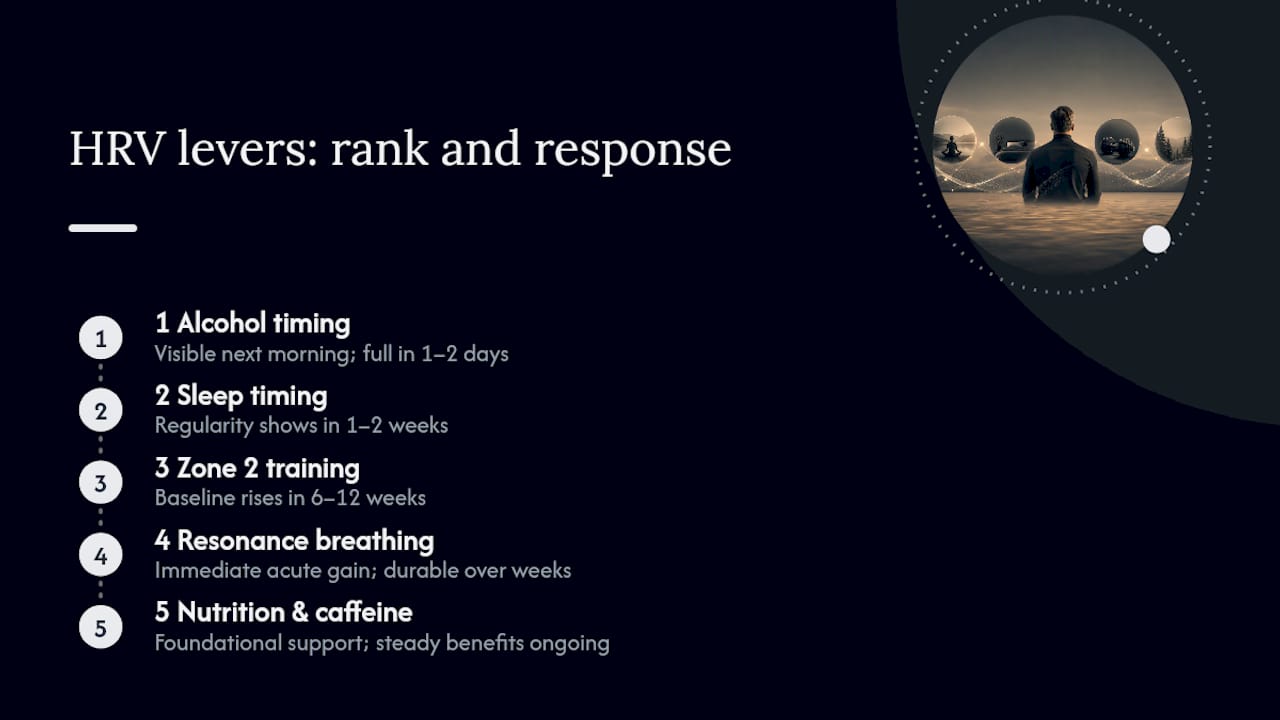
1. Remove or move evening alcohol. Timing often matters more than total volume. Drinking earlier in the evening rather than close to bedtime reduces overnight sympathetic activation and protects the deeper sleep stages that support autonomic recovery. Expect a visible effect the very next morning; a full recovery window after a heavier night can take one to two days.
2. Fix your sleep timing before you fix your sleep duration. A consistent bedtime and wake time, held within about 30 minutes night to night, strongly influences HRV. Sleep regularity tends to show up in your short rolling average within one to two weeks, targeting 7 to 9 hours for most adults. This is a habit, not a supplement, and it responds faster than almost anything else on this list except alcohol.
3. Build an aerobic base at conversational pace. Zone 2 training, roughly 150 to 300 minutes per week at a pace where you can still hold a conversation, reliably raises resting HRV baseline over time. The catch: this lever is slow. Expect six to twelve weeks before your 30-day average moves meaningfully. Stacking hard, high-intensity sessions on top of insufficient easy volume tends to suppress HRV rather than help it, since the nervous system never gets a genuine recovery signal.
4. Practice resonance breathing daily. Breathing at roughly six breaths per minute, five seconds in and five seconds out, or with a slightly longer exhale, produces a large acute increase in HRV during the session itself. Daily practice of resonance breathing sessions of moderate length can translate into meaningful baseline improvement over several weeks according to some studies. The acute effect is immediate and reproducible every time you practice; the durable shift takes weeks of repetition.
5. Support the foundation with nutrition, hydration, and caffeine discipline. Stable blood sugar avoids the sympathetic spikes that come with sugar crashes. Consistent hydration matters more than people assume; even mild dehydration raises resting heart rate and can flatten variability. Cut caffeine by early afternoon, and keep your last substantial meal at least two to three hours before bed to avoid digestive load competing with sleep-stage recovery.
A note on supplements: magnesium and omega-3 show some benefit in people who are genuinely deficient, but the evidence for supplements doesn't come close to the effect size of the four levers above. Treat supplementation as a secondary layer, not a substitute for the foundational habits that carry the real weight.
Pro Tip: Do resonance breathing right before a high-stakes call or a board meeting, not just as a nightly ritual. The acute HRV spike happens during the session, which means you can use it tactically to shift your state in the minutes before you need composure most.

How Do You Build a 12-Week Plan to Raise HRV Naturally?
A disciplined man doesn't need a complicated protocol. He needs a sequence he can actually sustain under real workload. Here's a structure that respects both the biology and a demanding calendar.
- Weeks 1 to 2: Establish measurement consistency and cut evening alcohol. Pick one device, one measurement window, and stick to it every day without exception. Commit to at least two alcohol-free evenings per week as your starting floor.
- Weeks 3 to 4: Lock sleep timing and start easy aerobic work. Hold bedtime and wake time within roughly 30 minutes, seven days a week. Add three easy aerobic sessions, 30 to 40 minutes each, conversational pace only.
- Weeks 5 to 12: Build volume and add breathing practice. Progress aerobic volume toward 150 to 300 minutes per week. Add 5 to 10 minutes of resonance breathing daily. Watch your 7-day average for fast-moving signals and your 30-day average for the structural shift.
| Week Range | Primary Focus | What to Watch |
|---|---|---|
| 1–2 | Measurement consistency, cut evening alcohol | Same-night HRV response |
| 3–4 | Sleep timing, 3 easy aerobic sessions/week | 7-day rolling average |
| 5–12 | Full aerobic volume, daily breathing practice | 30-day rolling average |
If your 30-day average hasn't moved after twelve weeks, don't abandon the plan. Review three things first: whether training load has crept up without matching recovery, whether sleep debt has quietly accumulated, and whether an untracked stressor is dominating the signal. If the flat trend persists despite genuine adherence, a conversation with a clinician is the next right step, not another supplement. For a deeper look at building the recovery discipline this program demands, see Viridos's guide to recovery and discipline for sustained executive performance.
How Should You Measure and Track HRV Without Being Misled by the Noise?
The single biggest mistake in HRV tracking isn't a bad habit. It's inconsistent measurement that makes a real trend indistinguishable from noise.
Pick one device and one measurement window, whether that's a first-morning short reading or a validated overnight wearable, and hold it constant. Switching devices mid-program invalidates your comparison, since different sensors calibrate differently even when measuring the same physiology.
Give yourself a genuine baseline period of 7 to 14 days before judging any intervention. After that, judge fast-acting changes like alcohol removal against your 7-day average, and judge structural changes like aerobic base building against your 30-day average.
Watch for these common pitfalls:
- Measuring at a different time each day, which introduces circadian noise
- Drinking alcohol the night before a reading you plan to treat as a baseline data point
- Switching wearables or apps mid-program without a transition period
- Travel and jet lag, which will temporarily depress HRV independent of your habits
- Acute illness, which suppresses HRV regardless of how disciplined your routine has been
The guide on sleep hygiene for executive performance covers additional tactics for protecting the measurement window that sleep quality depends on.
What Does the Research Actually Say About These Priorities?
The ranking above isn't arbitrary. Resonance breathing at roughly six breaths per minute has been shown to produce large acute HRV increases during practice, with daily sessions of 10 to 20 minutes linked to baseline gains over 4 to 12 weeks in some studies. Aerobic base training in the 150 to 300 minute weekly range shows measurable rolling-average changes after roughly 6 to 12 weeks. Alcohol's suppressive effect is documented as acute and same-night, with a dose-dependent recovery window extending into the following day or two.
HRV is not a score to optimize once and forget. It's a rolling conversation between your nervous system and the decisions you make about alcohol, sleep, and movement, updated every single day.
This performance philosophy favors foundational habit change over shortcuts that promise more than physiology delivers.
Why Small, Incremental Changes Suit High-Responsibility Schedules Better Than Overhauls
Executives don't fail HRV protocols because the science is wrong. They fail because they try to overhaul everything in week one. A five-minute breathing reset before a difficult meeting, a strict rule against evening work bleeding past a fixed bedtime boundary, two alcohol-free nights chosen in advance rather than negotiated in the moment. These micro-practices survive board season. Grand overhauls rarely do.
Small-batch precision beats broad promises here, the same principle that shapes how Viridos approaches formulation.
— Joakim
Sources
- Alcohol's effects on autonomic regulation (PMC5878366)
For readers who want a structured next step, Viridos offers two membership tiers built around sustained performance discipline: Member and Professional plans, starting at $99 per month, give approved applicants access to small-batch Swedish formulation designed to support the same resilience this protocol builds. Full membership details are available for those ready to apply.
FAQ
How Can You Raise HRV Naturally?
Cut evening alcohol first for an overnight effect, then fix sleep timing for gains within one to two weeks, then build aerobic base and daily resonance breathing for a six to twelve week baseline shift. Track your own 7-day and 30-day rolling averages rather than comparing to population norms.
Why Is Your HRV So Low?
Low HRV usually reflects a combination of poor sleep regularity, evening alcohol consumption, high stress load, or training without adequate recovery. Age, sex, and genetics also set your personal baseline, so a "low" number only means something relative to your own history.
What Health Conditions Can Cause Low HRV?
Chronic stress, poor sleep quality, cardiovascular and metabolic conditions, and acute illness can all suppress HRV through sustained sympathetic nervous system activation. A persistently flat trend despite genuine lifestyle changes is worth discussing with a clinician.
What Causes Low HRV at Night?
Evening alcohol is one of the fastest-acting causes, producing a measurable same-night decline in autonomic function. Late heavy meals, inconsistent bedtime, high unrecovered training load, and stress carried into the evening all contribute as well.