
Premium dietary supplements in the U.S. typically run $30–$80 per product per month, with a well-constructed evidence-backed stack landing between $33–$50/month at the budget end and $300–$450/month for an aggressive expert protocol. Understanding the cost of premium supplements before you commit is the difference between disciplined spending and expensive guesswork.
Here is what the price landscape looks like at a glance:
- Single-ingredient premium items such as vitamin D3+K2, magnesium bisglycinate, and creatine monohydrate often cost moderate amounts per month each
- Premium omega-3 / high-EPA fish oil can be more costly
- Premium multivitamins typically have a moderate monthly price range
- Specialized compounds like NMN, liposomal glutathione, and nootropic complexes usually carry higher monthly costs
A minimal, evidence-first stack of four core items runs roughly $33–$50/month at budget-tier pricing. A moderate performance stack sits closer to $100–$200/month. Maximalist, medically supervised protocols can reach $300–$450/month or well beyond, with some expert regimens exceeding $1,500–$2,000/month.
Key Takeaways
Premium supplement costs follow a predictable curve: the core evidence-backed stack delivers the highest return per dollar, and every tier above $150/month requires a specific, documented rationale to justify the spend.
| Point | Details |
|---|---|
| Core stack monthly cost | A four-item evidence-first stack (D3+K2, magnesium, creatine, omega-3) runs $33–$50/month. |
| Premium form multiplier | Chelated and premium forms cost a median 2.8× more per active dose than commodity forms. |
| Calculate before you buy | Divide price by servings, then by your target clinical dose, to find true cost per relevant dose. |
| Where to save | Third-party certified generics, 90–180 day bulk buys, and quarterly subscription audits cut spend by 15–50%. |
| Viridos membership | For men requiring precision sublingual delivery and small-batch Swedish production, Viridos offers a controlled-access membership beyond standard retail. |
Table of Contents
- How much do premium supplements cost by category?
- What actually makes a supplement "premium"?
- How do you calculate cost per serving and compare value?
- Three monthly stack examples at different budget levels
- Where should you buy premium supplements in the U.S.?
- Practical ways to reduce your supplement spend without losing quality
- When is premium pricing genuinely justified?
- An editorial perspective on cost versus value
- Viridos: a premium membership for men who require more than a bottle
- Sources
How much do premium supplements cost by category?
The table below reflects typical retail price ranges for premium-tier products in the U.S. market, based on standard serving counts and category cost data.
| Category | Premium price/container | Servings/container | Cost/serving | Typical monthly cost |
|---|---|---|---|---|
| Vitamin D3+K2 | $18–$30 | 60–90 | $0.20–$0.50 | $6–$15 |
| Magnesium bisglycinate | $20–$35 | 60–90 | $0.25–$0.55 | $8–$17 |
| Creatine monohydrate | $25–$40 | 60–80 | $0.35–$0.65 | $8–$20 |
| High-EPA omega-3 | $35–$55 | 30–60 | $0.60–$1.80 | $18–$50 |
| Premium multivitamin | $35–$60 | 30–60 | $0.60–$2.00 | $18–$60 |
| NMN (500 mg) | $50–$90 | 30–60 | $1.00–$3.00 | $30–$90 |
| Nootropic complex | $55–$120 | 30 | $1.80–$4.00 | $55–$120 |
| Protein (whey isolate) | $50–$80 | 25–30 | $1.70–$3.20 | $50–$80 |
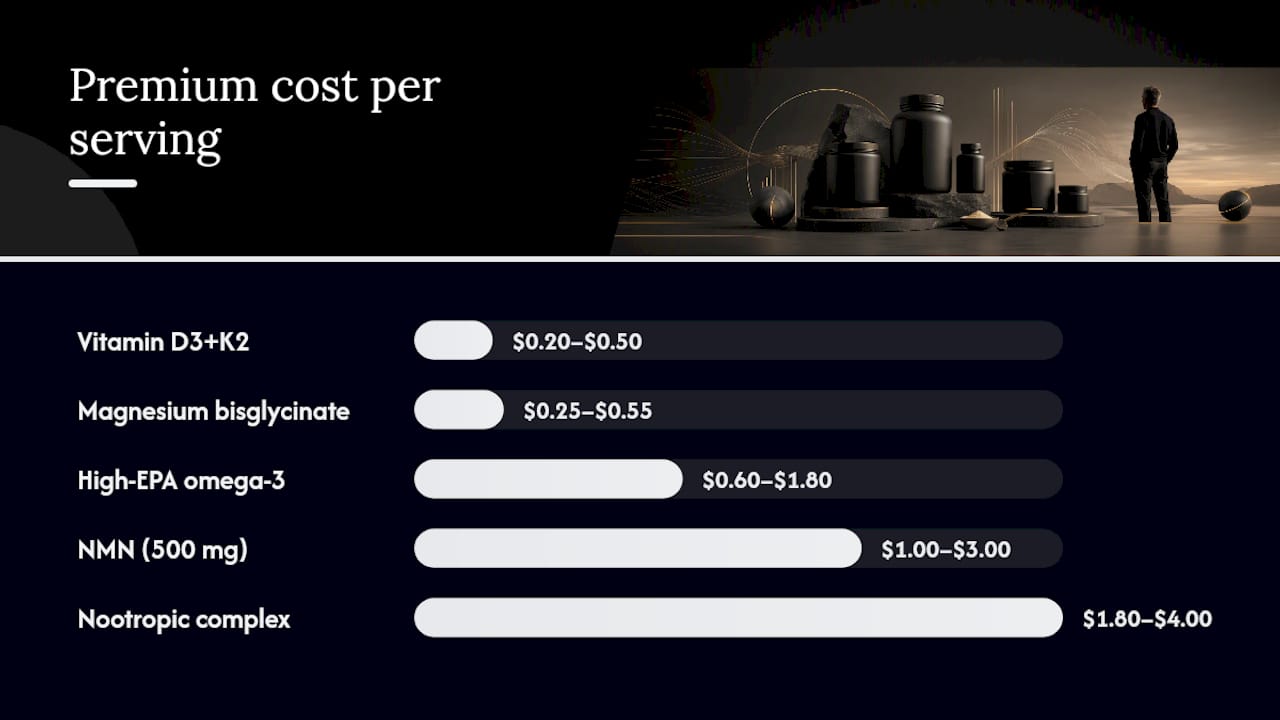
A few categories stand out at the extremes. Vitamin D3 is among the cheapest per dose in the entire supplement market, often delivering clinically relevant amounts for under $0.25 per day. NMN and specialized nootropics sit at the opposite end: a single 500 mg NMN product can cost more per month than the entire core-four stack combined.
Serving size also shifts the math significantly. High-EPA omega-3 targets (2–4 g EPA+DHA daily for cardiovascular or anti-inflammatory goals) can require two to four softgels per day rather than one, doubling or tripling the stated per-serving cost. Always calculate monthly cost against your actual target dose, not the label's suggested serving.
What actually makes a supplement "premium"?
Five factors consistently drive premium nutrition supplement expenses above commodity pricing. Knowing which ones matter lets you pay for substance, not packaging.
-
Ingredient form and chelation. The bioavailable form of a mineral or vitamin costs more to manufacture. Chelated and premium forms cost a median 2.8× more per active dose than their cheap counterparts, with iron bisglycinate reaching up to 29× the cost per mg of iron sulfate. Methylcobalamin versus cyanocobalamin, magnesium bisglycinate versus oxide, and zinc picolinate versus zinc oxide are the most common form-based price splits you will encounter.
-
Clinical dosing per serving. A product that delivers a dose matching the amounts used in clinical research costs more to produce. Many budget products underdose by 30–50% to hit a lower price point, which means you either take multiple servings or accept a sub-therapeutic dose.
-
Third-party testing and certification. NSF International, USP, ConsumerLab, and Informed Sport provide independent verification that a product contains what the label states and is free of contaminants. Certification adds cost, but it is the most credible trust signal available to buyers who cannot audit a manufacturing facility themselves.
-
Small-batch and traceable sourcing. Smaller production runs with documented raw-material sourcing allow tighter quality control at each batch. This is not marketing language when it is backed by a certificate of analysis (COA) available on request.
-
Delivery system. Sublingual sprays and liposomal encapsulation bypass first-pass metabolism and can increase bioavailability for certain compounds. The formulation technology required adds to unit cost, but for delivery-sensitive ingredients, the premium is often justified by the difference in absorbed dose.
Pro Tip: Before paying a premium, request or look up the brand's third-party COA for the specific batch you are buying. A brand that cannot produce one is charging a premium for marketing, not quality.
How do you calculate cost per serving and compare value?
The math is straightforward and takes under two minutes once you have the label in front of you.
- Find the price per container (after any subscription discount).
- Divide by servings per container to get cost per serving.
- Divide by the active ingredient amount per serving, then divide again by your target clinical dose to get cost per clinically relevant dose.
Example: A magnesium bisglycinate product costs $32 for 90 capsules at 200 mg elemental magnesium per capsule. Cost per serving = $0.36. If your target dose is 400 mg/day, you take two capsules, so your real daily cost is $0.72, or roughly $22/month. A budget magnesium oxide product at $12 for 120 tablets at 400 mg per tablet costs $0.10/day, or $3/month. The form premium is real, but so is the difference in GI tolerance and absorption.
Beyond the math, weigh these non-price signals before committing:
- Third-party certificate on file (NSF, USP, or ConsumerLab)
- Ingredient form listed explicitly on the label (not just "magnesium" or "B12")
- Dose per serving matches published clinical research ranges
- Expiration date and oxidation risk (especially for fish oil: check for a rancidity test or TOTOX score)
- Label transparency: no proprietary blends hiding individual ingredient amounts
A useful tool for normalizing these comparisons across products is the VitaWise cost calculator, which aggregates median retail prices per serving and shows budget versus premium monthly differences, typically in the $40–$50 range for equivalent effective doses.
For a deeper framework on choosing supplements with precision rather than brand loyalty, the precision supplement guide covers the evaluation logic in detail.
Three monthly stack examples at different budget levels
These three tiers translate abstract price ranges into concrete monthly budgets. Costs reflect mid-range premium pricing, not the cheapest or most expensive option available.
| Budget evidence-first | Vitamin D3+K2, magnesium bisglycinate, creatine, omega-3 | $33–$50 | | Moderate performance | Core 4 + premium multivitamin + adaptogen complex | $110–$175 | | Aggressive/expert | Core 4 + multivitamin + NMN + nootropic complex + liposomal add-on | $300–$450+ |
The budget tier delivers the highest measurable return per dollar. Research consistently supports vitamin D (particularly in lower-sunlight months), creatine, omega-3, and magnesium as the core items with the strongest population-level evidence for cost-effectiveness among healthy adults.

The moderate tier adds a premium multivitamin and an adaptogen or targeted complex. The cost jumps significantly, but the marginal evidence per added dollar begins to thin. Adaptogens such as ashwagandha and rhodiola have a credible evidence base for stress resilience and cognitive performance, and understanding why adaptogens matter for executive resilience helps clarify whether that addition is justified for your specific demands.
The aggressive tier is where diminishing returns become visible. NMN alone can add $50–$90/month, and the evidence base, while promising, remains less established than the core four. Expert stacks show that most marginal benefit occurs early in the cost curve. Spending beyond $200/month requires a clear rationale, ideally informed by bloodwork or a clinician's guidance, not marketing copy.
For context on how nutrition and supplementation interact with executive performance more broadly, the nutrition and performance guide covers the meta-analytic evidence behind core choices.
Where should you buy premium supplements in the U.S.?
Channel choice affects both price and product integrity. The options differ meaningfully:
- Direct-to-consumer (DTC) brand stores. Typically the highest list price, but subscription discounts of 10–20% are standard. You get direct access to COAs and batch information, and the authenticity risk is near zero.
- Pharmacies (CVS, Walgreens, Whole Foods). Stable pricing with less variance. Selection skews toward established brands with USP or NSF certification. Rarely the cheapest, but reliable for quality-verified products.
- Amazon and online marketplaces. Wide price variance. Third-party sellers introduce counterfeit and storage-condition risks for products like fish oil and probiotics. Price-check here, but verify the seller is the brand itself or an authorized distributor before buying.
- Clinician and medical-brand channels. Products sold through practitioners (Thorne, Pure Encapsulations, Metagenics) often carry higher prices but stricter manufacturing standards. Some are available direct; others require a practitioner account.
Pro Tip: When buying online, search the brand's website for the specific batch COA before purchasing from any third-party seller. If the brand does not publish COAs or respond to COA requests, that gap in transparency is itself a quality signal.
Subscription math is worth running explicitly. Stacked across three or four products, that is $200–$300 annually, which is meaningful. The risk is subscription drift: forgotten subscriptions cost consumers roughly $200/year on average. Audit your active subscriptions quarterly.
Practical ways to reduce your supplement spend without losing quality
Cost reduction in this category is about precision, not compromise. These tactics preserve evidence-backed benefit while cutting unnecessary expense:
- Buy by cost-per-active-dose, not by brand. Run the calculation from Section 4 on every product before purchasing.
- Choose equivalent cheaper forms where the evidence supports it. Creatine monohydrate, for example, has decades of clinical data and costs a fraction of newer creatine forms with thinner evidence. Creatine's evidence base extends beyond performance into bone and metabolic health, making it one of the highest-value items per dollar in any stack.
- Buy 90–180 day supplies. Bulk pricing typically cuts per-unit cost by 15–30%, and most core supplements are stable over that period.
- Verify third-party testing instead of paying for brand image. A store-brand vitamin D3 with a USP seal delivers the same active compound as a premium-branded equivalent at a fraction of the cost.
- Audit subscriptions every quarter. Cancel anything you are not consistently using. Unused supplements are a 100% waste, regardless of quality.
Where not to save: fish oil quality matters more than most buyers realize. Oxidized omega-3 products are not merely ineffective; some research suggests they may be counterproductive. Pay for a product with a published TOTOX score or third-party oxidation testing. Similarly, probiotic products require cold-chain integrity, and the cheapest options often cannot guarantee viable CFU counts at the time of consumption.
For strategies that complement a disciplined supplement protocol without adding unnecessary stack items, executive performance without stimulants covers the behavioral and nutritional levers that reduce the need for expensive add-ons.
When is premium pricing genuinely justified?
Not every premium claim holds up. The signals below distinguish real quality from well-packaged marketing:
- Published third-party COA for the specific batch, not just a brand-level certification claim
- Ingredient form stated explicitly (methylcobalamin, not just "B12"; bisglycinate, not just "magnesium")
- Dose per serving matches the range used in peer-reviewed clinical studies
- Small-batch production with documented sourcing and batch traceability
- Delivery system matched to the compound's bioavailability requirements
For delivery-sensitive compounds, sublingual and liposomal formats are not premium theater. They represent a genuine pharmacokinetic advantage: bypassing hepatic first-pass metabolism increases the fraction of active compound reaching systemic circulation. When a manufacturer can document that advantage with absorption data, the price premium reflects a real difference in biological relevance, not just a more expensive bottle.
For a structured checklist on evaluating whether a brand's premium claims are substantiated, how to identify a sophisticated supplement brand covers the label and sourcing signals that separate credible producers from marketing-first operations.
The clearest rule: if a brand cannot show you a COA, a third-party certification, and an explicit ingredient form on the label, the premium price is not justified by the evidence available to you as a buyer.

An editorial perspective on cost versus value
The question of whether premium supplements are worth it rarely has a universal answer. It depends on what you are optimizing for and how rigorously you apply the cost-per-dose framework.
My position: the core four (vitamin D3+K2, magnesium bisglycinate, creatine, high-EPA omega-3) justify premium-form pricing because the form differences are clinically meaningful and the monthly cost remains manageable. Beyond that tier, every addition requires a specific rationale, ideally bloodwork or a documented performance gap, not a compelling product page. The cost curve steepens fast, and most of the marginal spend above $150/month goes toward compounds with promising but still-developing evidence.
For men in demanding executive roles, the calculus shifts slightly. Sustained cognitive output, stress resilience, and metabolic consistency are not abstract goals. They are operational requirements. When a delivery system or a formulation approach can document a genuine bioavailability advantage, that premium is worth paying, because the alternative is spending the same money on a product that delivers less of the active compound to where it needs to go. Small-batch Swedish production and precision sublingual delivery are not positioning language when they are backed by documented manufacturing controls and absorption data. They are the difference between a supplement that performs and one that looks good on a shelf.
Viridos: a premium membership for men who require more than a bottle
Most of what this guide covers applies to off-the-shelf products you can order from any retailer. Viridos occupies a different position entirely.

Viridos is a controlled-access membership for men who have moved past the commodity supplement aisle and want a precision-formulated, plant-derived performance product delivered as a sublingual oral spray, produced in small batches in Sweden with documented manufacturing controls. The product targets phytoandrogen-related pathways relevant to drive, clarity, strength, and executive performance, and it is available only through individual application and membership approval.
This is not the right fit for every buyer. It suits men who have already built a solid evidence-first foundation, understand the value of delivery-system precision, and are committed to a consistent membership cadence. Before applying, confirm you have no contraindications with your physician and that a recurring membership model fits your protocol. The longevity and performance strategy page outlines the membership structure and what the application process involves.
Sources
These resources support the cost ranges, form-premium data, and stack examples referenced throughout this guide:
- Expert Stack Costs: $80/mo to $2,000/mo (2026)
- Supplement Cost Calculator | VitaWise
- Nnng
- Supplement form premium: chelated forms cost up to 29× more · VitaminDB
- Kosttillskott — en komplett guide baserad på forskning | Matkalkylen
This article is general information, not a substitute for advice from a qualified doctor. Consult a qualified healthcare professional about your own circumstances before acting on anything here.