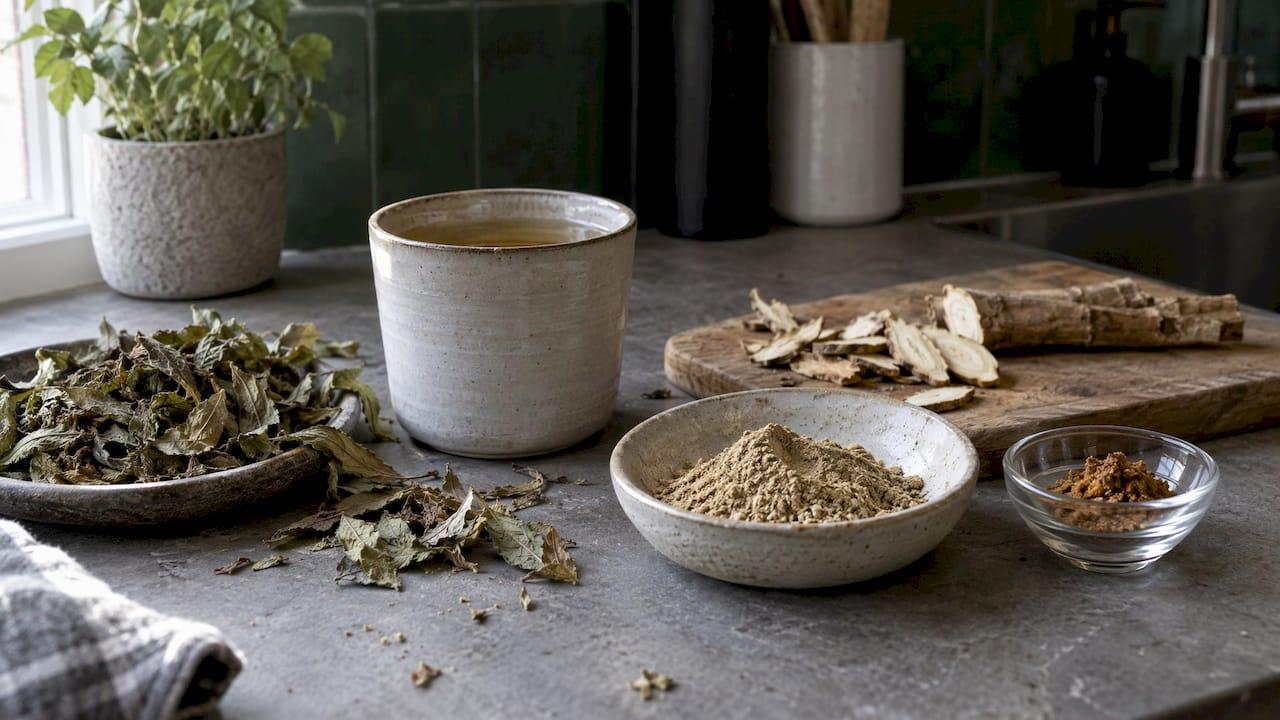
A whole herb is the plant material itself, dried and often powdered. A proprietary extract is a defined fraction of that plant, drawn out with a solvent by a specific method and then concentrated. The difference is not "natural versus processed". It is a difference in what you can specify, measure and repeat. For a man who manages his performance the way he manages a business, with defined inputs and consistent output, that is the question that matters. It is the reasoning behind our oral spray, which uses proprietary extraction methods to deliver phytoandrogen-related compounds.
TL;DR
- A whole herb is the plant, dried or powdered. An extract uses a solvent to dissolve selected constituents and separate them from the undissolved plant material.
- "Proprietary" describes the producer's own method. It says nothing about strength until the label gives numbers: the plant part, the extract ratio, the solvent and the quantity per daily dose.
- A stated plant weight alone does not tell you what you absorb. In one 2021 analysis of 54 turmeric products, measured active content varied widely at the same labeled dose.
- In Sweden, a supplement must be labeled "kosttillskott" and state a recommended daily dose, with active substances given numerically per dose.
- Judge any herbal product on repeatability, quantified labeling and quality control, not on adjectives.
Table of Contents
- What a whole herb is, and what an extract is
- What "proprietary extract" means on a label
- Is an extract stronger than a whole herb?
- Where whole herb and extract each fit
- Proprietary blends versus a quantified label
- What Swedish rules require on a supplement label
- Safe use: extracts, doses and interactions
- A note on "traditional use"
- How to compare the two on your own terms
- What we offer
- Perspective
- FAQ
- Sources
What a whole herb is, and what an extract is
Whole herb covers the plant in its simplest usable forms: fresh or dried leaf, root, bark or berry, steeped as tea, simmered as a decoction, or milled into powder. The NIH Office of Dietary Supplements describes these preparations, along with extracts and tinctures, and notes that extracts use a solvent and may be evaporated into a dry form, while tinctures soak botanicals in alcohol and water.
An extract is defined more precisely. According to a 2022 peer-reviewed paper on plant-to-extract ratios, a botanical extract is the complex mixture obtained when a solvent dissolves constituents from botanical material and those constituents are separated from the undissolved plant material. The result can be liquid, semisolid or dry, and its composition depends on both the plant and the extraction process.
Two consequences follow:
- Whole herb carries everything in the plant, including fiber and constituents that never dissolve. What reaches you depends on how you prepare it and how your body handles it.
- An extract carries what the process selected. Change the solvent, the temperature or the plant part and you change the product.
That second point is why the word "proprietary" exists at all.
What "proprietary extract" means on a label
In practice, "proprietary extract" tells you that the producer owns or controls the extraction method or the specification of the extract. It is a statement about process and ownership. It is not, by itself, a statement about concentration, purity or effect.
That distinction is useful, not suspicious. A proprietary method is how a producer holds a specification constant from batch to batch. The question for you is whether the label gives enough to understand what is in each dose.
The quality benchmarks come from regulation of herbal medicinal products. The European Medicines Agency's quality guideline treats the plant's scientific name and part, the preparation method, the extraction solvent and the extract ratio as material to defining an herbal preparation. Food supplements are not medicinal products, but those four items are a sound frame for reading any extract label.
Here is that frame as a short checklist:
| What to look for | Why it matters |
|---|---|
| Scientific (Latin) name and plant part | Root, leaf and seed of one species can differ in composition |
| Extraction solvent | Water, ethanol and other solvents dissolve different constituents |
| Plant-to-extract ratio | Shows how much starting material was used per unit of extract |
| Quantity of active substances per daily dose | Lets you compare products and track what you take |
| Recommended daily dose | Required for food supplements in Sweden |
Is an extract stronger than a whole herb?
Often an extract is more concentrated per gram. Concentration is a statement about the material, though, not about outcome. Two points keep the comparison honest.
First, the ratio is not a universal measure. The 2022 paper on plant-to-extract ratios stresses that a ratio such as 10:1 is only interpretable when you know how the extract was made and whether excipients or other materials were added. A ratio describes the starting material relative to the finished extract. It does not tell you what is in it. Our own analysis of this, written for Swedish executives, is in why a 10:1 ratio alone is not enough.
Second, a plant weight on the label can mislead. A 2021 analysis of 54 turmeric supplements found that among 12 products labeled at around 500 mg of turmeric per day, measured total curcuminoids ranged from 16 to 554 mg. Products that made a voluntary curcuminoid claim averaged 6.2% above it, and 63% were within ±10% of the claim. The lesson is that a quantified claim about the active constituent is far more informative than a gram figure for the raw plant. That holds for powders and extracts alike.

The NIH Office of Dietary Supplements adds a reminder worth keeping: human studies, including clinical trials, give the most direct evidence of a botanical's health effects, and the strength of evidence varies widely by ingredient. So the right comparison is ingredient by ingredient, never category by category.
Where whole herb and extract each fit
Whole herb suits preparations built around ritual and volume: a tea, a decoction, a culinary use. The plant is taken as it grows, in amounts set by the cup or the spoon.
An extract suits a different brief: a defined dose, taken at a set time, in a small and portable form. For a man with a full calendar, travel and early starts, the practical advantages are specificity and consistency. You know the daily amount, you can repeat it, and it fits into a routine without preparation.
The difference in format matters as well. Capsules and powders pass through digestion. A sublingual spray is designed around a different philosophy: a small, precisely measured dose placed under the tongue. That delivery logic is why we build around extraction and a spray format together, rather than milling plant material into a powder.
Proprietary blends versus a quantified label
"Proprietary" can also appear as "proprietary blend", which is a labeling term in its own right and a separate matter from a proprietary extract. Under US rules, as a 2023 peer-reviewed paper on proprietary blends explains, a blend's total weight and ingredient names can be listed without individual amounts. The same paper reports that omitting ingredient-level quantities prevents exposure calculations and makes it harder to identify the tested dose when comparing clinical trials.
The practical rule for you: prefer products that state the quantity of each active ingredient per daily dose. It lets you compare, track and discuss your regimen with a physician with real numbers.
What Swedish rules require on a supplement label
If you buy or take supplements in Sweden, the governing text is the Swedish Food Agency's regulation LIVSFS 2023:3. It applies to foods marketed as food supplements and requires, among other things:
- the designation "kosttillskott";
- the characteristic nature or category of the ingredients;
- the recommended daily dose;
- warnings not to exceed that dose, that the product is not a substitute for a varied diet, and that it should be kept out of reach of small children;
- numerical quantities of nutrients or other substances with nutritional or physiological effects, per recommended daily dose.
The regulation refers to the EU's general food-information rules for everything else. A Swedish industry guideline from Svenskt Genvård's 2023 labeling guidance adds that EU rules on herbs in food supplements are not fully harmonized, so national requirements should be checked in each country of sale. That is an industry interpretation, not the primary authority, but it explains why a product sold across Europe can look different from one sold in Sweden.
For a walk through each required line, see our guide to what a Swedish supplement label must state. For the format question, we also cover the legal checks for oral spray supplements.
Safe use: extracts, doses and interactions
Concentrated plant constituents deserve the same discipline you apply to any input. The European Directorate for the Quality of Medicines and HealthCare (EDQM) published a consumer leaflet and a professional guide on herbal food supplements. Its guidance centers on following label directions, checking for interactions, using reliable sources and seeking professional advice where appropriate.
In practice:
- Stay within the recommended daily dose. Swedish law requires the label to warn against exceeding it.
- If you take prescription medication, particularly for blood pressure, blood thinning, cholesterol or mood, speak to your physician or pharmacist before adding any herbal product. Plant constituents can interact with how the body processes some medicines. We explain the mechanism in our pieces on herb and P450 interactions and how long interaction risk can last.
- If you have a medical condition, or are unsure whether a botanical is suitable, consult your physician first.
A note on "traditional use"
Whole herbs often come with centuries of use behind them. Europe has a formal route for that history: the EMA says that registration of a traditional herbal medicinal product requires at least 30 years of medicinal use, including at least 15 years in the EU, along with a specified strength and dosage. A 2024 regulatory review describes this pathway as resting on long-standing use and plausible efficacy rather than the evidence pathway of a new medicine.
That pathway concerns medicinal products. A food supplement is regulated differently, so tradition is background, not a label claim you can rely on. What you can rely on is a specification: a named plant part, a defined method, a stated dose.
How to compare the two on your own terms
Use the same test you would apply to a supplier contract. Five questions:
- Is the plant identified by its scientific name and part?
- Is the method described, including the solvent or at least the extract ratio?
- Is the active content stated per daily dose, in numbers, not just a total weight?
- Is the production controlled and traceable, with batches small enough to keep specifications consistent?
- Does the product claim only what the rules allow, with no promise of a medical outcome?
Whole herb can satisfy some of these; a well-specified extract can satisfy all of them. Our guide to five checks for Swedish-made supplements shows how to verify the production side.
What we offer
Our supplement is a plant-derived oral spray for men, made with proprietary extraction methods to deliver phytoandrogen-related compounds, with small-batch production in Sweden. Access is by individual application and membership. The Member plan is 99 USD per month and the Professional plan is 299 USD per month; both are described on the pricing page, and the membership page explains how access works.

If you want to read further before applying, the Performance Journal collects our work on performance longevity and disciplined living.
Perspective
We built Viridos on a plain conviction: a man in a demanding role should be able to know what he takes, and take it the same way every day. That is why we work with extraction rather than raw plant material.
Whole herb has its place, and nobody should confuse a precise process with a promise. An extract is a decision about what to draw from the plant and how. Our method is proprietary because we keep that decision under our control, in small batches in Sweden, so the specification holds.
The same discipline guides how we write. We separate what is established from what is uncertain, and we keep a record of why we decide as we do. Your judgment stays yours; our job is to give it clean inputs.
A sublingual spray follows from the same thinking: a measured dose, in a form that fits a working day, for men still in the arena.
Joakim
FAQ
Is a proprietary extract better than whole herb?
It depends on what you need. An extract is the stronger choice when you want a defined, repeatable dose, because the method and specification are fixed. Whole herb suits teas and culinary use. Judge either one by what the label quantifies, not by the word "proprietary".
What is the difference between a standardized extract and a proprietary extract?
Standardization means a product is adjusted or tested to contain a stated amount of a marker or active constituent. Proprietary refers to who owns or controls the method. A product can be both, and the label should give the numbers either way.
Do extracts work faster than whole herbs?
Speed depends on the ingredient, the dose and the delivery format, so no single answer covers every plant. Human studies are the most direct evidence for any botanical, and the strength of that evidence varies by ingredient. A sublingual spray is designed around precise dosing under the tongue.
What must a supplement label state in Sweden?
It must carry the word "kosttillskott" and the recommended daily dose. It must also give warnings on not exceeding that dose and on keeping the product from small children, and state active substances numerically per daily dose. The rules are in LIVSFS 2023:3.
Should I check with a doctor before taking a herbal extract?
Yes, if you take prescription medication or have a medical condition. Plant constituents can interact with some medicines, and your physician or pharmacist can review your specific combination. Follow the label's recommended daily dose in every case.
Sources
- NIH Office of Dietary Supplements: Botanical Dietary Supplements Background Information
- Understanding plant to extract ratios in botanical extracts (2022)
- EMA: Guideline on quality of herbal medicinal products
- Comparison of label claims and measured curcuminoid content (2021)
- Perspectives on the use of proprietary blends in dietary supplements (2023)
- Livsmedelsverket: LIVSFS 2023:3
- Svenskt Genvård: Branschriktlinje kosttillskott 2023
- EDQM: Two new publications on herbal food supplements
- EMA: Q&A on traditional herbal medicinal products
- Ethical considerations in the regulation of traditional medicines (Frontiers, 2024)