
TL;DR:
- Regular physical activity enhances executive performance, reduces stress, and promotes long-term health. Consistent aerobic, strength, mobility, and movement breaks are necessary for cognitive longevity and resilience. Monitoring key metrics and progressive training help sustain high performance while minimizing injury risk.
Physical activity is the single most reliable, evidence-backed lever for preserving executive vitality: it sharpens cognition, reduces stress reactivity, and lowers long-term risk for chronic disease. Measurable benefits of physical activity appear within days of starting regular aerobic and strength training.
Start here:
- Block daily sessions of moderate to vigorous aerobic work several times per week.
- Add regular resistance training sessions weekly to preserve muscle mass and metabolic resilience.
- Break up extended periods of sitting regularly with brief movement, regardless of structured exercise volume.
- Track one objective metric from week one: resting heart rate or a simple strength benchmark.
Table of Contents
- Why does physical activity matter for executive performance?
- Which types of activity build the executive edge?
- A time-efficient weekly template for high-performance men
- How do you know it's working?
- Safety and smart progression for men 40+
- How to make activity sustainable in a demanding schedule
- Key Takeaways
- The discipline that compounds
- Structured support for executive performance
- Useful sources and further reading
Why does physical activity matter for executive performance?
The mechanisms are specific and well-documented. Regular aerobic training improves cerebral perfusion, supports neurotrophic signaling (particularly BDNF), and blunts HPA axis and sympathetic nervous system overactivity. In plain terms: your cortisol response to a high-stakes board meeting becomes more calibrated, and your recovery between stressors is faster.
Research published in the Royal Society confirms that fitness reduces stress reactivity by lowering inflammatory cytokine responses and optimizing neuroendocrine regulation. This is not a marginal effect. It is the physiological basis for why disciplined men who train consistently perform better under sustained pressure than those who do not.
A meta-analysis in Nature Mental Health found that high cardiorespiratory fitness (CRF) is associated with a reduced risk of depression (HR=0.64) and all-cause dementia (HR=0.61). Each 1-MET improvement in aerobic capacity maps to measurable reductions in both outcomes. CRF is not a vanity metric. It is a clinical-grade biomarker for cognitive longevity.
Nature Medicine has called for reframing physical activity beyond cardiometabolic prevention toward a broader model of health and wellbeing that includes immunity, mental health, and cancer outcomes. For executives, this reframing matters: movement is infrastructure for sustained performance, not a lifestyle add-on.
A single session produces immediate cognitive benefits — sharper thinking, reduced anxiety, better mood. Habitual activity compounds those gains into structural cognitive protection over years. Consistency across the week is what separates a temporary mood lift from a durable performance advantage.
Which types of activity build the executive edge?
All four domains contribute, and each plays a distinct role. Neglecting any one of them creates a gap in your performance infrastructure.
- Aerobic training (150–300 min/week moderate, or 75–150 min/week vigorous): builds CRF, supports cerebral blood flow, and drives the neuroprotective adaptations linked to lower dementia risk. This is your cognitive longevity investment.
- Resistance training (2 sessions/week minimum): muscle-strengthening activity preserves lean mass, maintains metabolic resilience, and reduces functional decline risk in men 40+. Strength is the foundation of physical independence at 65.
- Mobility work (10–15 min daily): maintains movement quality, reduces injury risk, and supports recovery between higher-intensity sessions. Neglected by most executives until an orthopedic issue forces the issue.
- Non-exercise activity thermogenesis (NEAT): breaking sedentary time every 30–60 minutes independently reduces cardiometabolic risk, even when weekly targets are met. Long bouts of sitting blunt vascular and metabolic benefits regardless of your workout log.
| Domain | Weekly Dose | Primary Benefit |
|---|---|---|
| Aerobic | 150–300 min moderate or 75–150 min vigorous | CRF, cognitive longevity, cardiovascular health |
| Strength | 2 sessions | Muscle mass, metabolic resilience, function |
| Mobility | 10–15 min daily | Movement quality, injury prevention, recovery |
| NEAT | Break sitting every 30–60 min | Cardiometabolic protection, sustained energy |
Pro Tip: For time-constrained weeks, high-intensity interval training (HIIT) or combined strength circuits (compound lifts with minimal rest) can meet aerobic and strength targets in 25–35 minutes. Reserve these for weeks when schedule compression is unavoidable — not as your default, since recovery demands are higher.
A time-efficient weekly template for high-performance men
The goal is to structure physical activity to meet health recommendations while allowing for adequate recovery. A multi-day weekly framework can support this.
| Day | Session | Duration | Focus |
|---|---|---|---|
| Monday | Strength A (upper body) | — | Compound lifts: press, row, pull |
| Tuesday | Aerobic (moderate) | 35 min | Brisk walk, cycle, or row at conversational pace |
| Wednesday | Strength B (lower body + core) | — | Squat, hinge, carry patterns |
| Thursday | Aerobic (vigorous or HIIT) | 25 min | Intervals or tempo run |
| Friday | Mobility + NEAT focus | 15 min + hourly breaks | Stretching, hip openers, standing desk |
| Saturday | Longer aerobic (optional) | — | Outdoor walk, cycle, or recreational sport |
| Sunday | Rest or light movement | — | Walking, leisure activity |
For travel days or back-to-back meetings, three alternatives work without a gym:
- 20-minute resistance-band circuit (rows, presses, squats, hinges): covers strength stimulus in a hotel room with one piece of portable equipment.
- Stair-burst protocol: 5 rounds of stair climbing at vigorous effort during building transitions — 10–12 minutes total, meaningful aerobic stimulus.
- Walking meetings: replace seated one-on-ones with 20–30 minute walks. Cognitive function and creativity both benefit from the movement and the change of environment.
How do you know it's working?
Track these six metrics. Each one gives you a different signal about adaptation.
- Resting heart rate (RHR): measure each morning before rising. A downward trend over 4–6 weeks signals improving cardiovascular efficiency.
- Heart rate variability (HRV): wearable-derived (Garmin, Whoop, Oura). Rising HRV trend indicates better autonomic recovery capacity.
- CRF proxy: 1-mile walk/run time or a submaximal step test. Retest monthly. Improvement here directly maps to the dementia and depression risk reductions from the CRF meta-analysis.
- Strength benchmark: track a key lift (e.g., goblet squat, dumbbell row) or a functional test (push-up max). Retest every 4 weeks.
- Sleep quality: subjective score plus wearable deep/REM data. Consistent training improves sleep architecture; a plateau or decline often signals overtraining or under-recovery.
- Mood and cognitive sharpness: a simple 1–10 daily self-report. Trends over 2–3 weeks are more informative than single-day readings.
| Metric | Measurement Method | Check Frequency | Meaningful Change |
|---|---|---|---|
| Resting HR | Morning wearable or manual | Daily | Downward trend over 4–6 weeks |
| HRV | Wearable (Oura, Whoop, Garmin) | Daily | Rising weekly average |
| CRF proxy | 1-mile time or step test | Monthly | Measurable time improvement |
| Strength | Key lift or push-up max | Every 4 weeks | Progressive load or rep increase |
| Sleep quality | Wearable + subjective score | Weekly average | Stable or improving trend |
| Mood/cognition | Daily self-report (1–10) | Weekly average | Upward trend over 2–3 weeks |
Avoid overtracking. Two or three of these metrics, monitored consistently, deliver more useful signal than six metrics monitored sporadically. When trends plateau or reverse for more than two consecutive weeks, consult a performance coach or clinician before escalating intensity.
Safety and smart progression for men 40+
Before escalating intensity, run through this self-check. If any item applies, seek clinical clearance first.
- Resting blood pressure above 140/90 mmHg
- Known or suspected cardiovascular disease, arrhythmia, or recent cardiac event
- Uncontrolled type 2 diabetes or metabolic syndrome
- Persistent joint pain, recent orthopedic injury, or post-surgical recovery
- Unexplained chest discomfort, shortness of breath, or dizziness during exertion
- No structured exercise in the past 12 months (deconditioned baseline)
For men who clear the self-check, apply these progression rules:
- 10% rule: increase weekly volume or intensity by no more than 10% per week to allow connective tissue adaptation.
- RPE scaling: use a Rate of Perceived Exertion scale (1–10). Moderate sessions should feel like a 5–6; vigorous sessions like a 7–8. Anything above 8 warrants a recovery day before the next session.
- Build aerobic base first: establish 8–10 weeks of consistent moderate aerobic work before adding frequent high-intensity sessions. The base protects the cardiovascular system and reduces injury risk.
Pro Tip: Men with hypertension or metabolic syndrome should prioritize moderate-intensity aerobic work and consult their physician before adding high-intensity intervals. The stress optimization demands of HIIT are real and require adequate recovery infrastructure.
How to make activity sustainable in a demanding schedule
Motivation is unreliable. Schedule architecture is not. The men who sustain consistent training across decades design their routines around calendar constraints, not how they feel on a given morning.
- Calendar-first scheduling: block training sessions as non-negotiable calendar events, treated with the same weight as board meetings. If it is not in the calendar, it does not happen.
- Minimum effective session: define a 15-minute floor for any session. On compressed days, 15 minutes of movement beats zero. This prevents the all-or-nothing collapse that derails most programs.
- Environment design: keep resistance bands, a jump rope, or a kettlebell accessible at home and in travel bags. Friction is the enemy of consistency.
- Habit stacking: attach mobility work to an existing anchor (morning coffee, post-lunch break). NEAT habits attach naturally to existing transitions (stairs instead of elevator, standing during calls).
- Selective accountability: one training partner or a structured membership creates external commitment that outlasts internal motivation. Research consistently shows social accountability improves long-term adherence.
For travel weeks, pre-book hotel gym time the night before. Treat it as a morning meeting. The vitality strategies that work for high-responsibility men share one trait: they are pre-decided, not improvised.
Key Takeaways
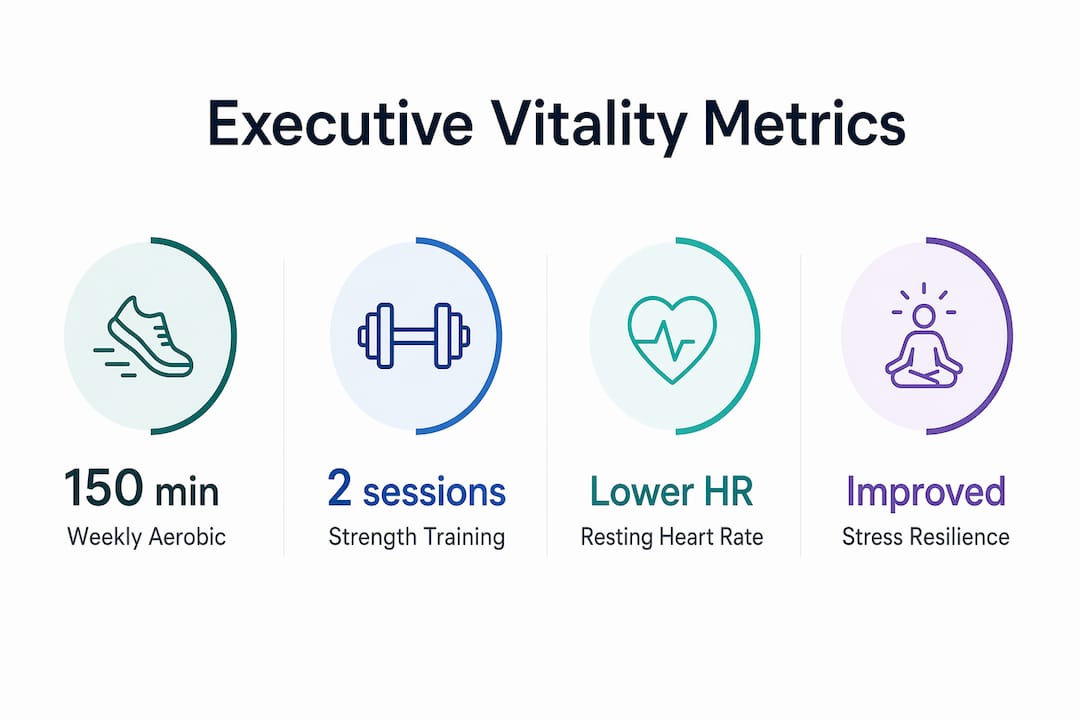
Regular physical activity is the most evidence-backed intervention for executive cognition, stress resilience, and long-term health, with measurable benefits beginning at 150 minutes of moderate aerobic work plus two weekly strength sessions.
| Point | Details |
|---|---|
| Minimum effective dose | 150 min/week moderate aerobic plus 2 strength sessions; break sitting every 30–60 min. |
| CRF as a biomarker | Each 1-MET gain in cardiorespiratory fitness links to lower risk of depression and dementia. |
| Consistency over intensity | Habitual weekly activity compounds into structural cognitive protection; single sessions do not. |
| Track what matters | Monitor resting HR, HRV, and one strength benchmark monthly for meaningful progress signals. |
| Viridos support | Viridos executive performance membership provides structured weekly plans and accountability for men 40–65. |
The discipline that compounds
Most executives I observe treat physical training as something to fit in around their real work. That framing is the error. The stress management process that sustains decision-making quality across a decade is built in the gym, on the trail, and in the discipline of showing up when the calendar is full. The science is unambiguous: cardiorespiratory fitness is a modifiable biomarker for cognitive longevity, and every week of consistent training is a deposit into that account.
What I find underappreciated is the asymmetry. The cost of consistent training is roughly five hours per week. The cost of neglecting it compounds invisibly until it becomes a clinical event, a cognitive plateau, or a performance ceiling you cannot explain. Men who operate at the highest levels of responsibility cannot afford that asymmetry. Viridos exists precisely for this: precision support, grounded in Swedish quality and small-batch formulation philosophy, for men who refuse to accept decline as inevitable.
Structured support for executive performance
Viridos is built for the man who understands that physical performance and executive performance are the same system. The executive performance program delivers a structured weekly training framework, progress tracking, and accountability designed specifically for high-responsibility men aged 40–65.

What membership includes: a personalized weekly plan calibrated to your schedule and baseline, objective metric tracking (HRV, CRF proxy, strength benchmarks), and expert support to adjust intensity as your capacity builds. The approach reflects Viridos's core philosophy: precision over volume, consistency over heroics, and quality that holds up under the demands of a real executive life.
To evaluate fit, visit the Viridos membership page and review the program structure. No pressure, no hard sell. If the evidence in this article resonates, the next step is straightforward.
This article is general information, not medical or clinical advice. Consult a qualified physician or performance clinician before beginning or escalating an exercise program, particularly if you have existing cardiovascular, metabolic, or orthopedic conditions.
Useful sources and further reading
The claims in this article draw from primary research and public health guidelines. Readers who want to verify findings or pursue deeper study can start here:
- Benefits of Physical Activity, CDC: immediate and long-term benefits, population-level mortality data, and strength training rationale for adults 40+.
- Benefits of Exercise, NHS: 150-minute guideline, sedentary behavior risk, and dose-response evidence.
- Physical Activity for Public Health in the 21st Century, Nature Medicine: reconceptualization of activity beyond cardiometabolic outcomes.
- CRF and Risk of Mental Disorders and Dementia, Nature Mental Health: meta-analysis linking CRF to depression and dementia risk reduction.
- Biological Mechanisms Underlying Physical Fitness and Resilience, Royal Society: HPA axis, SNS, and inflammatory mechanisms of fitness-derived resilience.
- WHO Physical Activity Fact Sheet: global guidelines and sedentary behavior recommendations.
- Mobility and Athletic Longevity, HTK Training: practical mobility programming for performance longevity.
Before escalating to high-intensity training, consult a physician or certified performance clinician for a baseline cardiovascular and metabolic screen. The evidence supports progressive intensity increases — but only when built on a sound clinical foundation.