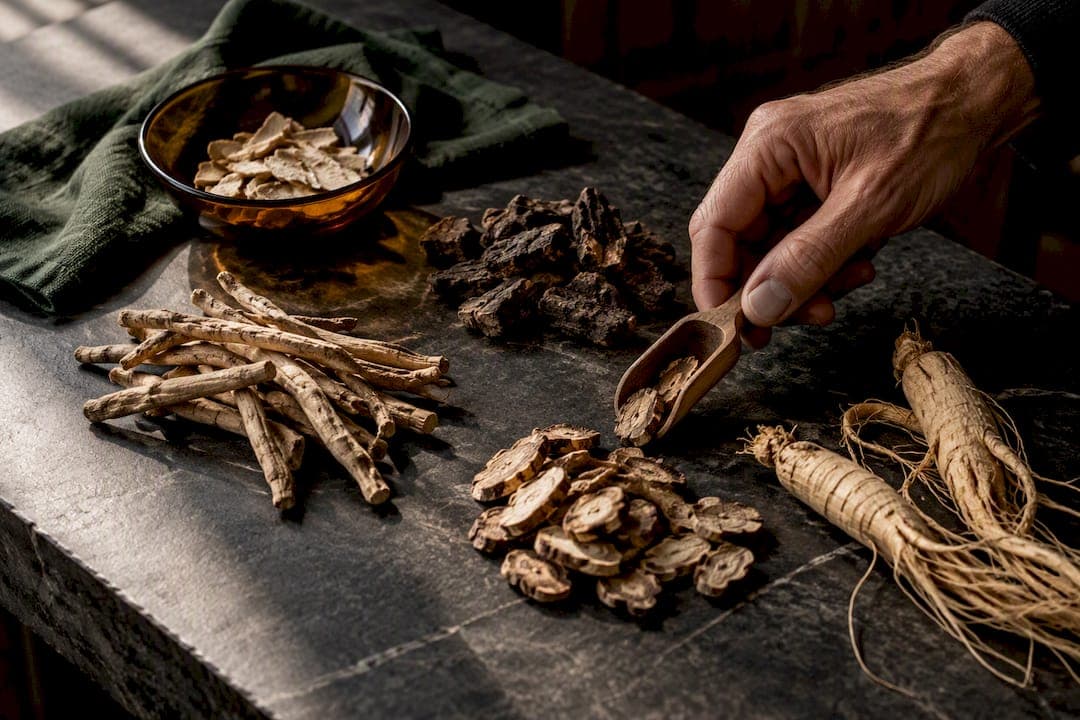
The evidence points to a short list: Ashwagandha, Rhodiola rosea, Panax ginseng, and Cistanche deserticola, supported by Astragalus and Maca as secondary tonics. None of these deliver an instant lift. They work by restoring the body's capacity to recover and adapt, which means results build over weeks, not hours. Choose standardized extracts, confirm third-party testing, and speak with a clinician before combining any of these with prescription medication.
TL;DR:
- Standardized extracts and third-party testing are essential for ensuring product quality, potency, and safety before selecting herbs for performance.
- Adaptogens like Ashwagandha, Rhodiola, and Panax ginseng typically require eight weeks of consistent use to produce measurable improvements in stress resilience and fatigue.
- Clinical evidence supporting Cistanche deserticola shows significant benefits for strength, endurance, and recovery after about two months of twice-daily dosing.
- Combining herbs without proper sequencing or ignoring the required duration may hinder benefits, as adaptogens and stimulants act on different physiological systems and timelines.
- Always review potential interactions with prescriptions, avoid contamination risks, and track personal response over multiple weeks for best results.
Table of Contents
- 1. Herbs Worth Your Attention for Strength and Vitality
- 2. How adaptogens, tonics, and stimulants actually work
- 3. What the clinical evidence shows and where the risks are
- 4. How to choose a quality product and use it well
- 5. The editorial standard behind this guide
- 6. What most vitality advice gets wrong
- A disciplined alternative to self-sourcing herbs
- Where this research comes from
- Sources
- FAQ
1. Herbs Worth Your Attention for Strength and Vitality
Not every botanical marketed for performance deserves a place in a disciplined regimen. The herbs below have the strongest human evidence, the clearest dosing data, and the fewest unresolved safety questions.
-
Ashwagandha (Withania somnifera): An adaptogen studied for cortisol regulation and stress resilience. A systematic review and meta-analysis covering multiple randomized controlled trials involving hundreds of participants found significant reductions in anxiety, perceived stress, and cortisol at eight weeks. Effective doses fall between a typical effective daily dose in a moderate milligram range of standardized root extract. Avoid it if you have autoimmune thyroid conditions or are on sedatives without medical guidance.
-
Rhodiola rosea: An adaptogen traditionally used for fatigue resistance and mental stamina under load. It works on the sympathetic stress response rather than cortisol directly, and most formulations standardize to rosavin and salidroside content. Typical protocols run 200 to 600 milligrams daily of a standardized extract. Rhodiola can be mildly stimulating late in the day, so morning dosing suits most executives better.
-
Panax ginseng: Classified as an adaptogenic tonic with a long history in traditional medicine and a growing body of modern trial data. An umbrella review in Frontiers in Pharmacology reported moderate improvements in exercise endurance and reduced fatigue, with a favorable safety profile at typical supplemental doses. Standard extracts are dosed at a moderate daily dose range used in clinical trials, standardized to ginsenoside content. Ginseng can interact with anticoagulants and blood pressure medication, so review your prescriptions first.
-
Cistanche deserticola: A tonic herb from traditional Chinese medicine now backed by a rigorous human trial. It is covered in depth in the following section because the data is recent and specific enough to warrant its own discussion.
-
Astragalus (Astragalus membranaceus): A supportive tonic traditionally used for stamina and immune resilience. Human trial data is thinner than for Ashwagandha or ginseng, but it is commonly stacked with Astragalus root extract at 500 to 1,000 milligrams daily. It carries a mild interaction risk with immunosuppressant drugs.
-
Maca (Lepidium meyenii): A root tonic used for libido and general vitality rather than raw strength. Evidence is more preliminary than for the herbs above. Typical doses range from 1.5 to 3 grams of dried root powder daily, and it is generally well tolerated, though thyroid patients should check with a clinician given its cruciferous origin.
-
Guarana (Paullinia cupana): A stimulant, not an adaptogen, delivering natural caffeine and related compounds for short-term alertness. It suits a pre-training boost rather than a foundation for sustained vitality. Doses vary widely by caffeine content, so check the label for total caffeine equivalence rather than the raw guarana weight. Avoid stacking with other stimulants or using it late in the day, since it can disrupt sleep architecture that adaptogens depend on to work.
-
Licorice root (Glycyrrhiza glabra): Occasionally included in traditional vitality formulas for adrenal support, but it carries a documented risk of raising blood pressure and lowering potassium with prolonged use. It belongs on a watch list rather than a default stack.
-
Tribulus terrestris: Widely marketed for strength and libido, but the human evidence for meaningful strength gains is weak and inconsistent. It is worth knowing by name mainly so you can recognize it in blended products and weigh it against better-supported alternatives.
Pro Tip: Introduce one adaptogen at a time for at least two weeks before adding another, so you can attribute changes in sleep, mood, or training capacity to the right ingredient.
For a broader look at how these categories fit into a resilience-focused routine, see why adaptogens matter for executive resilience.
2. How adaptogens, tonics, and stimulants actually work
These three categories are often marketed interchangeably, but they act on different systems and reward different expectations. An adaptogen, such as Ashwagandha or Rhodiola, works primarily by modulating the hypothalamic-pituitary-adrenal axis, the system that governs your cortisol response to stress. The effect is gradual: fewer stress spikes, steadier recovery, and better resilience under repeated load.
A tonic, such as Cistanche or Astragalus, tends to support broader metabolic and hormonal function over sustained use rather than triggering an acute response. A stimulant, such as Guarana, acts on the sympathetic nervous system directly, producing alertness within an hour but offering nothing toward long-term recovery capacity.
Timelines differ accordingly. Stimulants act in minutes to hours. Adaptogens and tonics generally require weeks to months before measurable change appears, whether that is endurance capacity, strength proxies like estimated one-rep max, or lower resting cortisol. Judging an adaptogen by how you feel on day three misreads the mechanism entirely, and it is the most common reason people abandon herbs that were working as intended.

3. What the clinical evidence shows and where the risks are
The strongest recent data point comes from Cistanche. A randomized double-blind trial gave 48 trained men 5 grams of Cistanche deserticola extract twice daily for approximately two months of consistent use and found measurable improvements in bench press and squat one-rep max, endurance, and recovery, alongside reductions in CRP and creatine kinase, both markers of muscle damage and inflammation.
A systematic review of Ashwagandha spanning 15 trials and 873 participants found significant reductions in anxiety, perceived stress, and cortisol at eight weeks, and a separate safety review covering a broad collection of clinical trials with several thousand participants found standardized root extract well tolerated at doses up to 600 milligrams daily for as long as 180 days, with no meaningful change in liver or kidney biomarkers. Ginseng's evidence base points the same direction: moderate but consistent improvements in endurance and fatigue across pooled trial data.

Quality control matters as much as the ingredient itself. Swedish regulatory guidance from Livsmedelsverket warns that plant-based supplements can carry contamination risks, including pyrrolizidine alkaloids and heavy metals, and that manufacturers bear responsibility for product safety and labeling accuracy.
Before adding any of these herbs, check the following:
- Avoid Ashwagandha if you have autoimmune thyroid disease, are pregnant, or take sedative medication.
- Avoid ginseng and Cistanche without medical review if you take anticoagulants or blood pressure medication.
- Consult a clinician before combining any adaptogen with thyroid medication, given overlapping effects on hormonal regulation.
4. How to choose a quality product and use it well
Sourcing discipline determines whether an herb helps you or does nothing at all. Follow this sequence before you buy:
- Request or locate a certificate of analysis confirming potency and screening for heavy metals and pyrrolizidine alkaloids.
- Confirm the label states a standardized extract ratio or marker compound percentage, not just a raw herb weight.
- Avoid proprietary blends that hide individual ingredient doses behind a single combined figure.
- Prefer single-ingredient formulations where trial evidence exists, since combination products make it harder to isolate what is working.
- Match the dose to the range used in trials: 125 to 600 milligrams daily for standardized Ashwagandha root extract, 200 to 400 milligrams for standardized ginseng, and 5 grams twice daily for the Cistanche extract used in the randomized trial.
Formulation matters beyond dose. Standardized extracts concentrate the active compounds that trials actually tested, while raw powders vary widely in potency and are harder to dose with precision.
Introduce one adaptogen at a time, avoid stacking multiple stimulants, and monitor sleep quality and blood pressure as early indicators of a poor fit. For more on integrating herbs into a broader nutritional strategy, see this guide to performance nutrition and this overview of ergogenic aids.
Pro Tip: Keep a simple log for 4 to 12 weeks tracking sleep quality, training performance, and recovery time. Subjective energy is the least reliable signal; consistent training data tells you whether an herb is working.
5. The editorial standard behind this guide
This article was built on the principle that a supplement claim is only as good as the trial behind it. Where evidence was strong, such as for Ashwagandha and Cistanche, we said so plainly. Where it was preliminary, such as for Maca and Tribulus, we said that too.
A disciplined approach to vitality starts with the same rigor you'd apply to any other high-stakes decision: verify the source, weigh the evidence, and discount the noise.
VIRIDOS applies this standard to its own small-batch Swedish production, prioritizing traceable formulation over broad, unverified claims.
6. What most vitality advice gets wrong
Most advice on strength and vitality herbs treats the category as a single, interchangeable pool: throw a handful of adaptogens and stimulants together and hope something works. That approach misreads the physiology. Stimulants and adaptogens pull in opposite directions, one spiking the sympathetic system, the other trying to calm it, and stacking them without sequencing undermines both.
The bigger failure is impatience. Executives who abandon Ashwagandha or Cistanche after two weeks because they feel nothing are judging a homeostatic mechanism by a stimulant's timeline. The evidence is consistent on this point: meaningful change shows up at eight weeks, not eight days.
If you take one thing from the research, take this: prioritize product quality and standardization before you worry about which exotic herb to add next. A well-sourced Ashwagandha extract, used consistently for two months, will outperform a poorly tested blend of six ingredients every time.
— Joakim
A disciplined alternative to self-sourcing herbs
Sourcing standardized extracts, verifying certificates of analysis, and tracking your own response over months is a legitimate path, and it demands real discipline to do well. VIRIDOS offers a different route to the same goal: a plant-derived performance formulation delivered as a precision oral spray, produced in small batches in Sweden under controlled quality standards, available through a membership structure rather than open retail.

The Member plan runs $99 per month, and the Professional plan runs $299 per month, each granting ongoing access to the formulation and the broader membership experience. This is not a claim to outperform any individual herb discussed above. It is a fixed-price, done-for-you alternative for men who would rather have sourcing and quality control handled than manage it themselves. If that fits how you already approach other high-stakes decisions, review the plans at Viridos.
Where this research comes from
The clinical and regulatory findings referenced above come from peer-reviewed trials and Swedish food safety guidance.
- The Cistanche trial supports the strength, endurance, and recovery findings in Section 3.
- The Ashwagandha meta-analysis and safety review support dosing and tolerability claims.
- Livsmedelsverket guidance supports the contamination and labeling cautions.
This article is general information, not a substitute for advice from a qualified doctor. Consult a qualified healthcare professional about your own circumstances before acting on anything here.
Sources
- Randomized double-blind trial of Cistanche deserticola extract — PubMed
- Meta-analyses on Ashwagandha and related outcomes — MDPI Nutrients
- Effects of Ashwagandha supplements on cortisol, stress, and anxiety — BJPsych Open
- Safety and tolerability of standardised Ashwagandha root extract — MDPI Pharmaceuticals
FAQ
How long does it take to feel the effects of vitality herbs?
Stimulants like Guarana work within an hour, but adaptogens and tonics such as Ashwagandha, Rhodiola, and Cistanche typically require eight weeks of consistent use before measurable change appears in clinical trials. Judge these herbs on sleep quality, training performance, and recovery time rather than how you feel after a few days.
Are these herbs safe during pregnancy or breastfeeding?
Swedish regulatory guidance advises caution with plant-based supplements during pregnancy and breastfeeding due to contamination and dosing uncertainty. Anyone pregnant or breastfeeding should consult a clinician before using any of the herbs discussed here.
Can I combine these herbs with prescription medication?
Ginseng and Cistanche can interact with anticoagulants and blood pressure medication, and Ashwagandha may interact with thyroid medication or sedatives. Always review your current prescriptions with a clinician before adding any adaptogen or tonic to your routine.
Are stimulant herbs like Guarana recommended for sustained vitality?
Guarana can support short-term alertness, but it does not address the recovery and resilience mechanisms that adaptogens and tonics target for sustained vitality. It works best as an occasional aid rather than a daily foundation, and it should not be stacked with other stimulants.
What should I check on a product label before buying?
Look for a standardized extract ratio or marker compound percentage, a certificate of analysis confirming potency and contaminant screening, and single-ingredient formulations where trial evidence exists. Avoid proprietary blends that obscure individual ingredient doses.