
A focused resistance program of 2 to 3 full-body sessions per week, built around mobility work, planned recovery, and 25 to 40 grams of protein per meal, produces measurable strength and energy gains within 6 to 8 weeks. The path is not complicated. It requires discipline in load selection, recovery discipline, and enough protein to make the training count. Skip the ego lifts and preserve the muscular intent behind every rep.
TL;DR:
- Men over 50 should train 2 to 3 full-body resistance sessions weekly, focusing on compound lifts with 70 to 80% of one-rep max.
- Ensure each meal includes 25 to 40 grams of high-quality protein to support muscle maintenance and recovery.
- Progress by increasing reps within the target range before adding load, and deload if performance, sleep, or joint health decline.
- Use joint-friendly exercise substitutions like goblet squats and neutral-grip presses to reduce stress and preserve mobility.
- Track effort, sleep quality, and joint health to identify when to deload or adjust training intensity, not just effort or feelings.
Table of Contents
- Why This Training Approach Works for Men Around 50
- Your 6 to 8 Week Training Block and Weekly Template
- When to Add Weight and When to Pull Back
- Choosing Exercises That Protect Your Joints
- Nutrition: Protein Targets That Support the Work
- Tracking Progress and Knowing When to See a Doctor
- About the Author and How Viridos Fits This Plan
- What Actually Matters After 50, and What Doesn't
- A Precision Adjunct for Men Who Train With Intent
- Sources
- FAQ
Why This Training Approach Works for Men Around 50
Strength declines roughly 15% per decade starting around age 50, which means a man who does nothing loses close to a third of his baseline strength by 70. The mechanism is partly anabolic resistance: muscle tissue in older men responds more sluggishly to the same training stimulus that built strength at 30. That is not a reason to train less. It is the argument for training with more intent.
Resistance work counters this directly. The same systematic review on exercise and hormones found that structured training raises basal levels of testosterone, IGF-1, human growth hormone, and DHEA in men over 40, regardless of the specific training mode. The goal is not maximal output. It is measurable progress: heavier working sets over time, better performance on functional tasks like a single-leg stand or a loaded carry, and a per-meal protein target that actually supports the muscle you are working to keep.
Your 6 to 8 Week Training Block and Weekly Template
A well-built week does not need five gym visits. It needs consistency and a structure that respects joints while still demanding effort. Consensus guidance on strength training for longevity recommends 2 to 3 resistance sessions weekly, with intensity climbing toward 70 to 80% of one-rep max where mobility and joint health allow.
Weekly layout:
- Two to three full-body resistance sessions, spaced on nonconsecutive days.
- One to two low-effort conditioning sessions, such as brisk walking or cycling.
- Daily mobility work, 5 to 10 minutes, targeting hips, thoracic spine, and shoulders.
Session format:
- A 10-minute warm-up covering joint mobility and a light ramp into the first lift.
- Three to four compound lifts (squat, hinge, push, pull pattern), 2 to 3 working sets each.
- One to two accessory movements targeting a weak point or stability need.
- An optional 10 to 20 minutes of zone-2 cardio or farmer's carry work to close the session.
Work in the 6 to 12 rep range, training with 1 to 3 reps in reserve (RIR) rather than to failure, and cap working sets at 1 to 3 per exercise. Progression follows rep before load: once you hit the top of your rep range across all sets with 1 to 2 RIR, add weight, not before.
Weeks 5 to 8 push toward the top of the rep range consistently, then apply the first micro-load increase. This is also where the CDC's aerobic activity guidance for older adults, 150 minutes of moderate activity weekly plus strengthening on 2 or more days, fits naturally into the conditioning slots. For a longer view of how this fits into a full performance routine, see this guide to optimizing performance for lasting vitality.
When to Add Weight and When to Pull Back
Progress in this program follows a two-step rule, and both steps matter more than raw effort. First, add reps inside your target range until every set hits the top number with 1 to 2 RIR left. Only then add load, and add it in small increments, roughly 1 to 2.5 kilograms on upper-body lifts and slightly more on lower-body work.
The instinct to push through a bad session is where most men over 50 sabotage their own progress. Watch for these deload signals instead:
- Performance declines across two consecutive sessions on the same lift.
- Sleep quality drops noticeably for several nights in a row.
- Joint irritation increases session over session rather than settling with a proper warm-up.
When two or more of these show up, deload. Cut volume by 30 to 50% for one week, keeping the same movements but fewer sets, or swap in a week of low-intensity sessions focused on mobility and light conditioning. The lifts will still be there when you come back.
Pro Tip: Log your RIR and top working set every session, even briefly. A one-line note ("squat 5x8, RIR 2") tells you more about when to progress or pull back than how you felt walking out of the gym.
Recovery is not passive. Sleep, stress management, and proper spacing between sessions are training variables, not afterthoughts. A guide to sustained vitality for men 40 to 65 covers how to build these recovery habits into an already demanding schedule.
Choosing Exercises That Protect Your Joints
The principle is simple: preserve the muscular demand, remove the joint stress that adds nothing to the result. A goblet squat loads the legs as effectively as a back squat for most men in this program, without compressing the spine under a barbell. A neutral-grip machine press protects aging shoulders while still building pressing strength.
Useful substitutions to keep in rotation:
- Goblet squat or leg press instead of a heavy back squat, when hip or lower back mobility is limited.
- Neutral-grip dumbbell or machine press instead of a barbell bench press, if shoulders feel compromised at end range.
- Hip hinge variations like the trap bar deadlift or cable pull-through instead of a conventional barbell deadlift.
- Single-arm or single-leg accessory work to expose and correct strength imbalances early.
Mobility work earns its place alongside the lifts, not after them. Thoracic rotations before pressing sessions, hip hinge drills before lower-body days, and loaded carries once or twice weekly for grip, core, and shoulder stability. Five to ten minutes before training is enough. Consistency matters more than duration.
Nutrition: Protein Targets That Support the Work
Training stimulates muscle. Protein is what lets the stimulus turn into actual tissue. For active men over 50, nutrition guidance for master athletes and older adults recommends 1.4 to 2.0 grams of protein per kilogram of body weight daily, with 25 to 40 grams of high-quality protein at each main meal to maximize muscle protein synthesis.
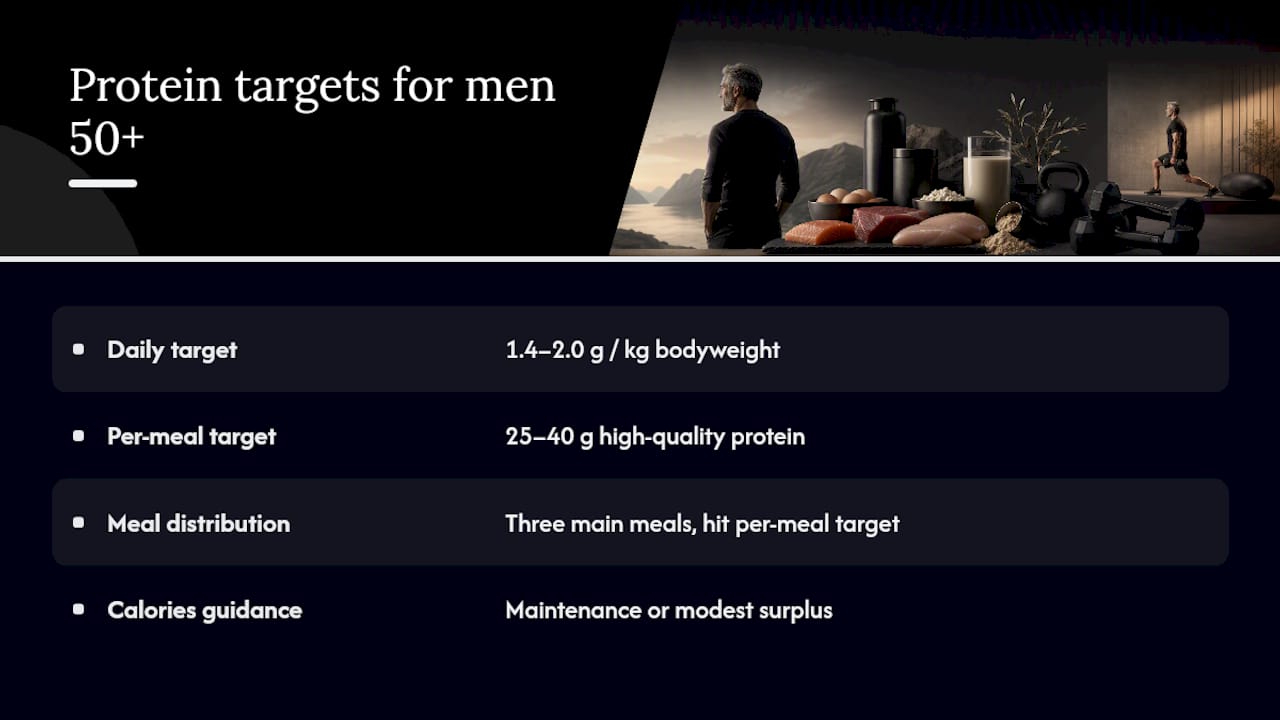
That per-meal target is often the missing piece. Many executives eat a light breakfast, a rushed lunch, and load most of their protein into dinner, which works against the goal. A detailed breakdown of per-meal protein targets for men over 50 covers how to distribute intake across a demanding schedule.
Practical options that hit the mark without much thought: three whole eggs plus a side of Greek yogurt at breakfast, a can of tuna or a chicken breast at lunch, and a whey shake or a lean protein source at dinner. On calories, aim for maintenance or a modest surplus while building strength. A steep deficit undermines recovery and blunts the very adaptations this program is built to produce.

Tracking Progress and Knowing When to See a Doctor
Track what actually reflects progress: working loads and reps, RIR trends, sleep quality, and functional benchmarks like how long you can hold a single-leg stance or how far you can carry a loaded weight without breaking form. Waist measurement and body weight matter, but they are secondary to performance markers.
Certain signals call for a pause and a conversation with a physician rather than another training session:
- Sharp or localized joint pain that does not ease with a proper warm-up.
- Any chest pain, tightness, or unusual shortness of breath during exertion.
- Unexplained weakness or fatigue that persists across multiple weeks despite adequate recovery.
On testosterone specifically, the evidence deserves a level-headed read rather than either dismissal or hype.
Randomized trial data shows testosterone as an adjunct to resistance training can meaningfully augment short-term gains in fat-free mass and strength in older men. The same trials are explicit that this comes with real risks and requires ongoing clinical monitoring, not casual self-administration.
Training and nutrition remain the foundation regardless of what else a man chooses to explore with his physician. For a deeper, evidence-aware look at the training and testosterone relationship, see what actually moves the needle.
About the Author and How Viridos Fits This Plan
This article is written by Joakim, an evidence-based writer covering performance and vitality for Viridos. The approach above, resistance-first, recovery-disciplined, protein-forward, reflects the same standard Viridos applies to its own work: precision over noise, and small-batch Swedish production over mass-market shortcuts.
Viridos exists for men who treat training the way they treat their business decisions, with discipline and evidence rather than trends. For readers who want to extend this framework into daily routine and long-term resilience, the self-optimization guide for resilience and performance is a natural next read.
What Actually Matters After 50, and What Doesn't
Most training advice aimed at men over 50 gets the emphasis backward. It obsesses over exercise selection, debating goblet squats versus back squats, machine presses versus barbells, as if the choice of movement were the limiting factor. It rarely is. The limiting factor is almost always recovery discipline and per-meal protein, the two variables men in demanding roles are most likely to neglect because they are unglamorous.
The conventional advice to "listen to your body" is also incomplete. A man who built his career pushing through discomfort will often override real recovery signals, mistaking stubbornness for resilience. What the evidence actually supports is structured deload triggers, not vague self-awareness: two declining sessions, degraded sleep, or rising joint irritation are objective signals, not feelings to argue with.
Prioritize the boring fundamentals first: consistent sessions, tracked RIR, and protein at every meal. The exercise variations matter far less than getting those three right for eight straight weeks.
— Joakim
A Precision Adjunct for Men Who Train With Intent
Training and nutrition remain the foundation of any real progress after 50. For disciplined executives who want an additional layer of support, Viridos offers a controlled membership built around a precision oral spray, formulated with proprietary extraction methods and produced in small batches in Sweden.

The membership is designed for men who already train seriously and want a premium, evidence-minded adjunct rather than another generic supplement stacked onto their routine. It comes with ongoing support through a limited-cohort structure, not a mass retail product. Viridos offers two membership tiers with details available on the Viridos pricing page. If your training block is already dialed in and you're evaluating what else belongs in a serious performance routine, review the membership overview and apply for the tier that matches your goals.
Sources
This plan draws on a systematic review of exercise and anabolic hormones in older adults, the CDC's physical activity guidelines for older adults, nutrition recommendations for master athletes and older adults, and a randomized trial on testosterone and resistance training. Each addresses a different piece of the plan: hormonal response, activity minimums, protein targets, and the risk profile of hormonal adjuncts.
- Effects of Exercise Training on Anabolic and Catabolic Hormones with Advanced Age: A Systematic Review
- Physical Activity Guidelines for Older Adults
- Nutrition recommendations for master athletes and older adults
- Randomized trial: Testosterone adjuvant to resistance exercise training in older men
FAQ
How Many Days a Week Should Men Over 50 Train?
Two to three full-body resistance sessions per week, on nonconsecutive days, covers the strength stimulus most men need. Add one to two low-effort conditioning sessions and daily mobility work to round out the week without overloading recovery.
How Much Protein Should I Eat Per Meal After 50?
Aim for 25 to 40 grams of high-quality protein per meal, with daily intake between 1.4 and 2.0 grams per kilogram of body weight. Eggs, Greek yogurt, lean meats, and whey shakes make this easy to hit at any meal.
When Should I Take a Deload Week?
Deload when you see two consecutive sessions of declining performance, noticeably worse sleep, or joint irritation that builds across sets rather than easing with warm-up. Cut training volume by 30 to 50% for one week rather than pushing through.
How Long Until I See Results From This Training Plan?
Most disciplined men notice visible strength and energy improvements within 6 to 8 weeks of consistent training, provided protein intake and recovery are managed alongside the workouts. Full adaptation, including meaningful lean-mass gains, typically builds over a longer stretch of consistent months.
Should Cardio or Strength Training Take Priority After 50?
Strength training should anchor the week, since resistance work directly counters age-related strength decline. Layer in 150 minutes of moderate aerobic activity weekly as a complement, not a replacement, for the resistance sessions.