
TL;DR:
- Resistance training enhances executive control, decision-making, and neural flexibility critical for leadership. Regular strength workouts build physical durability and lower stress hormone impact, supporting sustained energy and focus. Structured, efficient programs with compound movements and EMOM formats fit busy schedules and promote long-term professional longevity.
Physical strength is a direct performance asset for executives, not a lifestyle accessory. Resistance training, the clinical term for what most call strength training, builds the neural architecture, hormonal stability, and physical durability that high-stakes leadership demands. A 2025 network meta-analysis confirmed that resistance training enhances executive control and inhibitory processing, the cognitive functions most critical to strategic thinking. For executives aged 40–65, understanding why strength matters for executives is not an academic exercise. It is a competitive advantage with measurable returns.
Why strength matters for executives: the cognitive case
Strength training reshapes the brain in ways that directly serve leadership. Executives who practice 45–60 minute resistance sessions two to three times weekly over 12–24 weeks develop faster, calmer decision-making neural pathways. That is not a marginal gain. In a role where a single poor decision can cost millions, the quality of your thinking under pressure is your most valuable resource.
The physiological mechanism is specific. Resistance training increases cerebral blood flow and promotes neuroplasticity in the prefrontal cortex, the region governing judgment, impulse control, and long-range planning. These are not soft benefits. They are the biological foundations of effective leadership.
The importance of strength for leaders becomes clearest under cognitive load. When a board meeting runs long, a deal collapses, or a team crisis lands at 6 p.m., the executive with a trained nervous system processes the situation with greater clarity. The untrained executive reacts. The trained one responds.
Key cognitive benefits of resistance training for executives include:
- Faster information processing under high-stakes conditions
- Improved inhibitory control, reducing reactive and emotionally driven decisions
- Greater working memory capacity, supporting complex multi-variable analysis
- Sustained attention across long meeting schedules and travel days
Pro Tip: Structure your strength sessions for early morning or midday. Research shows cognitive benefits peak in the hours immediately following a resistance training session, making it a direct input to your most demanding work blocks.
How muscle mass buffers stress and stabilizes executive energy
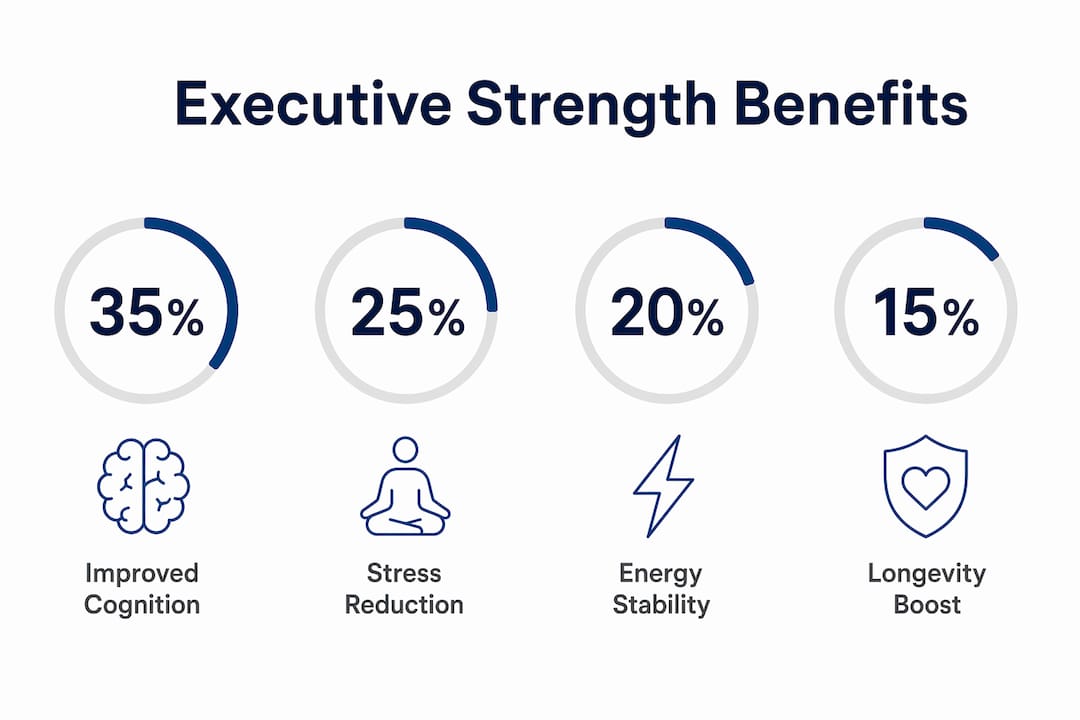
Skeletal muscle tissue functions as an endocrine organ. This is not a metaphor. Muscle mass inactivates cortisol at the tissue level, providing a biological buffer against the systemic damage that chronic workplace stress causes. Executives with higher muscle mass carry a physiological advantage into every high-pressure situation.

The practical implication is significant. An executive with greater muscle mass experiences the same stressful event as a peer but absorbs less of its hormonal impact. Focus stays sharper. Energy holds longer. Recovery between demands is faster.
| Muscle mass level | Cortisol impact | Executive outcome |
|---|---|---|
| Low | High systemic exposure | Fatigue, reactive decisions, poor recovery |
| Moderate | Partially buffered | Inconsistent energy, manageable stress |
| High | Significantly reduced | Sustained focus, stable energy, faster recovery |
The connection between muscle tone and executive vitality is one of the most underused insights in executive wellness. Most performance conversations focus on sleep and nutrition. Muscle mass belongs in the same conversation.
Pro Tip: Track your energy levels across the week, not just your workout performance. Executives who manage stress effectively report that consistent strength training produces the most noticeable energy stabilization within six to eight weeks.
What does an efficient executive strength program look like?
Efficiency is the non-negotiable constraint for any executive fitness program. A program that demands two hours daily will not survive contact with a real leadership schedule. The solution is structure, not sacrifice.
Prioritize compound movements
Compound lifts like squats, deadlifts, presses, and rows produce more functional strength in less time than isolated machine exercises. A 30-minute session built around these movements delivers a superior metabolic response and builds the kind of full-body strength that translates directly to physical durability and energy. Think of these as the "Big Rocks" of executive strength training. Get them in first.
Use EMOM training for time-constrained days
EMOM, which stands for Every Minute on the Minute, is a training format that fits executive schedules by fixing the workout duration and maximizing density. An executive can complete a quality strength session in 15–20 minutes using EMOM structure. The format removes the need for complex planning, which preserves cognitive bandwidth for business.
Control intensity deliberately
High-intensity, brutal workouts backfire for stressed executives. Controlled resistance training resets the nervous system rather than taxing it further. The goal is to leave a session feeling clear and capable, not depleted. Executives who train to exhaustion on high-stress days compound their cortisol load rather than reducing it.
A practical weekly structure for executives:
- Monday: Full-body compound session, 45 minutes, moderate intensity
- Wednesday: EMOM session, 20 minutes, focused on pressing and pulling movements
- Friday: Lower body and posterior chain, 40 minutes, controlled tempo
Pre-structured programs or a qualified personal trainer remove the planning burden entirely. Many executives lack the bandwidth to design their own programs, and that planning gap is where consistency breaks down. Removing that friction is itself a performance decision.
Strength as a long-term executive durability asset
The most underappreciated argument for executive strength training is the one that compounds over time. Strength training functions as risk management. It reduces the likelihood of preventable physical decline, including chronic pain, metabolic fatigue, and postural deterioration, all of which directly impair professional effectiveness.
An executive who neglects physical capacity in their 40s pays the price in their 50s and 60s. Chronic back pain shortens focus. Low energy limits availability. Poor posture signals diminished authority in rooms where presence matters. These are not hypothetical risks. They are the predictable outcomes of physical neglect in demanding roles.
"Strength training improves posture, joint integrity, and movement quality, leading to better physical capability and durability over time." Regular strength work builds the musculoskeletal health that supports executive energy and longevity across a full career.
The compounding effect of consistent strength training is real. Executives who build physical durability through resistance training over years report sustained energy, fewer injury-related disruptions, and greater physical confidence in high-visibility situations. Physical capacity, like financial capital, grows with consistent investment and erodes with neglect.
The framing that serves executives best is this: strength training is not a health expense. It is a career longevity strategy. The executive who maintains physical capacity through their 50s and into their 60s extends the quality of their professional output by years, not months.
Key takeaways
Physical strength is a measurable performance input for executives, not a personal preference. The most effective approach to executive strength is consistent, controlled resistance training built around compound movements and structured formats like EMOM.
| Point | Details |
|---|---|
| Cognitive performance | Resistance training improves decision speed and inhibitory control, the core of strategic leadership. |
| Stress buffering | Higher muscle mass reduces cortisol's systemic impact, stabilizing energy under pressure. |
| Training efficiency | Compound movements and EMOM formats deliver results in 20–45 minutes, fitting real executive schedules. |
| Long-term durability | Consistent strength training prevents chronic pain and metabolic decline that shorten leadership effectiveness. |
| Measurable progress | Physical strength gives executives a concrete metric of achievement independent of external validation. |
Strength training as a leadership discipline
I have worked with enough high-performing men to know that the ones who resist strength training usually frame it as a time problem. It is rarely a time problem. It is a priority problem, and that distinction matters because executives solve priority problems every day.
What I find more interesting is what strength training reveals about a person's relationship with delayed gratification. You do not feel stronger after one session. You feel it after eight weeks of consistent work. That timeline is uncomfortable for executives who are wired for fast feedback. But tolerating that discomfort, building through controlled failure, is exactly the mindset that separates durable leaders from those who peak early and fade.
The other thing I have observed is that strength training gives executives a measurable win that has nothing to do with their company's quarterly results, their team's performance, or anyone else's opinion. That independence is rare in leadership. A deadlift either goes up or it does not. The bar does not care about your title. That objectivity is clarifying in a way that most executive environments are not.
My honest recommendation: start with three sessions per week, keep the intensity controlled, and track your energy and focus alongside your lifts. The cognitive returns show up before the physical ones do. When they do, you will understand why this belongs in your performance stack, not your leisure time.
— Joakim
Viridos and the disciplined executive's performance stack
Strength training produces results when it is tracked, measured, and adjusted with the same rigor you apply to business decisions. Viridos is built for exactly this kind of disciplined approach to performance.

The Viridos Performance Journal gives executives a structured system for tracking strength sessions, energy levels, and cognitive performance across the week. It is designed for men who want data, not motivation posters. If you are serious about using physical strength as a leadership asset, the Performance Journal is where that intention becomes a practice. Precision tracking is what separates consistent progress from repeated restarts. Viridos is built for the long game.
FAQ
Why does strength training improve executive decision-making?
Resistance training increases blood flow to the prefrontal cortex and strengthens neural pathways governing impulse control and judgment. Executives who train consistently develop faster, calmer responses under cognitive pressure.
How often should an executive strength train?
Two to three sessions per week of 30–45 minutes each produces measurable cognitive and physical benefits. Consistency over 12–24 weeks is where the most significant performance gains appear.
What is the best strength training format for a busy schedule?
EMOM training allows executives to complete a quality session in 15–20 minutes by fixing the workout duration and maximizing movement density. Compound lifts like squats, deadlifts, and presses deliver the highest return per minute invested.
Does strength training reduce workplace stress?
Skeletal muscle tissue inactivates cortisol at the tissue level, reducing the systemic hormonal impact of stress. Executives with higher muscle mass recover faster between high-pressure demands and maintain more stable energy throughout the day.
When do executives start seeing results from strength training?
Cognitive benefits, including improved focus and decision clarity, typically appear within six to eight weeks of consistent training. Physical strength and durability gains compound over months and years of sustained practice.