
TL;DR:
- Lifestyle design involves deliberately aligning your time and energy with your long-term values for sustained performance. It creates a system that supports energy replenishment, focused effort, and motivation through measurable KPIs and planned reviews. Most failures occur when professionals neglect barrier planning and follow-up or build rigid plans without scheduled revisions.
Lifestyle design is defined as the deliberate process of aligning your time, energy, and attention with your long-term values and goals rather than defaulting to external demands. For executives, founders, and investors operating under sustained pressure, this alignment is not a luxury. It is the structural foundation of high-performance living. The role of lifestyle design extends beyond personal preference. It creates a practical map for trade-offs, focuses limited resources on highest-return activities, and builds a system that maintains itself through changing conditions. The formal term in coaching and occupational therapy is life architecture, and it applies directly to professional vitality.
What is the role of lifestyle design in sustained performance?
Lifestyle design intentionally aligns time, energy, and attention with long-term vision instead of letting external forces dictate your defaults. That distinction matters enormously for professionals. Most executives manage their calendars reactively. Lifestyle design flips that pattern by establishing a deliberate architecture before the week begins.
The core frameworks behind lifestyle design draw from three disciplines: life architecture, systems thinking, and structured goal setting. Life architecture treats your daily routines as a designed system rather than a collection of habits that accumulated by accident. Systems thinking asks how each element of your life, sleep, nutrition, movement, recovery, and deep work, interacts with every other element. Structured goal setting converts values into specific, measurable commitments with timelines and review cycles.
Occupational therapy and workplace health promotion both recognize lifestyle design as a clinical and organizational tool. Integrative health coaching in occupational therapy uses client-led goal identification and partnership-based frameworks to support motivation aligned to personal lifestyle factors. That approach works because it respects the individual's context rather than imposing a generic prescription.
The importance of lifestyle design for executives specifically comes down to one reality: high-responsibility roles consume resources faster than they replenish them. Without a designed system, energy deficits accumulate silently until performance degrades. Lifestyle design creates the replenishment architecture that keeps output consistent over years, not just quarters.
How does lifestyle design support lasting motivation?
Sustainable motivation does not come from discipline alone. Self-Determination Theory identifies three psychological needs that must be met for motivation to remain intrinsic: autonomy, competence, and relatedness. Lifestyle design, when built correctly, satisfies all three.
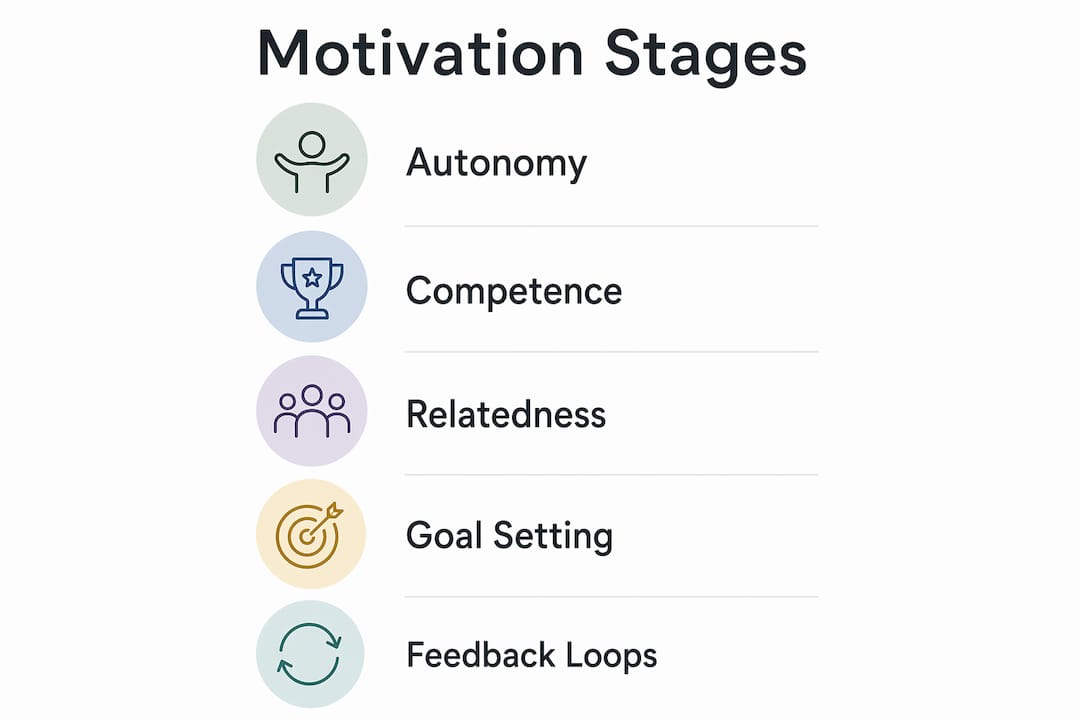
Autonomy means your goals feel self-chosen rather than externally imposed. When lifestyle design is client-led and built around your values, you internalize the goals as genuinely yours. Competence means the system gives you regular evidence that you are progressing. Relatedness means the design connects your personal growth to something larger, whether that is your family, your organization, or your long-term legacy.
The practical implication is significant. When lifestyle design supports autonomy, motivation shifts from controlled forms (obligation, guilt, external pressure) to autonomous forms (interest, values, genuine engagement). That shift produces more consistent behavior and greater resilience during high-demand periods.
Key conditions that support autonomous motivation in lifestyle design:
- Goals are self-identified, not assigned by a coach or framework
- Routines fit your actual schedule and energy patterns, not an idealized version
- Feedback loops are built in so you can see progress without waiting for external validation
- Barriers are anticipated and planned for before they arise
- The system is designed to flex, not collapse, when conditions change
Pro Tip: Design your lifestyle around your peak energy window first. If your best cognitive hours are 6–9 a.m., protect that block before scheduling anything else. The rest of the day can absorb interruptions. That window cannot.
Effective systems preserve autonomy, use realistic goals, and incorporate feedback loops to sustain high motivation over time. Willpower is a finite resource. A well-designed lifestyle system reduces the number of decisions that require willpower by making the right behavior the default.
What does the goal-setting process look like in lifestyle design?
Goal setting within lifestyle design is a multi-stage process, not a single event. Structured goal-setting involves understanding your background context, setting specific goals, planning with barrier analysis and tailored strategies, and maintaining ongoing follow-up with reinforcement or revision. Each stage is necessary. Skipping any one of them degrades the entire system.
The stages in sequence:
- Background assessment. Map your current state across energy, health, productivity, and relationships. Identify where the largest gaps exist between your current reality and your intended direction.
- Specific goal commitment. Convert your values into concrete goals with defined timelines. Vague intentions do not produce behavior change. Specificity does.
- Barrier analysis. Identify the obstacles most likely to interrupt execution. For executives, these typically include travel schedules, high-stakes deadlines, and social obligations that compress recovery time.
- Strategy design. Build a response plan for each barrier before it occurs. This is where most professionals under-invest. Knowing what you will do when your schedule collapses is more valuable than having a perfect plan for when it does not.
- Monitoring and follow-up. Review progress on a defined cycle, weekly at minimum. Reinforce what is working. Revise or disengage from goals that have become unattainable due to changed circumstances.
Pro Tip: Treat your weekly review as a non-negotiable appointment. Block 30 minutes every Sunday evening to assess the prior week and set intentions for the next. Professionals who skip this step consistently report that their lifestyle system drifts within three weeks.
Skipping planning and follow-up stages is the most common reason lifestyle design fails to convert intentions into durable behavior change. The goal-setting literature is clear: follow-up that includes reinforcement or goal revision is what separates sustained achievement from abandoned resolutions.
How does lifestyle design connect to workplace productivity metrics?
Lifestyle design becomes executive-grade when it is linked to measurable indicators rather than subjective intentions. Workplace health promotion KPIs allow professionals to operationalize lifestyle design within a productivity framework. Without measurable indicators, initiatives lack the feedback necessary for long-term adaptation and impact.
The distinction between operational indicators and subjective intentions is critical:
| Indicator type | Example | What it measures |
|---|---|---|
| Operational (objective) | Resting heart rate trend | Cardiovascular recovery and stress load |
| Operational (objective) | Sleep duration and consistency | Recovery quality and cognitive readiness |
| Operational (objective) | Deep work hours per week | Productive output capacity |
| Subjective (intention) | "I want to feel less stressed" | No measurable baseline or progress signal |
| Subjective (intention) | "I want to be healthier" | No actionable feedback loop |
Tracking lifestyle design with objective workplace KPIs elevates it from a personal aspiration to a precision lifestyle system. Executives who monitor sleep, recovery, and focused output alongside business metrics gain a feedback loop that connects personal health directly to professional performance.
The practical benefits of measurement in lifestyle design include:
- Early detection of performance degradation before it affects output
- Clear evidence of what is working, removing guesswork from system adjustments
- Accountability that does not depend on external pressure
- A data foundation for conversations with coaches, physicians, or performance advisors
Initiatives without measurable indicators lack executive-grade feedback, which diminishes long-term impact and the ability to adapt the system when conditions change.
Practical strategies for implementing lifestyle design sustainably
The most durable lifestyle designs treat the process as an iterative cycle: plan, monitor, and revise. This cycle prevents system collapse when conditions or priorities shift, enabling sustainable adaptation over years rather than months.
Four pillars structure a sustainable implementation:
- Energy management. Identify your biological peaks and troughs. Schedule cognitively demanding work during peak hours and administrative tasks during low-energy windows. This single adjustment produces measurable gains in output quality without adding hours.
- Discipline architecture. Build your environment to reduce friction for high-value behaviors. If you want to train in the morning, lay out your gear the night before. If you want to read before bed, remove your phone from the bedroom. The environment does the work that willpower cannot sustain.
- Barrier strategy. Professionals commonly over-focus on initial goal selection and under-invest in barrier handling and follow-up. Identify your top three recurring obstacles and build a written response protocol for each.
- Accountability framework. Accountability works best when it respects autonomy. A peer check-in, a performance journal, or a structured coaching relationship all provide external reference points without removing ownership of the system from you.
The balance between work and health is not achieved by working less. It is achieved by designing the conditions under which both can coexist without one systematically depleting the other. That requires deliberate architecture, not good intentions.
Lifestyle design for personal growth also demands that you recognize when a goal has become unattainable and disengage cleanly. Holding onto a goal that no longer fits your circumstances wastes resources and erodes motivation. Revision is not failure. It is the system working as designed.
Key takeaways
Lifestyle design is most effective when it combines autonomy-supportive goal setting, barrier analysis, and measurable KPIs into a single iterative system that adapts as conditions change.
| Point | Details |
|---|---|
| Define before you design | Align time, energy, and attention with specific values before selecting goals or routines. |
| Build for autonomy | Self-identified goals sustain intrinsic motivation far longer than externally assigned ones. |
| Invest in barrier strategy | Planning responses to obstacles before they occur is more valuable than perfecting the initial plan. |
| Measure what matters | Link lifestyle goals to objective KPIs like sleep, recovery, and deep work hours for executive-grade feedback. |
| Treat design as a cycle | Plan, monitor, and revise on a defined schedule to keep the system functional as priorities shift. |
Why most executives design their lifestyle too rigidly
Most of the executives I have worked with or observed closely make the same mistake. They build a lifestyle design that works perfectly under ideal conditions and then abandon it the moment a demanding quarter arrives. The design was not wrong. The assumption was: that a fixed plan could survive a dynamic environment.
The most effective lifestyle designs I have seen share one quality. They are built with explicit revision points. Not "I will revisit this someday," but a scheduled date every 90 days where the entire system gets assessed and adjusted. That discipline, treating the review as seriously as the plan itself, is what separates professionals who sustain performance over decades from those who cycle through bursts and burnout.
Autonomy also matters more than most frameworks acknowledge. When a lifestyle design feels imposed, even self-imposed, motivation erodes. The goal is not to follow a system. The goal is to build conditions where the behaviors you want become the path of least resistance. That requires honest self-knowledge, not borrowed frameworks.
Vitality for professionals is not a destination. It is a maintained state that requires active management. The executives who understand that treat lifestyle design as a core professional competency, not a wellness hobby.
— Joakim
Viridos: tools built for executive lifestyle design
Viridos was built for the professional who takes performance seriously enough to track it. The Viridos Performance Journal gives you a structured framework to record your lifestyle design goals, monitor your key indicators, and conduct your weekly and quarterly reviews in one place. It is not a generic planner. It is a purpose-built tool for executives who want their lifestyle system to function at the same standard as their business operations.
For professionals who want deeper support, the Viridos Membership provides access to curated executive performance strategies, formulation guidance, and a community of disciplined high-agency men. Viridos products are produced in small batches in Sweden, with a sublingual delivery philosophy designed for precision and consistency. The standard you apply to your professional work deserves the same standard in your performance system.
FAQ
What is lifestyle design?
Lifestyle design is the intentional process of aligning your time, energy, and attention with your personal values and long-term goals rather than defaulting to external demands. It draws on frameworks from life architecture, systems thinking, and structured goal setting.
Why does lifestyle design matter for executives?
High-responsibility roles deplete energy faster than they replenish it. Lifestyle design creates a structured replenishment system that sustains output consistency over years, not just short performance cycles.
How does Self-Determination Theory apply to lifestyle design?
Self-Determination Theory identifies autonomy, competence, and relatedness as the three psychological needs that sustain intrinsic motivation. Lifestyle design built around self-identified goals satisfies all three, producing more durable behavior change than externally imposed programs.
What are the most common mistakes in lifestyle design?
Professionals most commonly over-invest in initial goal selection and under-invest in barrier analysis and follow-up. Skipping these stages is the primary reason lifestyle systems fail to convert intentions into lasting behavior change.
How do you measure lifestyle design effectiveness?
Link your lifestyle goals to objective indicators such as resting heart rate trends, sleep consistency, and deep work hours per week. These KPIs provide the feedback loop necessary to assess progress and adjust the system before performance degrades.