
TL;DR:
- Executive stamina is the capacity to sustain physical energy, mental clarity, and emotional resilience in leadership roles. Most leaders lack a system to build and maintain this stamina, leading to burnout and performance issues. Building stamina through consistent exercise, recovery, and emotional management enhances leadership effectiveness and organizational success.
Executive stamina is defined as the integrated capacity to sustain physical energy, mental clarity, and emotional steadiness across extended periods in high-demand leadership roles. It is not about running on adrenaline or projecting endless drive. According to a Deloitte 2025 report, 77% of leaders identify stamina as essential for long-term success, yet that same share of executives report experiencing burnout. That gap is not a coincidence. It signals a widespread failure to treat stamina as a system to be built and maintained, not a trait you either have or lack.
What is executive stamina, and why does it matter?
Executive stamina is the professional term for what researchers and performance coaches increasingly call strategic energy management. The concept covers three distinct but connected dimensions: physical endurance, mental acuity, and emotional resilience. Each one degrades under sustained pressure. Each one can be trained.
The definition matters because most executives misread the problem. They interpret fatigue as a scheduling issue or a motivation deficit. The real issue is a depleted system with no recovery protocol. Executive stamina integrates physical, mental, and emotional endurance into a single operating capacity, allowing leaders to remain present and make sound decisions under pressure. Without that integration, performance becomes inconsistent, and leadership quality erodes in exactly the moments it is needed most.
Workplace stamina, as a concept, applies to anyone in a demanding role. For executives, founders, and investors, the stakes are amplified. A single poor decision made under cognitive fatigue can cost an organization months of progress. The importance of executive stamina is therefore both personal and organizational.
What are the components of executive stamina?
Executive endurance is built from three pillars. Understanding each one separately makes it easier to identify where your system is weakest.

Physical stamina is the foundation. It refers to the body's capacity to sustain effort and recover efficiently. Aerobic training improves executive functioning, emotional regulation, and stress resilience. This is not a wellness perk. It is a direct input into leadership capacity. Zone 2 training, defined as sustained aerobic effort at 60–70% of maximum heart rate, builds mitochondrial efficiency. More mitochondria means more cellular energy, which translates directly into sustained cognitive output.
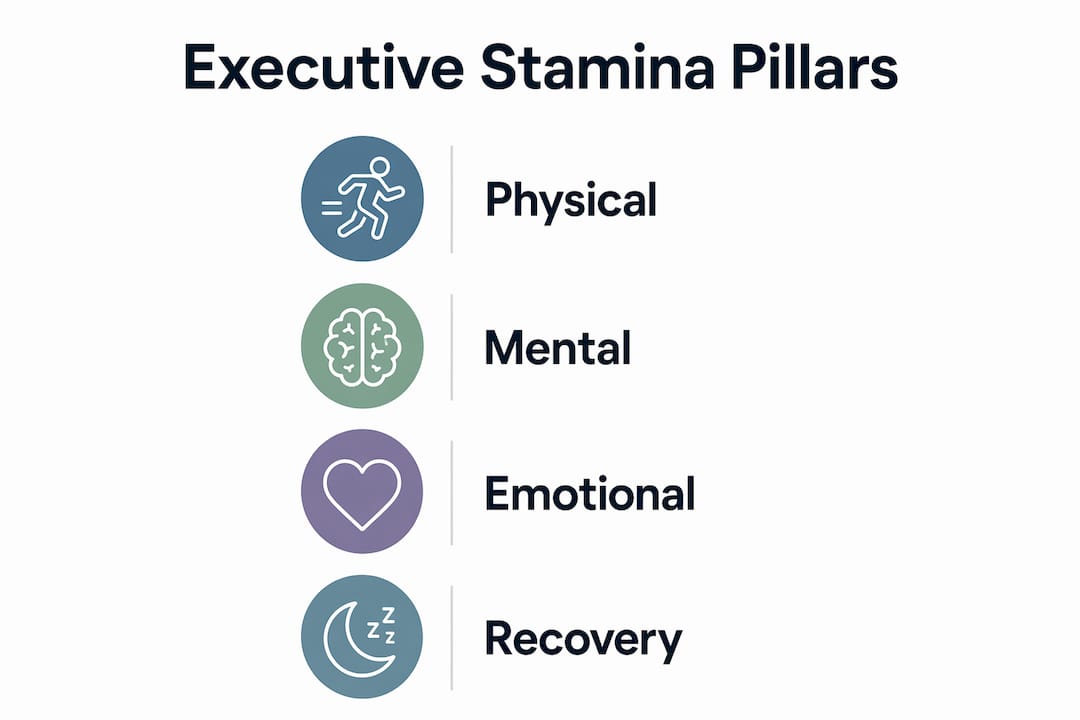
Mental stamina governs focus, clarity, and the quality of decisions made under pressure. It is the capacity to hold complex problems in mind without losing thread, especially late in a long day or during a high-stakes negotiation. Mental stamina degrades faster than most executives realize. Low stamina causes decision-making fatigue and team misalignment, two organizational problems that are rarely traced back to their real source.
Emotional stamina is the least discussed and often the most critical. It is the ability to remain present and regulated during conflict, uncertainty, or sustained organizational stress. Emotional stamina involves creating inner room to stay present during conflict, maintained best through proactive stabilizing rituals rather than reactive stress management. That distinction matters. Reactive coping is damage control. Proactive rituals are infrastructure.
- Physical stamina: built through Zone 2 aerobic training, sleep, and progressive overload
- Mental stamina: maintained through structured recovery, single-tasking, and cognitive load management
- Emotional stamina: developed through executive debriefs, stabilizing rituals, and deliberate presence practices
Pro Tip: Identify which of the three pillars degrades first under pressure. Most executives have one clear weak link. Targeting that pillar first produces the fastest performance return.
What evidence supports the importance of executive stamina?
The business case for improving executive performance through stamina is well documented. Leaders with high stamina can improve workplace productivity by up to 20% through aerobic training protocols that emphasize 80% of effort in Zone 2. That figure is not about fitness for its own sake. It reflects the direct transfer of physical conditioning to cognitive output and sustained decision quality.
The organizational effects extend beyond the individual leader. Organizations led by executives with high stamina report 30% higher employee engagement. That number reflects a cascading effect. When a leader is regulated, present, and energized, those qualities spread through the team. When a leader is depleted, that spreads too.
| Metric | Finding | Implication |
|---|---|---|
| Productivity gain | Up to 20% with aerobic stamina training | Physical conditioning directly improves output quality |
| Burnout prevalence | 77% of executives report burnout | Most leaders operate with a depleted stamina system |
| Employee engagement | 30% higher under high-stamina leaders | Stamina has measurable team-level effects |
| Stamina as priority | 77% of leaders call it essential | Recognition exists; practice lags behind |
The burnout statistic deserves particular attention. Burnout is not a personality flaw or a sign of insufficient commitment. It is the predictable outcome of sustained output without adequate recovery. The gap between recognizing stamina as essential and actually building it is where most executive performance plans fail.
Strategies for mental stamina produce compounding returns. A leader who maintains cognitive clarity through the third hour of a board meeting makes better decisions than one who is running on cortisol and caffeine. The difference is not talent. It is a trained system.
How do leaders build and maintain executive stamina?
Building stamina for sustained executive performance follows the same principles as building any physical or cognitive capacity: progressive load, consistent recovery, and patience with the timeline.
-
Apply progressive overload. Increase physical activity intensity or duration by approximately 10% per week. This prevents injury and allows adaptation. The same principle applies to cognitive load. Gradually extend deep work sessions rather than forcing marathon focus blocks from day one.
-
Prioritize Zone 2 aerobic training. Spend 80% of training time at 60–70% of maximum heart rate. This builds the aerobic base that underpins both physical recovery and mental endurance. Running, cycling, rowing, and brisk walking all qualify. Consistency matters more than intensity.
-
Treat sleep as a non-negotiable input. Seven or more hours of quality sleep per night is the minimum for cognitive recovery. Sleep is where the brain consolidates decisions, clears metabolic waste, and resets emotional regulation. Cutting it short is the fastest way to erode all three stamina pillars simultaneously.
-
Use nutrition and hydration as professional tools. Experienced leaders treat nutrition and recovery protocols as essential professional tools, equal in importance to strategy planning. Blood sugar stability, adequate protein, and consistent hydration directly affect focus and emotional regulation throughout the day.
-
Build proactive emotional rituals. Structured executive debriefs after high-pressure events, brief mindfulness practices before major meetings, and deliberate transitions between work modes all build emotional stamina over time. These are not soft practices. They are recovery protocols for the nervous system.
Pro Tip: Avoid the trap of sporadic high-intensity efforts. A 90-minute Zone 2 session three times per week outperforms a single brutal workout followed by five days of sedentary recovery. Consistency is the mechanism.
The executive fitness routines that produce lasting results share one feature: they are boring by design. The discipline to repeat a simple protocol week after week is itself a form of stamina training.
What are the common misconceptions about executive stamina?
The most damaging misconception is that stamina means indefatigability. It does not. Executive stamina is not about infinite energy but about strategic conservation and replenishment to ensure effective presence under pressure. Leaders who operate as though they are immune to fatigue do not demonstrate stamina. They demonstrate poor self-awareness, and they pay for it eventually.
A second misconception is that charisma substitutes for endurance. Leadership endurance relies on consistent fundamentals, including hydration, blood sugar stability, and Zone 2 training, over sporadic high-intensity hacks or relying solely on charisma. Charisma is a social skill. Stamina is a physical and cognitive system. One can mask the absence of the other for a short time. Over years, the gap becomes visible.
A third misconception is that burnout is a personal failure. The cultural myth of toughness frames exhaustion as weakness and recovery as indulgence. That framing is counterproductive. Burnout is a systems failure, not a character flaw. Reframing stamina as ongoing management, rather than a fixed trait, removes the stigma and opens the door to practical intervention.
- Stamina is not infinite energy. It is managed energy with deliberate recovery built in.
- Charisma does not replace endurance. It only delays the reckoning.
- Burnout signals a depleted system, not a weak character.
- Leadership fatigue spreads. A depleted executive creates a depleted team.
The importance of executive stamina becomes clearest when you examine what happens in its absence. Decisions slow. Conflicts escalate. Talent leaves. The organization begins to drift, and the leader rarely connects the drift to their own depleted state.
Key Takeaways
Executive stamina is the single most underleveraged performance variable in leadership, built through consistent physical training, structured recovery, and proactive emotional management rather than willpower or charisma.
| Point | Details |
|---|---|
| Definition of executive stamina | Integrated physical, mental, and emotional endurance enabling sustained leadership performance under pressure. |
| The performance gap | 77% of leaders value stamina, yet 77% report burnout, showing most lack a real stamina system. |
| Organizational impact | High-stamina leaders drive up to 30% higher employee engagement and up to 20% productivity gains. |
| Core building method | Progressive overload, Zone 2 training, 7+ hours of sleep, and proactive emotional rituals compound over time. |
| The biggest misconception | Stamina is not infinite energy. It is strategic energy management with deliberate recovery built in. |
The discipline no one talks about
The executives I respect most share one quality that rarely makes it into leadership profiles: they are boring about their fundamentals. They sleep at consistent times. They train at moderate intensity, regularly. They eat in ways that stabilize their energy rather than spike it. They debrief after hard days instead of just pushing through to the next one.
What I have observed, working alongside high-responsibility men in demanding roles, is that the leaders who last are not the ones with the most talent or the most drive. They are the ones who treat their energy as an organizational asset and manage it accordingly. Endurance leaders combine adaptability and practicality, treating their role as long-term stewardship. That framing changes everything. Stewardship implies maintenance. It implies patience. It implies that the goal is not to sprint to the finish line but to remain effective for the full duration.
The uncomfortable truth is that most executive performance problems are stamina problems in disguise. The leader who snaps in a board meeting, the founder who makes a rash acquisition, the investor who misreads a room: these are not failures of intelligence. They are failures of a depleted system operating without recovery. Building executive resilience starts with accepting that your energy is finite, manageable, and worth protecting as seriously as your balance sheet.
Patient consistency beats every short-term hack. That is not an inspiring message. It is a true one.
— Joakim
Viridos and the long game of executive performance
Viridos was built for exactly this kind of leader. The one who has stopped looking for shortcuts and started building systems.

The Viridos Performance Journal gives executives a structured tool to track energy, recovery, and output patterns over time. It makes the invisible visible, turning stamina from a vague aspiration into a measurable practice. For leaders who want guided support in building a complete performance protocol, the Viridos Membership provides access to executive performance formulation developed with the same precision and restraint that defines everything Viridos produces. Small-batch, Swedish-made, and designed for men who take the long view.
FAQ
What is executive stamina in simple terms?
Executive stamina is the ability to sustain physical energy, mental clarity, and emotional steadiness across demanding leadership roles over time. It is defined as strategic energy management, not unlimited drive.
How do I build stamina as a busy executive?
Apply progressive overload by increasing activity 10% weekly, prioritize Zone 2 aerobic training, and get 7 or more hours of sleep per night. Consistency across these three areas produces compounding returns.
What is the difference between executive stamina and burnout resistance?
Burnout resistance is a passive quality. Executive stamina is an active system built through physical training, recovery protocols, and emotional regulation practices. Leaders with high stamina are less likely to burn out because they manage energy proactively.
How does executive stamina affect team performance?
Organizations led by high-stamina executives report 30% higher employee engagement. A regulated, present leader sets the emotional tone for the entire team.
Can mental stamina be trained like physical stamina?
Mental stamina responds to the same principles as physical stamina: progressive load, consistent recovery, and deliberate practice. Structured deep work sessions, cognitive recovery periods, and sleep are the primary training tools.