
High-agency living means treating your circumstances as material to work with, not conditions to wait out. You act on the world rather than wait for the world to act on you, and you assume permission rather than request it. Right now, before reading further: write down one decision you have been deferring and name the single next physical action that would move it forward. That thirty-second exercise is agency in practice. This article supplies a complete 30/90-day framework and six-step program to make that disposition durable.

Table of Contents
- What does "high agency" actually mean?
- How do you recognize a high-agency person?
- Why high-agency living matters for performance and resilience
- High-agency vs. low-agency: what the contrast looks like in practice
- How to build a high-agency mindset: a six-step program
- What gets in the way, and how to manage it
- The evidence base and your 30/90-day framework
- Practical next steps to keep building
- Key Takeaways
- High agency and the long game of executive performance
- Viridos and the vitality foundation for sustained initiative
- Useful sources for deeper study
What does "high agency" actually mean?
Agency?ref=keheka.com) is the capacity to act intentionally in the world. It is not a personality type or a fixed trait. Sociologists and psychologists treat it as a disposition that sits on a spectrum, ranging from near-total passivity at one end to deliberate, self-directed initiative at the other. Most people operate somewhere in the middle, shifting position depending on context, energy, and environment.
High agency is the disposition to act on the world rather than be acted on. It treats constraints as negotiable and assumes permission rather than waiting for it. That framing matters because it shifts the question from "Am I allowed?" to "What does this situation require, and how do I drive it?"
Three related constructs are worth distinguishing briefly. Self-efficacy, from Albert Bandura's work, is your belief that you can execute a specific task. Locus of control, from Julian Rotter's research, describes whether you attribute outcomes to your own actions (internal) or to external forces. Ownership is the behavioral expression of both: actually claiming responsibility for outcomes rather than narrating why they belong to someone else. High-agency living integrates all three. It is not enough to believe you can act; you must habitually choose to act, and then own what follows.
Thinking in degrees matters because it removes the binary trap. You are not either high-agency or low-agency. You are more or less agency-oriented in a given domain, and that is trainable. Agency can be developed through deliberate practice, situation-reframe exercises, and daily decision protocols, not through a personality overhaul.
How do you recognize a high-agency person?
Observable signs are more reliable than self-report. Watch for these behaviors:
- Biased toward action: moves before all information is available; treats a decision made with 70% confidence as better than no decision at all
- Resourceful under constraint: finds a path using what is available rather than listing what is missing
- Permissionless initiative: starts projects, conversations, and experiments without waiting for authorization
- Ownership of outcomes: claims responsibility for results, including failures, without deflecting to circumstances
- Constraint-reframing: when blocked, asks "which of these constraints is actually fixed?" rather than accepting the full stack as given
- Emotional regulation in service of action: manages frustration and uncertainty well enough to keep moving, not by suppressing feeling but by not letting it veto forward motion
- Preference for specificity: converts vague goals into concrete next actions within minutes
The psychological markers that practitioners identify most consistently include decisiveness, resourcefulness, and a preference for ownership over explanation.
Quick self-assessment
Answer these five questions honestly, on a scale of 1 (rarely) to 5 (consistently):
- When a project stalls, do I identify the next action within 24 hours rather than waiting for clarity?
- Do I regularly start things without being asked?
- When I hit a constraint, do I test whether it is actually fixed before accepting it?
- Do I own outcomes, including the ones that went wrong?
- Do I spend more time creating than consuming on a typical workday?
Higher scores suggest a stronger agency baseline. Lower scores indicate areas with clear opportunities for improvement.
One important caveat: culture, role, and identity shape how agency reads to others. A founder who acts without permission is called decisive; the same behavior in a junior employee or in someone from a marginalized group is often labeled insubordinate or aggressive. High-agency acts carry asymmetric social costs depending on context, a point worth holding alongside the framework rather than ignoring it.
Why high-agency living matters for performance and resilience
The performance case for a high-agency lifestyle is not motivational; it is structural. When you default to action rather than waiting, you generate more data, more feedback cycles, and more opportunities to course-correct. That compounds over time in ways that passivity cannot match.

High agency functions as a strategic asset in organizations: it amplifies execution, helps teams navigate incomplete data, and compensates for dispersed decision-making. For an executive or founder, this means agency is not a personality bonus. It is a core execution multiplier, especially when the environment is ambiguous and the org chart cannot supply the answer fast enough.
The resilience benefit is behavioral, not clinical. High-agency individuals treat setbacks as data about their operating system rather than verdicts about their worth. That reframe shortens recovery time after a stalled deal, a failed hire, or a missed quarter. Instead of cycling through blame narratives, the agency-oriented response is: what did this reveal, and what changes next? That loop, run consistently, builds what practitioners call metabolic resilience in decision-making: the capacity to absorb disruption without losing forward momentum.
Chronic stress, for executives, often comes not from workload but from perceived helplessness. When you believe circumstances are controlling you, the physiological stress response runs longer and harder. Shifting to an active problem-solving stance, even on small daily decisions, interrupts that pattern. The benefits of high-agency living show up most clearly in three executive scenarios: stalled projects (agency converts waiting into testing), high-stakes decisions (agency converts paralysis into structured experimentation), and difficult conversations (agency converts avoidance into prepared directness).
High-agency vs. low-agency: what the contrast looks like in practice
The difference is not ambition. It is the default script that runs when things get hard.
| Dimension | Default script (low agency) | Possibility script (high agency) |
|---|---|---|
| Thought pattern | "I need more information before I can move." | "What can I test with what I have right now?" |
| Response to obstacles | Lists reasons the constraint is fixed | Asks which constraints are actually negotiable |
| Ownership | Attributes outcomes to circumstances or others | Claims responsibility for results, good and bad |
| Communication | Waits to be asked; hedges requests | States needs directly; makes asks without over-justifying |
| Time orientation | Focuses on what went wrong | Focuses on what changes next |
| Likely outcome | Slower progress; higher frustration; dependency on external validation | Faster feedback loops; greater resilience; compounding initiative |
Deliberately shifting stance is a skill, not a character judgment. The trigger list is short: when you notice yourself waiting for permission, listing obstacles, or deferring a decision for the third time, those are signals to run the possibility script instead. The shift is not about ignoring reality. It is about testing which parts of reality are actually fixed.
How to build a high-agency mindset: a six-step program
Building high agency requires deliberate practice, exposure to high-agency peers, and projectized micro-experiments rather than waiting for an internal feeling of readiness. Action precedes identity change, not the other way around. Here is a sequenced program you can start this week.
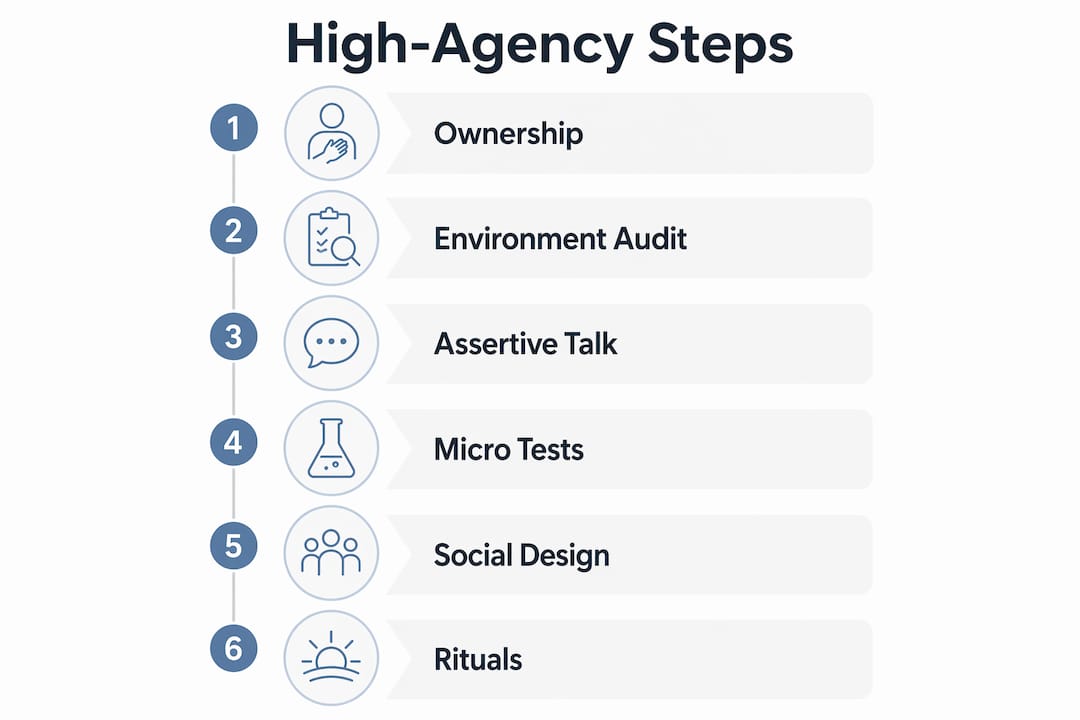
Step 1: Establish an ownership protocol
Every morning, identify one outcome in your domain that you have been treating as someone else's problem. Claim it explicitly. Write it down with your name next to it.
Micro-action A: At the start of each week, list three outcomes you own completely, regardless of who else is involved. Review them Friday. Micro-action B: When something goes wrong, write one sentence that begins: "My contribution to this outcome was..." before analyzing external factors.
Step 2: Audit your environment for creation vs. consumption
Your environment shapes your defaults. If your mornings start with email, news, and social feeds, you are training a consumption reflex. High-agency living requires a creation reflex.
Micro-action A: Block the first 60 minutes of your workday for output only: writing, deciding, building, calling. No inbox. Micro-action B: Audit your weekly calendar. If a substantial portion of your time is reactive, redesign one block per week to focus on generative activities.
Designing a daily executive routine around creation-first sequencing is one of the highest-leverage structural changes available.
Step 3: Practice assertive communication
Assertive communication is not aggression. It is stating what you need, what you have decided, and what you are asking for, without over-justifying or hedging.
Micro-action A: Replace "I was thinking maybe we could..." with "I recommend X because Y. Are you in?" in your next three professional conversations. Micro-action B: Make one direct ask per day that you would normally avoid or soften into a suggestion.
Step 4: Run micro-experiments instead of making plans
Plans are hypotheses. Treat them as such. A micro-experiment is a small, time-boxed test of an assumption, run with the explicit intent to learn rather than to succeed.
Micro-action A: Identify one assumption underlying a current project. Design a 48-hour test of that assumption. Run it. Micro-action B: Keep a one-line experiment log: what you tested, what you expected, what happened. Review weekly.
Treating agency as a Life OS shifts practice from a motivational slogan to a repeated, testable decision protocol with measurable micro-experiments.
Step 5: Design your social environment deliberately
You adopt the agency level of the people you spend the most time with. This is not a soft observation. It is a calibration mechanism.
Micro-action A: Identify one person in your network who consistently acts without waiting for permission. Schedule a 30-minute conversation this month. Micro-action B: Reduce unstructured time with people who default to complaint, blame, or passivity. This is not about judgment; it is about signal-to-noise.
For motivation strategies that sustain initiative under pressure, peer environment is consistently the most underrated lever.
Step 6: Build maintenance rituals
Agency erodes without reinforcement. The rituals that sustain it are simple and short.
Micro-action A: Weekly: a 10-minute review of initiative attempts, constraint-reframes, and experiments run. Note what worked. Micro-action B: Monthly: revisit your ownership list and update it. Add one new domain you are claiming.
Pro Tip: Stay close to the technological frontier in your field. Fluency with new tools, including AI, expands your perceived degrees of freedom and therefore your sense of what is worth attempting. Thirty minutes per week exploring a new capability is a high-agency habit with compounding returns.
Practitioners often experience a shift in their default question within about 30 days, and within around 90 days, the micro-experiment habit typically leads to multiple completed tests per month, with the ownership protocol becoming more automatic than effortful.
What gets in the way, and how to manage it
The obstacles to a high-agency lifestyle are predictable. Knowing them in advance is half the mitigation.
Analysis paralysis is the most common. It masquerades as diligence but is usually fear of a wrong decision dressed in the language of thoroughness. The mitigation is a decision deadline: give yourself a fixed window (often 24–48 hours for non-critical decisions) and commit to the best available option when the window closes. Imperfect action generates data; extended deliberation generates none.
Anxiety about reprisal is real, particularly in hierarchical organizations. Acting without permission carries social risk, and that risk is not evenly distributed. The practical mitigation is to start with low-stakes experiments where the cost of failure is small and the learning is high. Build a track record of judgment before taking on higher-visibility initiative. This is not timidity; it is sequencing.
Social pushback from peers and colleagues is common when someone begins acting with more initiative. It can read as threatening or as a judgment on others' passivity. The critique that high-agency language can be unevenly applied across social groups is legitimate and worth taking seriously. The response is not to abandon agency but to be precise about context: assertive communication in a one-on-one conversation is different from unilateral action in a team setting.
Burnout is the long-game obstacle. High agency without recovery is not sustainable. The maintenance rituals in Step 6 exist specifically to prevent the compulsive overextension that high-initiative people are prone to. If you find yourself unable to stop initiating even when exhausted, that is a signal to bring in external accountability, whether a coach, a peer group, or a structured program.
Pro Tip: If you have run the six-step program for 60 days and still find yourself defaulting to passivity or avoidance in a specific domain, that domain likely carries a deeper psychological pattern. A single session with an executive coach focused on that specific context is often more efficient than another month of solo effort.
The evidence base and your 30/90-day framework
The Harvard Business Review's 2026 analysis of organizational leadership confirms what practitioners have observed for years: uncertainty and disruption push organizations toward passivity, and the most effective leaders deliberately cultivate high agency as a counterforce. The construct maps onto established psychological research in self-determination theory, locus of control, and Bandura's self-efficacy literature, all of which converge on the same finding: perceived control over outcomes is a primary driver of both performance and psychological well-being.
30-day primer checklist
Daily:
- Run the ownership protocol (Step 1, 5 minutes)
- Block the first 60 minutes for creation output
- Make one direct ask or assertive statement
Weekly:
- Log initiative attempts, constraint-reframes, and experiments run
- Review your experiment log (one line per test)
- Schedule one conversation with a high-agency peer or model
90-day consolidation checklist
- Complete at least six projectized micro-experiments with documented outcomes
- Redesign your calendar so creation-first blocks are protected by default
- Audit your social environment: identify two relationships to invest in and two to reduce
- Review your ownership list and add two new domains
- Assess your tool fluency: identify one new capability to develop in your field
Environment audit checklist
Remove passive dependencies:
- Notifications that interrupt creation blocks
- Default-yes commitments that fill reactive time
- Information feeds with no output trigger
Add high-agency cues:
- A visible experiment log on your desk or digital workspace
- A weekly ownership review in your calendar
- One high-agency book or resource in your current reading rotation
Weekly tracking metrics
| Metric | What to log | Interpretation |
|---|---|---|
| Initiative attempts | Number of actions taken without being asked | Upward trend over 4 weeks = agency building |
| Constraint-reframes | Times you tested a "fixed" constraint | Any nonzero number is progress |
| Micro-experiments run | Completed tests with documented outcomes | Target: 2 per month |
| Outcome ratio | Experiments with useful learning vs. total run | Aim for all experiments to produce data |
Log these weekly in a simple spreadsheet or notebook. The goal is not perfection on any single metric. It is a visible upward trend across all four over 90 days.
Staying close to the technological frontier in your field, including AI tools and emerging platforms, accelerates agency development by expanding what you perceive as possible and therefore worth attempting.
Practical next steps to keep building
The 30/90-day framework gives you structure. These five steps give you traction beyond it.
-
Complete the self-assessment this week. Score yourself on the five questions in the Signs/Traits section. Identify your lowest-scoring item and make it the focus of your first 30 days.
-
Start the experiment log today. Open a document or notebook. Write today's date, one assumption you are currently operating on, and how you will test it in the next 48 hours.
-
Read one foundational resource. George Mack's essay at HighAgency.com is a 30-minute read that covers the core disposition and daily practice in practical terms. It is the most efficient entry point for practitioners.
-
Practice agency in a low-stakes domain first. Family conversations, side projects, and volunteer commitments are ideal proving grounds. The social cost of a failed experiment is low; the learning transfers directly to higher-stakes contexts.
-
Build the physical foundation. Decision discipline and initiative require sustained cognitive energy. A home workout routine and consistent sleep are not peripheral to high-agency living. They are the substrate it runs on.
For deeper reading, the NPR "It's Been a Minute" episode on high agency offers a balanced cultural perspective, including the legitimate critiques of how the concept is sometimes applied. It is worth 30 minutes for anyone who wants to hold the framework with appropriate nuance rather than as ideology.
Key Takeaways
High-agency living is a trainable disposition: the consistent practice of acting on circumstances rather than waiting for them to change, measured by initiative attempts, constraint-reframes, and completed experiments over 30 and 90 days.
| Point | Details |
|---|---|
| Agency is a spectrum, not a trait | You are more or less agency-oriented by domain, and deliberate practice shifts your position. |
| Action precedes identity change | Start micro-experiments before you feel ready; the disposition follows the behavior, not the other way around. |
| The 30-day target is a mindset shift | By day 30, your default question should shift from "Am I supposed to?" to "What does this require?" |
| Track four metrics weekly | Log initiative attempts, constraint-reframes, experiments run, and outcome ratio to make progress visible. |
| Viridos supports the physical substrate | Sustained initiative and decision discipline require the vitality foundation that Viridos is built to support. |
High agency and the long game of executive performance
The executives who sustain performance into their fifties and sixties are not the ones who worked hardest in their forties. They are the ones who built systems, habits, and dispositions that compound. High-agency living is one of those dispositions. It does not peak and fade the way raw drive does. Practiced consistently, it becomes a decision architecture: a reliable way of meeting ambiguity with initiative rather than with waiting.
What the framework in this article makes clear is that agency is not a mindset you adopt once. It is a protocol you run repeatedly, update based on evidence, and maintain through deliberate environmental design. The men who do this well are not exceptional in talent. They are exceptional in consistency. That is a discipline, and discipline is something you can choose.
Viridos and the vitality foundation for sustained initiative
The six-step program above is self-directed and executable without any external support. For men who want a structured, evidence-oriented complement to that practice, Viridos offers a different route: a premium membership built around longevity-performance strategy, designed specifically for founders, executives, and high-responsibility men who want sustained edge without the trial-and-error of building everything from scratch.

Before committing to any paid program, apply this evaluation checklist: Does it cite evidence rather than testimonials? Does it offer a defined trial period? Does it match you with peers at a comparable level? Does it track outcomes, not just activities? Are the credentials of those guiding it verifiable? Viridos is built to meet each of those criteria, with small-batch Swedish formulations, a precision membership experience, and a longevity-performance strategy grounded in biological relevance rather than marketing claims. If you are ready to add a structured performance foundation to the agency practices in this guide, explore the Viridos membership and assess whether it fits your current protocol.
Useful sources for deeper study
-
What Is High Agency? — The clearest single-page definition and spectrum framing available. Start here for the conceptual foundation before moving to practice. Practical and conceptual.
-
How Leaders Can Build a High-Agency Culture — Harvard Business Review — Organizational and leadership-level application of the construct, grounded in research on how effective leaders counteract institutional passivity. Practical and evidence-backed.
-
Opinion: All the Worst People Seem to Want to Be 'High Agency' — The New York Times — A necessary critical perspective on how high-agency language can be weaponized, applied unevenly, or used to justify behavior that is simply self-serving. Read this alongside the how-to material, not instead of it. Critical and contextual.