
TL;DR:
- Discipline alone does not drive high performance; agency, influenced by personality traits and environment, is the key.
- High agency entails genuine control over life through adaptable, feedback-driven behaviors that promote longevity and well-being.
Most men assume discipline is the engine of high performance. It isn't. Agency is measurable, moderately heritable, and tightly linked to extraversion and vitality-driven personality traits, meaning it operates far deeper than willpower alone. For founders, executives, and high-agency professionals, understanding what actually drives sustained performance changes everything. This guide breaks down the science, the structure, and the practical habits that translate agency from an abstract concept into your most durable competitive edge.
Table of Contents
- What does high agency mean for men?
- The structure of agency: Inputs, routines, and measurement
- The double-edged sword: Pitfalls of rigid agency and the role of flexibility
- Applying high agency: Performance, vitality, and executive longevity habits
- Why lasting agency is more than rigorous discipline: A perspective
- Elevate your agency: Take the next step with Viridos
- Frequently asked questions
Key Takeaways
| Point | Details |
|---|---|
| High agency is measurable | Agency combines self-control with structured feedback, and is partly heritable. |
| Structure beats willpower | Daily routines with built-in measurement and recovery support sustainable high agency. |
| Flexibility protects well-being | Rigidity in agency can harm satisfaction; psychological flexibility is essential. |
| Sustainable routines require feedback | Closed feedback loops help adjust routines and prevent burnout or hollow achievement. |
| Agency supports lasting performance | Agency-driven habits underpin lifelong vitality and competitive edge for high-achievers. |
What does high agency mean for men?
Agency is not a motivational buzzword. Personal agency is defined as the capacity to exercise genuine control over your life, and research consistently shows it drives flourishing across mental and physical health, relationships, and financial outcomes. When men operate with high agency, they initiate rather than react, own outcomes rather than deflect, and adjust course based on feedback rather than stubbornness.
The science behind it is more nuanced than most men expect. Agency is a stable behavioral pattern that is moderately heritable and strongly correlated with extraversion, making it part temperament and part environment. That distinction matters because it removes the excuse that some men are "just wired differently." Your baseline may vary, but agency as a practiced quality is absolutely trainable.
Here is what the data tells us:
| Agency dimension | Outcome domain | Impact strength |
|---|---|---|
| Internal locus of control | Career advancement | Strong positive |
| Proactive goal pursuit | Physical health longevity | Strong positive |
| Feedback responsiveness | Relationship quality | Moderate positive |
| Adaptive decision-making | Financial independence | Strong positive |
The most common misconception is that high agency equals relentless self-control, a kind of stoic rigidity where men push through pain and override every signal their body sends. That is not agency. That is suppression. True agency is a dynamic, feedback-driven quality. It means knowing when to accelerate and when to recover, when to hold a position and when to pivot. Men who want to optimize performance for vitality need to internalize this distinction early.
Key traits that characterize genuinely high-agency men:
- They own problems without catastrophizing. Ownership doesn't mean suffering alone; it means being the one who responds.
- They seek feedback loops. High agency thrives on information, not ego protection.
- They connect daily behavior to long-term outcomes. Each choice is part of a deliberate system, not a random reaction.
- They adapt routines when the environment changes rather than forcing outdated strategies.
- They invest in sustainable inputs. Sleep, nutrition, and recovery aren't luxuries. They are operational requirements.
Embedding healthy lifestyle routines into your daily structure is not about perfection. It is about maintaining the physiological conditions that allow agency to function at its highest level over decades, not just during peak quarters.
"Agency is not simply doing more. It is architecting the conditions under which you can consistently perform, recover, and grow without burning out the machine."
The structure of agency: Inputs, routines, and measurement
Understanding agency intellectually is one thing. Building the structural conditions that make it operational every single day is where most men stall. The difference between men who sustain high performance across a 30-year career and those who flame out by 50 almost always comes down to system design, not raw drive.
Agency only supports vitality and longevity when it is consistently reinforced through structure, measurement, and recovery loops rather than willpower alone. Willpower is a finite resource. Systems are not.

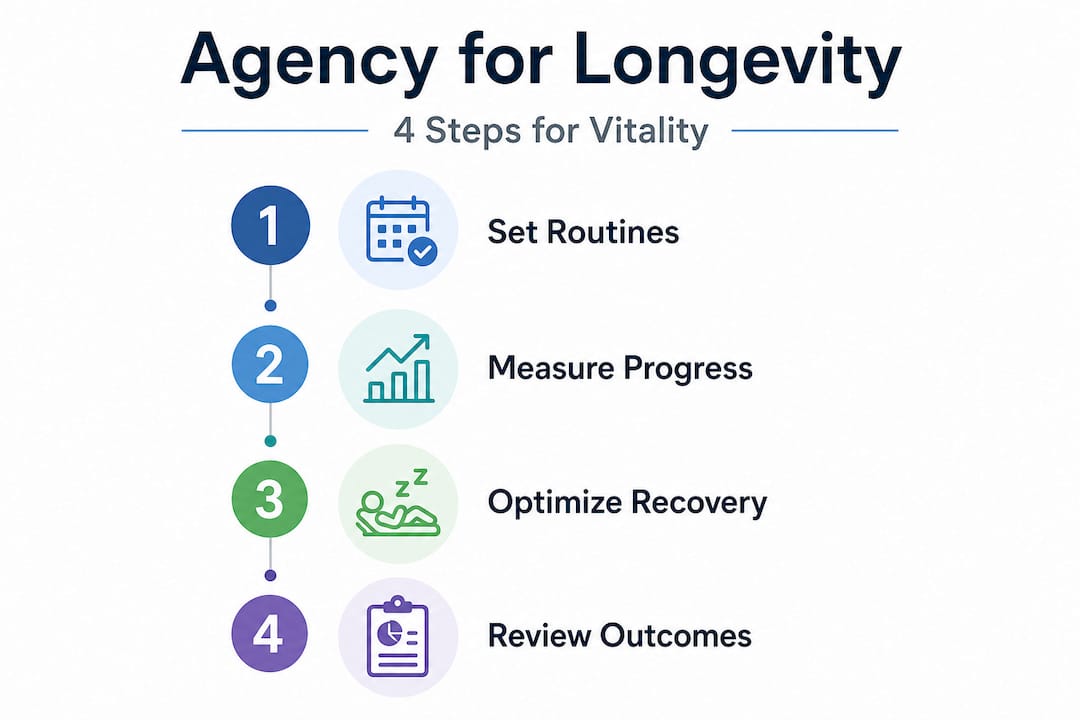
The framework for applied agency looks like this:
Comparison of routine types:
| Routine type | Characteristics | Long-term outcome |
|---|---|---|
| Rigid, willpower-driven | Fixed, inflexible, ego-guarded | Burnout, injury, resentment |
| Adaptive, feedback-driven | Dynamic, measured, recovery-aware | Sustained edge, longevity |
| Outcome-only focused | Results-obsessed, ignores process | Hollow wins, fragile identity |
| Process and feedback focused | Input-tracked, course-corrected regularly | Compounding performance |
The adaptive, feedback-driven model is what separates executive-level self-optimization frameworks from temporary performance hacks. It builds a closed loop: you perform, you measure, you recover, you refine.
Here is a practical sequence for designing your agency-centric routine:
-
Define your three performance pillars. For most high-achieving men, these are cognitive output, physical condition, and relationship quality. Be specific, not vague. "Good health" is not a pillar. "HRV above 55 and resting heart rate below 58" is a pillar.
-
Design daily inputs that serve each pillar. Morning inputs should include movement, protein-forward nutrition, and a 10-minute planning block. These are not optional additions to your schedule. They are the foundation that makes the schedule run.
-
Build a weekly measurement ritual. Spend 20 minutes each Sunday reviewing your key metrics. Energy levels, work output, sleep quality, training consistency. Use a journal or structured tracking tool to close the loop.
-
Set a quarterly review process. Quarterly is the right cadence for recalibrating big-picture goals. Monthly feels reactive; annually is too slow. Quarterly gives you enough data to spot trends without overreacting to noise.
-
Schedule recovery as an active input. This is not downtime. It is a deliberate physiological and cognitive restoration protocol. High-performance men who boost performance and vitality consistently treat recovery with the same seriousness as a board meeting.
Pro Tip: Track your energy output across the day for two weeks using a simple 1-10 scale noted at 8am, 12pm, 4pm, and 8pm. Most executives discover they have a 90-minute peak window in the morning that gets consumed by email. Protect that window for high-leverage cognitive work and watch your output per hour dramatically improve.
Leveraging vitality optimization strategies specifically designed for men in the 40-65 range will accelerate this process significantly. The physiological landscape changes, and your system design needs to account for it.
The double-edged sword: Pitfalls of rigid agency and the role of flexibility
Most performance content aimed at high-achieving men glorifies relentless agency. Push harder. Rise earlier. Tolerate less. What that content consistently leaves out is the growing body of evidence showing that rigid, inflexible agency is genuinely harmful to long-term well-being and performance.
Treating agentic masculinity as a rigid norm measurably hurts well-being when men cannot meet their own expectations. The pressure to always be the initiator, the decision-maker, the unmoved force in the room creates a performance trap where men sacrifice health and relationships to maintain an image of control. And masculinity's organizational advantages are real, but so are the documented downsides when rigidity replaces adaptability.
The psychological and cultural pitfalls of idolizing rigid agency:
- Identity fusion with productivity. When your sense of self is inseparable from your output metrics, any slowdown feels like personal failure. This is one of the primary drivers of executive burnout.
- Resistance to help-seeking. High-agency men often interpret asking for support as a weakness signal. This isolates them from the feedback and resources they need most.
- Ignoring biological signals. Fatigue, pain, and mood shifts are data. Suppressing them in the name of discipline is not strength. It is willful ignorance of your own operating system.
- Hollow goal achievement. Reaching milestones without meaning creates a disorienting vacuum. Many high-performing men in their 40s and 50s describe hitting professional peaks and feeling nothing, because the agency was never connected to genuine purpose.
- Relationship erosion. Sustained high-control orientation in professional settings often bleeds into personal relationships, creating distance where intimacy and trust should be building.
"The most expensive thing a high-agency man can do is apply his control instinct to situations that require surrender, collaboration, or simple patience."
Flexibility is not the opposite of agency. It is a prerequisite for agency that compounds over time. Psychologically flexible men maintain strong ownership and initiative while updating their strategies based on reality rather than ego. They sustain performance longevity precisely because they know when to hold firm and when to adapt intelligently.
Pro Tip: Once a month, deliberately practice a structured "release day." No optimization goals, no tracked metrics, no productivity targets. Observe how your body and mind respond. Most high-agency men discover that what they labeled as relaxation was actually suppressed anxiety. That awareness alone is actionable intelligence.
Separating agency from status signaling is equally critical. Agency is about ownership and initiative. Status signaling is about how that ownership appears to others. Confusing the two leads to performative discipline that looks like high agency but actually consumes energy without producing meaningful output.
Applying high agency: Performance, vitality, and executive longevity habits
Theory without application is philosophy. Here are the specific practices that translate high agency into measurable, sustained performance for men operating at the executive level.
Agency supports flourishing across health, relationships, and finances simultaneously, which means your habits need to address all three domains rather than optimizing one at the expense of the others.
Weekly high-agency habit sequence:
- Monday planning block (25 minutes). Map your three highest-leverage outcomes for the week. Not tasks. Outcomes. The difference forces clarity about what actually moves the needle.
- Daily movement commitment. Minimum 30 minutes of purposeful physical activity, with at least two sessions per week of structured strength training. Muscle mass is a biomarker of vitality that most men let erode after 40.
- Nutritional structure, not restriction. Protein intake of 0.7 to 1 gram per pound of bodyweight keeps cognitive function and hormonal health stable under high stress. Track it for 30 days and you will understand why elite performers treat nutrition as performance infrastructure.
- Sleep architecture protection. Target 7 to 8 hours with consistent sleep and wake times, even on weekends. Sleep is when the nervous system consolidates decisions, clears metabolic waste, and recalibrates stress response. You cannot out-discipline sleep debt.
- Friday review (20 minutes). Review what you committed to Monday and what actually happened. No judgment, only data. Adjust inputs for the following week accordingly.
- Quarterly relationship audit. Evaluate your three to five closest professional and personal relationships. Are they energizing or depleting? High-agency men curate their relationship environment with the same precision they bring to business strategy.
High-agency choices that compound over time:
- Declining non-essential commitments that don't align with your current strategic priorities
- Scheduling annual comprehensive bloodwork and acting on the results
- Hiring a coach, therapist, or advisor to create structured external accountability
- Keeping a performance journal that tracks energy, mood, focus, and output simultaneously
- Building in single-day "strategic thinking" blocks every six to eight weeks where no meetings are allowed
Using resilient performance strategies grounded in measurement and recovery gives you a durable edge that raw ambition alone cannot sustain past your mid-40s.
Key stat: Men who consistently practice structured self-review and recovery protocols report significantly higher career satisfaction and lower burnout rates than those who rely purely on work volume to signal commitment.
Why lasting agency is more than rigorous discipline: A perspective
Here is the uncomfortable truth that most performance content avoids: a significant portion of high-agency behavior in professional environments is actually image management wearing the costume of discipline. Men build elaborate morning routines, track every biometric, and push through weekends not because it genuinely serves their long-term flourishing, but because it reinforces a self-concept they are afraid to question.
Output-optimization cultures produce insecurity when agency is not connected to meaning and responsibility. We have seen this pattern repeatedly in high-performing executives who have mastered every external indicator of agency and still feel fundamentally adrift by their early 50s. The routines were real. The discipline was real. But the meaning was borrowed from external validation rather than built internally.
The men who sustain genuine agency across a full career do something different. They connect every system they build to a clear answer to the question: What am I building this for, and who does it serve beyond myself? That is not soft thinking. It is structurally necessary for the kind of agency that remains robust when markets collapse, health challenges arrive, or relationships demand something other than performance.
Responsibility is the stabilizing axis of lasting agency. Not responsibility in the liability sense, but in the deeper sense of choosing to be the person who shows up, owns outcomes, and remains invested in the health of the systems around them, including the people in their professional orbit.
Executive fitness and performance strategies matter enormously, but they work best when they serve a man who knows what he is training for beyond the mirror or the quarterly numbers. The discipline becomes lighter when it carries real meaning. The recovery becomes easier when it is understood as service to something larger than the next performance cycle.
Agency built on meaning doesn't collapse when circumstances change. That is the version worth building.
Elevate your agency: Take the next step with Viridos
Moving from understanding agency to genuinely living it requires the right tools and a structured environment that supports long-term growth rather than short-term performance theater. VIRIDOS was built specifically for men who operate at this level and want the infrastructure to match their ambition.

The Performance Journal gives you a precision-designed framework for tracking inputs, measuring outputs, and maintaining the feedback loops that turn high agency from a concept into a compounding daily practice. For men who want a deeper, ongoing structure, the Executive Performance Membership delivers curated resources, accountability systems, and community specifically built for high-achieving men committed to sustained vitality and executive longevity. Explore Viridos to find the tools that fit your current performance phase and start building agency that lasts.
Frequently asked questions
Is high agency an inborn trait or can it be cultivated?
High agency has a moderate genetic component but responds significantly to structured environment and intentional practice, meaning your starting point matters far less than your system design.
What are the risks of pursuing high agency without flexibility?
Rigid agency norms measurably lower well-being and life satisfaction when men cannot meet self-imposed expectations, making psychological flexibility an essential component of durable performance.
How does agency impact performance longevity?
Agency supports flourishing across health, relationships, and finances simultaneously, enabling disciplined routines and adaptive recovery that keep performance sustainable well into your 50s and beyond.
Can high agency be bad for men in professional settings?
When agency is linked primarily to output or status rather than meaning, output-optimization cultures produce insecurity and hollow behavior patterns that undermine the genuine vitality high-agency living is supposed to create.