
TL;DR:
- A structured, evidence-based routine focused on physical activity, sleep, cognitive engagement, and stress management is essential for maintaining executive-level mental sharpness. Consistently optimizing environment, practicing focused work, and incorporating mindfulness strengthen long-term cognitive resilience. Tracking key indicators like sleep quality, focus duration, and stress levels ensures sustainable performance improvements over time.
Your calendar is full, your decisions carry real consequence, and somewhere in the last decade your margin for cognitive error has quietly narrowed. A solid mental sharpness routine is not a wellness indulgence — it's a performance asset, as critical as your financial discipline or leadership judgment. The good news: research consistently shows that targeted lifestyle habits can counter age-related cognitive decline and sustain executive-level thinking well into your sixties. This article gives you a structured, evidence-backed framework covering exercise timing, sleep, focus control, and stress management — without a single piece of generic advice.
Table of Contents
- Understanding the foundations of mental sharpness in executive life
- Prepare your environment and body for peak cognitive function
- Execute daily practices to optimize sharpness, focus, and memory retention
- Incorporate stress management and mindfulness for sustained cognitive resilience
- Verify and optimize your mental sharpness routine for long-term success
- Why simplicity and consistency trump intensity in mental sharpness routines
- Achieve sustained mental sharpness with VIRIDOS executive formulations
- Frequently asked questions
Key Takeaways
| Point | Details |
|---|---|
| Multi-domain routine essential | Combining physical activity, sleep, and cognitive engagement supports long-term mental sharpness. |
| Consistent sleep crucial | Regular 7-8 hours of sleep enhances memory consolidation and executive function. |
| Exercise timing matters | Aerobic exercise about 4 hours after learning boosts memory retention effectively. |
| Focus controls enhance attention | One-task-at-a-time and structured listening improve immediate cognitive performance. |
| Mindfulness reduces stress | Incorporating mindfulness lowers stress, preserving attentional capacity and mental clarity. |
Understanding the foundations of mental sharpness in executive life
To build a routine, first grasp the evidence-backed pillars that protect your cognitive function. Most executives optimize for output — hours logged, meetings attended, decisions made. What they rarely optimize for is the biological infrastructure that makes good decisions possible in the first place.
Three domains determine the long-term trajectory of your mental sharpness: physical activity, sleep quality, and cognitive engagement. These are not independent levers. They interact. Miss one consistently and the others lose significant return. Physical activity, sleep, and sedentary behavior are each independently linked to lower dementia risk and measurably better cognition — but the combination produces results no single intervention can match.
Here is what the evidence tells you about each pillar:
- Physical activity reduces your dementia risk by approximately 25%. This is not a soft correlation. It reflects structural changes in brain volume and blood flow.
- Sleep needs to land in the 7 to 8 hour window. Consistently sleeping less than 6 hours or more than 9 hours both correlate with faster cognitive aging. The optimal window is narrow.
- Sedentary behavior is a hidden threat. Sitting for 8 or more hours daily is independently associated with higher dementia risk, even if you exercise.
- Cognitive and social engagement — reading, complex problem-solving, mentoring — act as a buffer against decline by strengthening neural redundancy.
Think of these pillars the way you think about a well-structured executive health routine: each component earns its place by serving the whole system. No single element is optional.
Prepare your environment and body for peak cognitive function
With the foundational pillars in mind, prepare your daily environment and body to support them effectively. Preparation is where most executive routines fail. Men at your level understand strategy, but they skip the implementation infrastructure that makes strategy repeatable.
Sleep first. Consistent 7 to 8 hour sleep is foundational for learning and memory consolidation — not a recovery tool you deploy when exhausted, but a nightly non-negotiable. Fix your wake time first. Everything else adjusts around it. Building consistent sleep habits is the single highest-ROI change most executives can make.
Workspace matters more than you think. Cognitive load is not just about difficulty of content — it is also about the number of competing signals in your environment. Open-plan offices, notification-heavy devices, and back-to-back meetings all fragment your attention before the real work begins. Designate single-thread time blocks: calendar slots where one task gets your entire brain.
Here is a comparison of two approaches to structuring your cognitive environment:
| Factor | Fragmented approach | Protected approach |
|---|---|---|
| Morning block | Emails, Slack, meetings | One deep-focus task, 90 minutes |
| Notification settings | All alerts active | Phone silent, desktop notifications off |
| Meeting scheduling | Throughout the day | Clustered in afternoon |
| Movement | Sedentary 6+ hours | Movement break every 90 minutes |
| Sleep consistency | Varies by schedule | Fixed 7.5-hour window |
Movement preparation is also part of this phase. Aim for light to moderate aerobic activity several times per week. Even a 20-minute brisk walk before a demanding morning primes cerebral blood flow and puts your brain in a more receptive state. Explore how sustaining high energy over 40 connects directly to how you structure movement across your day.

Pro Tip: Set a "cognitive cutoff" 90 minutes before sleep. No emails, no financial documents, no strategic planning. This is not willpower — it is architecture. Your prefrontal cortex needs a decompression window or it will stay partially activated when you need it resting.
Execute daily practices to optimize sharpness, focus, and memory retention
Now that you are prepared, implement these daily practices to activate and sharpen your mental capacities. This is where the routine becomes real.
Exercise timing is an underused memory tool. Aerobic exercise after learning boosts memory retention significantly, and the research points to roughly four hours post-learning as a particularly effective window. If you take a high-stakes briefing at 9 a.m., a hard 30-minute run at 1 p.m. is not just good for your cardiovascular system — it is actively consolidating what you heard in that room.
Single-thread work blocks are your primary focus tool. One-at-a-time task focus improves attention and encoding. This is not news — but most executives still attempt to process email while listening to a presentation. Every context switch has a re-entry cost of 15 to 25 minutes of reduced cognitive efficiency.
Here is a practical daily execution sequence:
- Morning anchor (first 90 minutes): Single-thread deep work only. No meetings, no email. This is your peak cortisol window — use it for your most demanding cognitive task.
- Mid-morning movement break: 10 minutes of walking or light movement. Clears mental fatigue and resets focus capacity.
- Learning block: Consume the information you need to retain — reports, strategy sessions, key briefings.
- Post-lunch aerobic session: 25 to 40 minutes of moderate cardio approximately four hours after your learning block.
- Afternoon focus block: Apply focus-sharpening techniques — active listening with deliberate paraphrasing, quieter meeting environments, and phone out of sight.
- End-of-day review: Five minutes of written reflection on what you processed. This reinforces memory without adding cognitive load.
Here is how common cognitive enhancement exercises compare in time investment versus impact:
| Practice | Daily time investment | Primary benefit |
|---|---|---|
| Aerobic exercise (timed) | 30 to 40 minutes | Memory consolidation, brain blood flow |
| Single-thread focus blocks | 90 minutes x 2 | Attention depth, encoding quality |
| Active listening drills | Ongoing in meetings | Real-time information retention |
| Written end-of-day review | 5 minutes | Memory reinforcement |
| Pattern recognition drills | 10 to 15 minutes | Working memory, processing speed |
Pro Tip: Move your phone to another room during deep work blocks. Physical distance eliminates the ambient distraction of its presence — even a face-down phone on your desk measurably reduces available working memory.
Incorporate stress management and mindfulness for sustained cognitive resilience
To complete your routine, embed mindfulness practices to manage stress and fortify focus over time. Stress is not just uncomfortable — it is neurologically destructive. Chronically elevated cortisol literally shrinks the hippocampus, the brain region most critical to memory and learning.
Mindfulness-based interventions significantly reduce perceived stress with moderate to large effect sizes across non-clinical adult populations. That includes men with demanding professional lives. The mechanism is attentional control: mindfulness trains you to redirect focus deliberately, which is exactly what high-stakes executive stress management requires.
You do not need 45-minute meditation sessions. Effective daily integration looks like this:
- Two to five minutes of breath-focused attention after your morning exercise, before transitioning to work
- A one-minute reset between high-stakes meetings — eyes closed, three slow exhales, deliberate reconnection to the present task
- Weekly review of your subjective stress level using a 1-to-10 self-rating, logged in the same place you track sleep
"The highest performers I have observed do not have fewer stressors than their peers. They recover faster from them. Mindfulness is recovery infrastructure for the brain."
Tailor your approach based on what you observe over four to six weeks. If your stress score stays elevated despite practice, the issue is usually sleep deficit or unmanaged schedule fragmentation — not the mindfulness practice itself.
Pro Tip: Pair mindfulness with an existing habit. After your post-lunch run, before you shower, spend three minutes in seated breath focus. Habit stacking removes the friction of starting a new behavior and embeds it into a sequence that already runs automatically.
Verify and optimize your mental sharpness routine for long-term success
Having established your routine, regularly verify and optimize it to ensure sustainable cognitive performance. What gets measured improves. What gets ignored drifts.
Three indicators give you a reliable read on whether your routine for mental agility is working: sleep quality (depth and consistency), focus duration (how long you sustain single-thread work before needing a break), and perceived stress (your end-of-day cognitive load feeling). Track them weekly, not daily — daily variation is noise; weekly trends are signal.
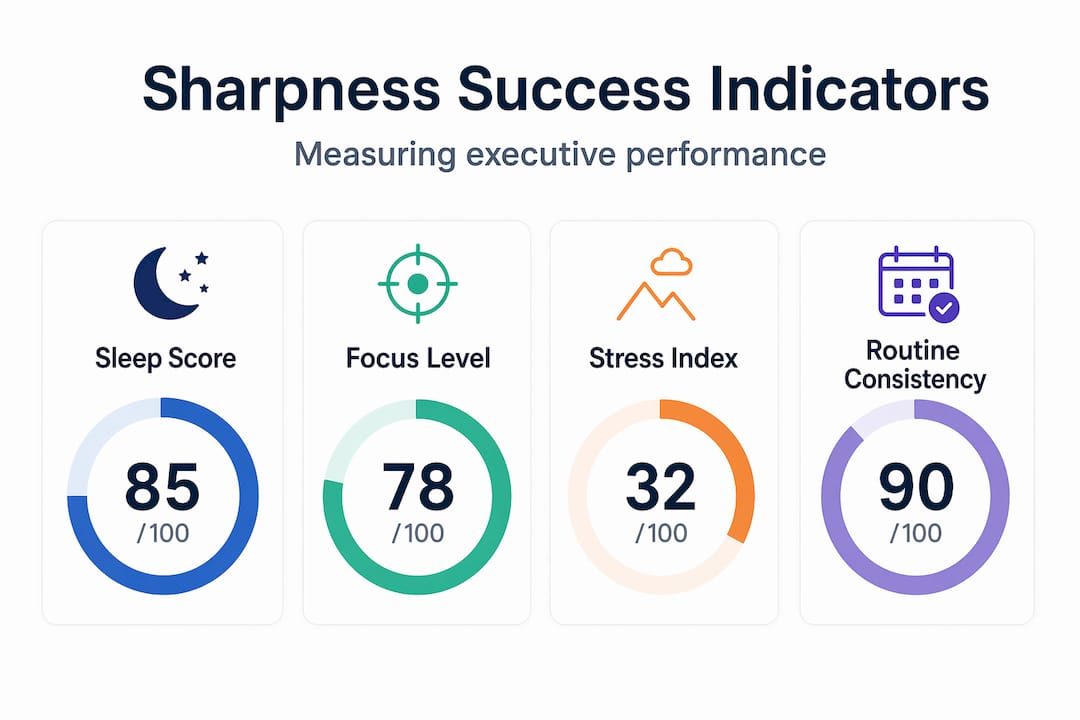
A neuroscientist-backed perspective confirms that small consistent practices outperform high-effort grinding, and that protected unstructured time is itself a cognitive performance asset. Schedule it explicitly or it will not happen.
Common execution pitfalls and adjustments:
| Pitfall | Impact | Fix |
|---|---|---|
| Inconsistent sleep schedule | Degrades memory consolidation | Lock wake time; vary bedtime within 30-minute window only |
| Multitasking during meetings | Reduces encoding by 30 to 40% | Phone out, single-thread attention |
| Exercise too late in the day | Disrupts sleep onset | Cut off vigorous cardio by 6 p.m. |
| No recovery time scheduled | Chronic cognitive fatigue | Block 20-minute unstructured breaks daily |
A four-step optimization cycle keeps the routine sharp over months:
- Review your three performance indicators every Sunday.
- Identify the weakest pillar from the past week.
- Make one targeted adjustment — not three.
- Hold that adjustment for two weeks before evaluating it.
Pro Tip: Leverage routine consistency and recovery as a discipline, not a mood-dependent choice. The executive who sleeps well on Wednesday but sacrifices Thursday to a late dinner still pays a cognitive debt. Consistency compounds — in both directions.
Why simplicity and consistency trump intensity in mental sharpness routines
With routine execution covered, this perspective challenges conventional wisdom to sharpen your approach.
The executive wellness market sells complexity. Biohacking stacks, polyphasic sleep protocols, nootropic cocktails, cold plunge regimens at 5 a.m. Some of it has merit. Most of it fails because it creates a parallel performance system that is too demanding to maintain alongside a real professional life.
Here is what experience and the research actually support: the men who sustain mental sharpness into their sixties are not doing more. They are protecting fewer things with greater discipline. Reducing cognitive overload and practicing consistently produces more measurable gains than adding layers of new interventions.
Context switching is the biggest unaddressed sharpness killer in executive life. Not age. Not diet. Not supplement gaps. It is the 47 times a day you shift between tasks, tools, and mental modes. Every switch is a tax on working memory. The executive who eliminates half his context switches gains more cognitive capacity than the one who adds a sophisticated morning protocol on top of a fragmented afternoon.
The other conventional trap is confusing effort with effectiveness. Men conditioned to perform through intensity apply the same instinct to cognitive routines: more challenging puzzles, more hours of deliberate practice, more supplements. But the brain does not work like a muscle in that respect. It needs protected recovery as much as it needs challenge. Sleep and mindfulness are not the soft parts of the routine. They are the compounding mechanism that makes the hard parts work. Discover recovery discipline and you will likely find it delivers more return than anything you were planning to add.
Build your routine to be boring to execute. That is when it starts working.
Achieve sustained mental sharpness with VIRIDOS executive formulations
Now that you understand and can implement an evidence-based routine, VIRIDOS membership offers tailored support to elevate and sustain your mental sharpness.
A structured routine is the foundation. What you put into your body on top of that foundation either reinforces it or works against it. VIRIDOS was built specifically for men in demanding roles who want precision, not guesswork. Every formulation is produced in small batches in Sweden, delivered sublingually for superior absorption, and designed around one goal: sustained cognitive vitality and long-term performance longevity.

The VIRIDOS membership gives you access to precision-engineered formulations that complement the routines covered in this article — supporting focus, stress resilience, and the kind of consistent daily performance that separates executives who sustain their edge from those who gradually lose it. This is not a supplement subscription. It is a performance infrastructure built for men who take the long view.
Frequently asked questions
What duration of sleep best supports mental sharpness for executives?
Optimal sleep for cognition falls consistently in the 7 to 8 hour range — both shorter and longer durations are associated with measurably higher cognitive decline risk over time. Fix your schedule around this window before adjusting anything else in your routine.
How often should I exercise to boost memory and focus effectively?
Moderate aerobic exercise several times per week supports memory and focus, and timing your sessions roughly four hours after learning new information amplifies the retention benefit significantly. Consistency across weeks matters more than intensity on any single day.
Can mindfulness really reduce stress and improve my executive function?
Yes — mindfulness-based practices show significant reductions in perceived stress with moderate to large effect sizes, and lower stress directly preserves attentional capacity and working memory in high-demand environments. Even two to five minutes daily produces measurable results over four to six weeks.
What strategies can help maintain focus during busy executive meetings?
One-at-a-time task focus combined with active listening and deliberate paraphrasing keeps you encoding information in real time instead of passively hearing it. Choosing quieter meeting environments and keeping devices out of reach reduces the ambient cognitive drain that fragments retention.
How can I measure if my mental sharpness routine is effective?
Track three weekly indicators — sleep quality, sustained focus duration, and perceived stress — and look for trends over two to four weeks rather than day-to-day variation. Consistent tracking of these metrics allows you to isolate which routine components are delivering returns and which need adjustment.