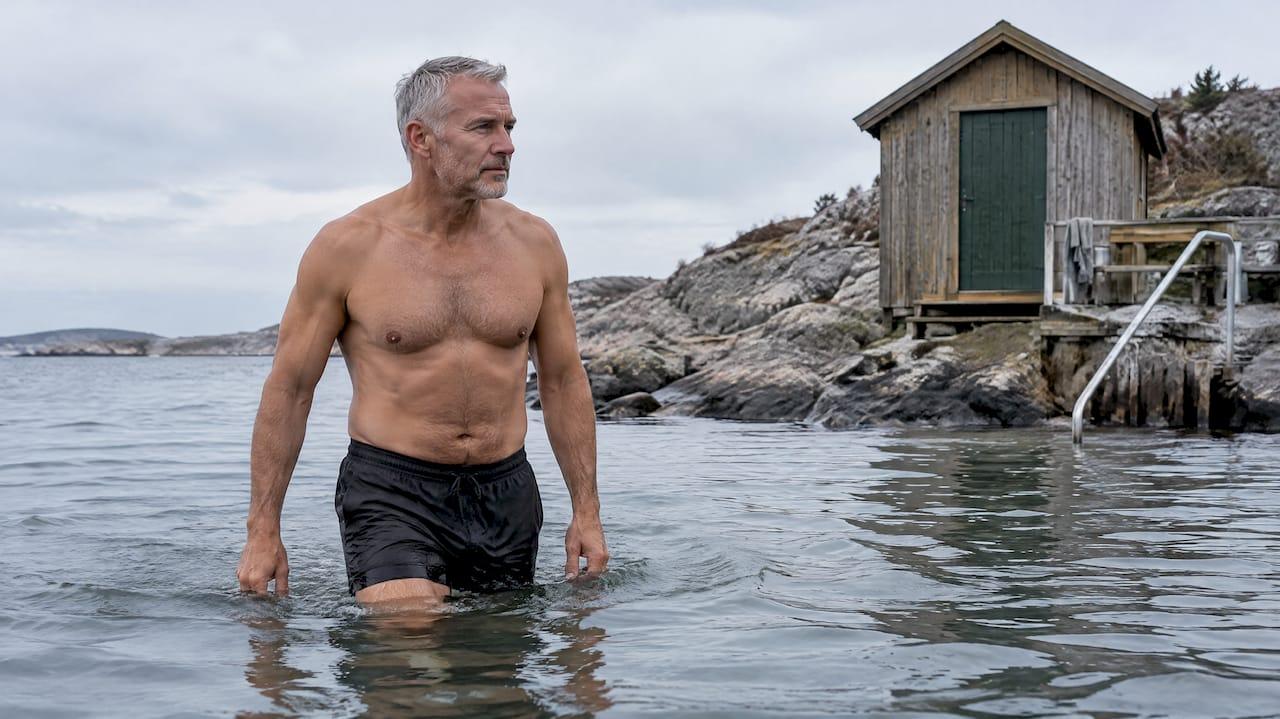
Cold exposure has a strong reputation among disciplined men, but the human evidence does not show that cold showers or ice baths reliably raise testosterone. The better-supported benefits are alertness, a sense of discipline and, for some athletes, recovery. If your goal is sustained drive and clarity over decades, the useful move is to separate what cold does for your nervous system from what it does for your hormones, and to build a routine on the parts that hold up. Below is what the studies measured, where they fall short, and how to approach morning light, sleep and testing with the same rigor you apply to the rest of your work.
TL;DR
- Cold showers: a 2026 study of 11 male athletes found no significant change in salivary testosterone after four days of 10-minute showers at 17°C.
- Ice baths: a 2025 review found inconsistent hormonal benefits, and after hard training, immersion has been linked to a blunted testosterone response.
- Sunlight: the one small study we found was in infertile men in Iraq and cannot be generalized to healthy executives, but morning light remains a sound anchor for a stable daily rhythm.
- If you suspect low testosterone, the answer is a morning blood test and a clinical assessment, not a cold plunge.
- Cold can still earn a place in a routine for alertness and discipline, as long as you do not expect a hormonal return from it.
Table of Contents
- Why men over 40 ask this question
- What cold showers do to testosterone
- Ice baths and cold plunges: the exercise context
- What about cold weather and winter swimming?
- Does sunlight raise testosterone?
- What cold is actually good for
- The inputs with a stronger case
- If you suspect low testosterone, measure it properly
- Building a routine you can defend
- Where VIRIDOS fits
- Our perspective
- FAQ
- Sources
Why men over 40 ask this question
By your forties and fifties, the demands rarely shrink. Decisions get heavier, sleep gets shorter, and the margin for a flat day narrows. Testosterone is one of the hormones tied to drive, muscle, mood and energy, so it is natural to look for daily habits that support it. Cold exposure fits the profile: it is demanding, measurable in minutes, and it feels like effort. That feeling is exactly why it is easy to credit it with more than the data supports.
The question is worth answering with the actual trials. Most of them are small, many involve young athletes, and the designs differ. Reading them closely tells you what to expect, and what not to.
What cold showers do to testosterone
The most recent controlled look at the topic is a 2026 study of a four-day cold shower protocol. Eleven male athletes took 10-minute showers at 17°C daily for four days. Salivary testosterone, measured within 24 hours, showed no significant change at group level.
Two points matter when you read this. First, the sample was small and specific, with no control condition and no long follow-up, so it says little about months of daily practice or about men in their fifties. Second, it gives you no evidence that this particular routine raises testosterone. The honest conclusion is narrow: a short, moderate cold shower series did not move the number.
That matches the pattern across the literature. A cold shower is a brief stressor. It raises adrenaline and noradrenaline, which is why you feel awake, but alertness is not the same as a change in circulating testosterone.
Ice baths and cold plunges: the exercise context
Most men who use ice baths do so after training, so the relevant question is what immersion does to the hormonal response to exercise. Two studies are informative.
In a randomized, counterbalanced study of 11 resistance-trained men, participants did squats and then either sat in 15°C water for 15 minutes or recovered passively. Thirty minutes later, testosterone had risen 9.2% in the passive condition and changed by -0.5% after immersion. At 60 minutes it was 10.4% below baseline after immersion and 1.6% below baseline after passive recovery. In plain terms, the cold water blunted and delayed the normal post-exercise rise.

A 2021 study of 30 young men looked at four sauna sessions with one-minute 10-11°C immersions between them. Testosterone moved from 4.04 to 4.24 ng/ml, a change that was not statistically significant.
A 2025 review of emerging alternative therapies in men's health summarized cold-water immersion as having inconsistent benefits for testosterone and noted that small samples and a lack of long-term follow-up limit what can be concluded.
If you train to build strength, the practical reading is simple: the hormonal signal after a hard session is part of the stimulus. Our own piece on training and testosterone covers what moves that needle. Cold immersion immediately afterward is a recovery choice, not a hormonal one. For the wider logic of how structured movement supports healing and performance, this overview of exercise and recovery after injury is a good companion.
What about cold weather and winter swimming?
Deliberate cold exposure and living in a cold climate are different things, and the evidence differs too.
A 1995 winter-swimming study followed 11 healthy students and teachers, six of them men, over about 2.5 months of at-least-weekly swims of 2 to 10 minutes in Baltic water between 6.8°C and 2.0°C. It reported no change in LH or FSH, the pituitary hormones that signal the testes. Its abstract does not establish a testosterone increase.
A 2026 Czech study is sometimes cited as proof that cold lifts testosterone. Here is what it actually found: five days of exercise in a cold environment produced no immediate hormone change, but testosterone was 56% above baseline after seven days of recovery. Cortisol, the stress hormone, rose 54% as well. Because cold was combined with training and the result was delayed, it cannot be read as a benefit from passive cold exposure. It is closer to a picture of how the body responds to a hard block of work followed by rest.
For a man in Stockholm or Gothenburg, the winter itself therefore offers no hormonal advantage you can bank on. What winter does offer is a reason to protect light exposure, which is the next topic.
Does sunlight raise testosterone?
The search interest in morning sunlight and testosterone is real, and the evidence is thinner than the interest. One study of 45 infertile men in Iraq reported higher vitamin D and testosterone after 10 minutes of daily sunlight exposure for three months. It is a small study in a specific clinical group in a sunny region. It does not show that a healthy executive in Sweden would see the same.
What you can say with confidence is more modest. Morning light is a widely used anchor for a regular sleep-wake rhythm, and consistent sleep is one of the conditions under which your body keeps its hormonal pattern steady. Treat daylight as part of a stable daily structure, not as a hormonal lever. In a Swedish winter, when daylight is short, planning a walk outdoors in the morning is a reasonable discipline for the same reason.
What cold is actually good for
None of this makes cold worthless. It makes it a different tool.
- Alertness. Cold water triggers a sharp catecholamine response. You feel awake and focused, and that sensation is real even though it is not a testosterone effect.
- Discipline. Doing something uncomfortable on schedule is a form of practice. Many men use it as a daily proof of consistency.
- Recovery preference. Some athletes simply feel better after immersion. If that is true for you, there is no hormonal reason to stop, only a reason to understand the trade-off after strength sessions.
We have looked at the neurochemistry in more detail in our article on cold baths and plasma dopamine. That mechanism concerns motivation and arousal, which is a separate pathway from the androgen axis.
A safety note belongs here. Cold water places a sudden load on the cardiovascular system. If you have heart disease, high blood pressure or any condition your physician monitors, ask your doctor before starting cold immersion, and never immerse alone in open water.
The inputs with a stronger case
If you want to protect testosterone and the energy that goes with it, look at the inputs that have a longer research record and a clearer mechanism:
- Resistance training with progressive load and adequate rest, as covered in our training guide.
- Alcohol discipline. Heavy drinking has measurable effects on the hormonal picture, which we outline in the 48-hour rule for alcohol.
- Hydration and recovery, discussed in hydration and testosterone.
- Eating pattern. If you fast, protect strength and libido with the approach in our intermittent fasting guide.
- Bone and muscle health, where testosterone plays a long-term role, summarized in this look at testosterone and bone density.
- Sleep and light, the foundation under all of the above.
For a broader frame, see our self-optimization guide for resilience and performance.
If you suspect low testosterone, measure it properly
A cold plunge cannot tell you what your level is. A blood test can. A regional Swedish clinical guideline from Region Uppsala says the assessment of suspected male hypogonadism should combine symptoms with a fasting morning testosterone sample. The sample should be taken between 07:00 and 10:00 after a normal night's rest. A result below 12 nmol/L is repeated, and the guideline advises confirmation with a new sample and further tests when indicated.
Interpretation also needs context. Region Norrbotten's guidance explains that low testosterone with high LH points toward a primary cause in the testes, while low testosterone with low LH points toward a secondary cause upstream. That distinction is why a single number should not be self-diagnosed. Persistent fatigue, low libido or loss of strength is a reason to see your physician, who can order the right tests and read them in context. Our guide to free testosterone explains the related markers you may see on a lab report.
Building a routine you can defend
A sensible weekly structure for a man with a demanding schedule might look like this:
- Morning: daylight within the first hour awake, even ten minutes on a walk.
- Training: two to four strength sessions, with the recovery that lets you repeat them.
- Cold: a short cold shower for alertness if you enjoy it, kept away from the minutes immediately after strength work if muscle adaptation is your priority.
- Evening: alcohol limited, consistent bedtime, screens down.
- Annually: a morning blood panel with your physician if you have symptoms or simply want a baseline.
The principle is to keep a record of what you do and how you feel. Without a log, you cannot tell whether a habit contributes or merely feels like discipline.
Where VIRIDOS fits
VIRIDOS is a plant-derived performance supplement for men, formulated as a precision oral spray with proprietary extraction methods to deliver phytoandrogen-related compounds aimed at drive, clarity, strength and executive performance. It is produced in small batches in Sweden and offered through a membership with limited cohort access, after an individual application is approved.
There are two plans. Member is $99 per month and Professional is $299 per month, with details on the pricing page. You can read how access works on the membership page.
It is a daily-practice product for men who already keep the fundamentals in order: training, sleep, light, measured health markers. It sits beside those habits, not in place of them, and it makes no promise of a specific result.
Our perspective
Men who carry real responsibility tend to look for a single lever. Cold, light, a supplement, a protocol. The research on cold exposure is a useful reminder that the lever rarely works alone, and that the honest answer is often "it depends on what you measure."
We built VIRIDOS around that principle. Our approach rests on small-batch Swedish production, careful handling of evidence and a sublingual delivery philosophy: a precision spray designed to deliver plant-derived phytoandrogen-related compounds in a form you can take consistently. Consistency is the point. A discipline you can sustain for years does more for performance longevity than a dramatic habit you abandon in a month.
That is also why membership is by application and limited by cohort. We want men who treat vitality as a long-term responsibility, who keep their training, sleep and bloodwork in order, and who want a premium, precise addition to that structure. Cold showers can stay in your morning if they sharpen you. Our formulation is there for the part of the picture that a bucket of ice does not address.
Joakim
FAQ
Do cold showers increase testosterone?
The best recent test found no significant change. In a 2026 study, 11 male athletes took 10-minute 17°C showers for four days, and salivary testosterone did not shift at group level. The study was small and short, so it cannot speak to longer routines, but it gives no support for expecting a boost.
Does an ice bath increase testosterone after training?
Not in the trial that measured it directly. After squats, 15 minutes of 15°C immersion was followed by a flat 30-minute testosterone value, while passive recovery showed a 9.2% rise. A 2025 review also described the hormonal benefits of cold-water immersion as inconsistent.
Does morning sunlight raise testosterone?
The evidence is limited. One small study in infertile men in Iraq reported higher testosterone after three months of 10 minutes of daily sun, which does not transfer directly to healthy men in Sweden. Morning light is still a sound anchor for a regular sleep rhythm.
When should I get my testosterone checked?
If you have persistent symptoms such as low energy, reduced libido or loss of strength, speak with your physician. Swedish regional guidance describes a fasting morning sample taken between 07:00 and 10:00, repeated when the result is low, with further tests where indicated.
Sources
- A Four-Day Cold Shower Protocol Does Not Increase Salivary Testosterone (2026)
- Cold-water immersion blunts and delays increases in testosterone after exercise (2019)
- Endocrine effects of repeated hot thermal stress and cold water immersion in young men (2021)
- A systematic appraisal of emerging alternative therapies in men's health (2025)
- Acute and chronic effects of winter swimming on LH, FSH and related hormones
- Increase in testosterone and cortisol one week after repeated cold exposure during exercise (2026)
- Sunlight exposure study in infertile men, Iraq (2019)
- Handläggning av misstänkt manlig hypogonadism, Region Uppsala (2024)
- Hypogonadism hos män, Region Norrbotten
- The Role of Exercise in Recovery After Injury
- Testosterone and Bone Density in Men: What the Research Shows