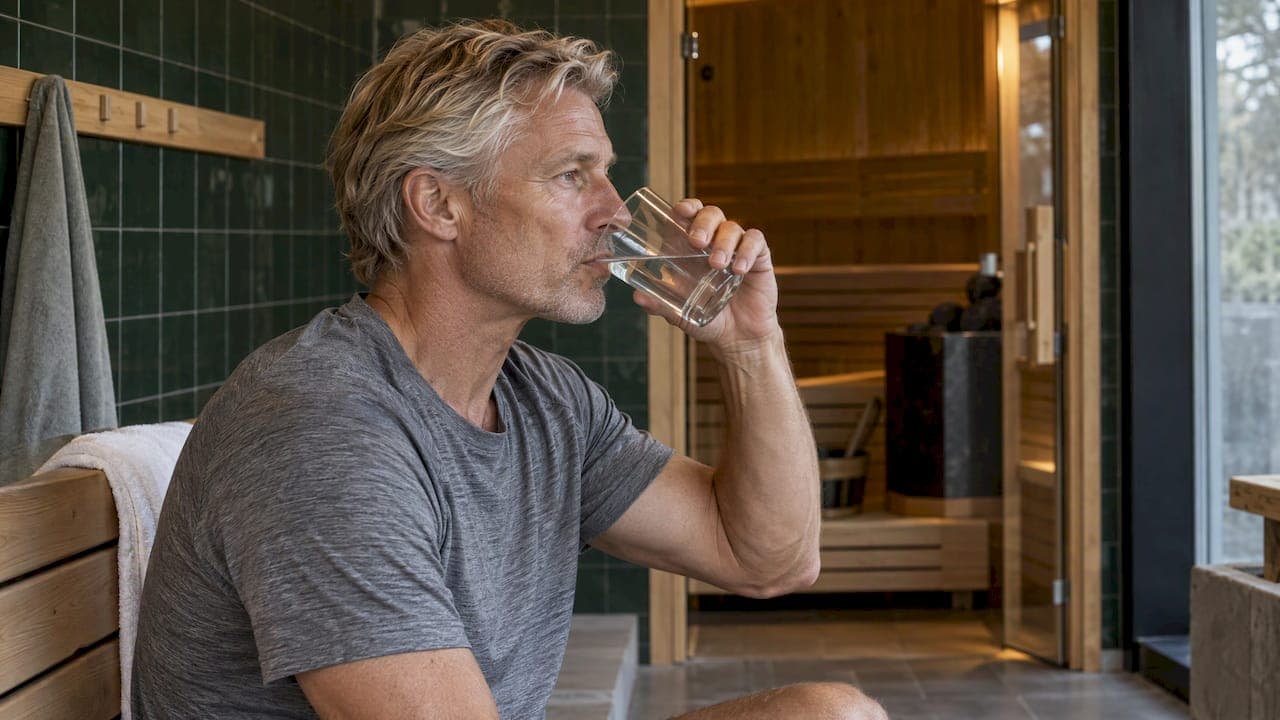
Hydration does not act as a testosterone lever in healthy men who drink to thirst. The research points to something narrower: significant fluid deficits, especially combined with hard training, heat or aggressive calorie restriction, can shift the hormonal environment around a session. The practical aim is to stay well hydrated so that nothing in your daily routine adds avoidable physiological stress. This article sets out what studies found, what they did not find, and how a disciplined man with a full calendar can apply it.
TL;DR
- A meta-analysis found testosterone was lower when dehydration came with calorie restriction, but not significantly changed when dehydration was studied alone.
- In resistance-trained men, a fluid deficit of roughly 2.5 to 5.0% of body mass raised cortisol and blunted the testosterone response to a lifting session.
- The official Swedish adequate intake for moderately active adult men is 2.5 liters of fluid per day, from food and drink combined.
- Electrolytes, mainly sodium, matter for fluid balance during intense or hot-weather exercise. They are not a testosterone strategy.
- Persistent tiredness or weakness belongs in a conversation with a physician, not in a hydration experiment.
Table of Contents
- What the research actually shows
- Why the surrounding conditions matter more than the glass
- Hydration, cortisol and recovery
- Dehydration and erectile function
- Electrolytes: fluid balance, not a hormone shortcut
- How much should you drink?
- Signs you are running low
- A disciplined daily hydration protocol
- Our perspective
- Built for men who keep standards
- FAQ
- Sources
What the research actually shows
The most useful starting point is a systematic review and meta-analysis on acute hypohydration and hormonal and glycemic indicators. Its finding on testosterone is specific. Levels were significantly lower when hypohydration accompanied caloric restriction. In studies that examined hypohydration alone, testosterone was not significantly changed.

That distinction matters. A great deal of online content treats dehydration as a direct switch on testosterone production. The pooled evidence does not support that reading. What it supports is that fluid loss rarely travels alone: it arrives with a hard workout, a sauna, a long flight, a cut in food intake, or a night of alcohol. The review itself notes that exercise, heat exposure and caloric restriction can independently affect hormone levels, so their effects have to be separated from fluid loss.
Training studies: the exercise context
A controlled study in resistance-trained men, Judelson and colleagues in 2008, examined hydration state and the hormonal response to lifting. When participants were hypohydrated by about 2.5 to 5.0% of body mass, cortisol and norepinephrine rose, and the testosterone response to resistance exercise was attenuated. This is a finding about the post-exercise hormonal milieu. It describes an acute response in trained men under deliberate dehydration, not a lasting change in baseline levels.
For reference, 2.5 to 5.0% of body mass in an 85 kg man is roughly 2 to 4 kg of fluid. That is far more than the mild shortfall most men carry through a busy workday, and it is a deficit you reach through heavy sweat loss or deliberate fluid restriction.
Athletes under extreme conditions
A study of elite wrestlers, published in the American Journal of the Medical Sciences, reported an inverse association between plasma osmolarity and total testosterone. Plasma osmolarity is a marker of dehydration. The authors' context was rapid, severe weight loss in a specific athletic population. It is a signal worth noting, but wrestlers cutting weight are not executives drinking too little coffee-adjacent water between meetings.
The opposite direction: overhydration in illness
Research in hemodialysis patients found that overhydration correlated with lower serum total testosterone and DHEA and higher estradiol. This is a clinical population with impaired fluid regulation, so it should not be extended to healthy men. It does illustrate a useful principle: the goal is balance, not maximum intake. Drinking far beyond thirst does not improve hormonal health.
Why the surrounding conditions matter more than the glass
If fluid status interacts with other stressors, the sensible move is to manage the stressors together. Three deserve attention.
Training load. Hard sessions in a fluid deficit are where the evidence is clearest. If you lift or run early, before coffee and before water, you start in the zone the studies describe. Our guide to training and testosterone covers how volume, intensity and recovery interact.
Caloric restriction. The meta-analysis result on dehydration plus restricted intake is the one to take seriously. Men who combine fasting windows with heavy training and little fluid stack stressors. If you use time-restricted eating, read our evidence review on keeping strength and libido while intermittent fasting before you tighten the protocol further.
Alcohol. Alcohol is a diuretic and a recovery disruptor, and it often sits behind a morning when you feel flat and thirsty. We examine the pattern in the 48-hour rule for alcohol and testosterone.
Hydration also touches energy metabolism more broadly. If you want the wider physiology, this overview of hydration and fat metabolism explains how fluid status relates to how the body uses fuel, which is relevant for men training while managing body composition.
Hydration, cortisol and recovery
The Judelson data link a fluid deficit with higher cortisol during exercise. Cortisol is not a villain; it is part of a normal stress response. The issue for a man carrying professional pressure is cumulative load. Poor sleep, long hours, hard training, alcohol and underhydration each add a little, and the total shapes how you feel and recover.
This is why we treat hydration as part of a recovery framework rather than a standalone fix. Our cortisol balance framework for executives places fluid intake alongside sleep timing, training dose and workload planning.
Dehydration and erectile function
Search results often link dehydration with sexual performance. The careful version is this. According to Medical News Today, dehydration may temporarily affect erectile function by reducing blood volume and constricting blood vessels, which can impair blood flow. The same source notes it is not typically the sole contributor to long-term erectile dysfunction.
In practice: a day of heavy sweating, travel and little water can plausibly make you feel off in several ways at once. If changes in erections, drive or energy persist after you are well hydrated and rested, book an appointment with your physician. Persistent changes deserve a proper evaluation, including blood work, rather than a larger water bottle.
If you do get tested, understand the numbers before you interpret them. Start with our guides to free testosterone and the age-by-age testosterone chart. Hydration status and the time of day can influence a single reading, so ask your clinic about sampling conditions.
Electrolytes: fluid balance, not a hormone shortcut
The second query men type is whether electrolytes affect testosterone. We found no solid evidence that supplemental sodium or potassium raises testosterone. What electrolytes do is help the body hold and distribute water. The Swedish Food Agency (Livsmedelsverket) advises that during exercise you should drink enough before, during and after, and that in intense activity, hot and humid conditions or at altitude, you should take in salt (sodium), and possibly glucose, along with fluid.
That gives a clear working rule:
- For an ordinary office day and a moderate session, water and normal meals cover your needs.
- For long, hard or hot sessions, add sodium to what you drink or eat.
- Treat social-media salt tricks and exotic mineral mixes with suspicion. If a claim promises hormonal or sexual results from salt, it has left the evidence behind.
Micronutrients such as zinc do have a defined place in the androgen conversation, but that belongs in a tested, time-bound approach. See our protocols on zinc and androgens and micronutrients for androgen health, both built around testing first and retesting after 8 to 12 weeks.
How much should you drink?
There is no universal figure, and a gallon a day is not a performance standard. The Swedish Food Agency gives an adequate daily water intake of 2.5 liters for adult men who are moderately active in normal temperatures. That figure counts water from all food and drink, not only what you pour from a bottle. Needs vary with age, body size, metabolism, health, activity, diet and climate, and healthy people with normal fluid regulation generally drink when thirsty.
Three adjustments are worth making:
- Heat and sweat. Saunas, summer travel and training raise requirements. Replace what you lose.
- Diet. Meals rich in vegetables, soups and fruit supply a meaningful share of fluid.
- Alcohol and caffeine. Account for them in the evening and the following morning rather than pretending they are neutral.
Signs you are running low
Livsmedelsverket lists the effects of dehydration as including headache, fatigue, dizziness, irritability, reduced appetite, impaired concentration, low blood pressure, palpitations, concentrated urine and dry mucous membranes. For a man whose work is decisions, impaired concentration and irritability are the ones to watch. A simple check is urine color: dark and scant suggests you need fluid.
Note also what the Swedish health service says about more serious situations. In the context of stomach illness, 1177 advises contacting a health center or calling 1177 when you have tiredness or weakness together with signs such as dry mouth, strong thirst, little urination and dark urine, or when vomiting lasts more than a day. Seek urgent care for marked weakness, bloody diarrhea, high fever with chills or severe abdominal pain. These are medical situations, not performance questions.
A disciplined daily hydration protocol
Treat this like any other standard you keep: simple, repeatable, measurable.
- Start the day with fluid. Drink a glass of water before coffee, especially before an early session.
- Anchor intake to routines. One glass at each meeting block, one with each meal. You do not need to track milliliters.
- Pre-load before training. Arrive at the session without a deficit, because the studies describe harm from starting depleted, not from a normal day.
- Replace sweat losses. After heavy sessions, drink and eat salt-containing food. In long or hot efforts, add sodium as the Swedish guidance describes.
- Respect the evening. If you drink alcohol, add water alongside it and plan lighter training the next morning.
- Watch the pattern, not the day. Persistent fatigue, low drive or poor concentration despite good hydration, sleep and nutrition calls for a physician and, where appropriate, blood tests.
- Avoid extremes. More is not better. Forcing fluid far beyond thirst offers no hormonal advantage.
Our perspective
Hydration is the least glamorous variable in performance, and that is exactly why disciplined men skip it. Our reading of the evidence is plain: water will not raise your testosterone, but a fluid deficit stacked on top of hard training, heat, restricted eating or alcohol adds stress you do not need.
At VIRIDOS we build around the same principle: remove avoidable noise, then support the system with precision. Our plant-derived formulation is delivered as a sublingual spray, designed with phytoandrogen-related compounds and produced in small batches in Sweden. It is made for men who already keep the fundamentals in order: sleep, training, nutrition, hydration and regular testing.
That sequence matters to us. A premium formulation works best on a foundation of consistent habits. We would rather you master the basics and then add a quality, carefully produced product than look for a shortcut that does not exist. Men still in the arena sustain their edge through standards, and hydration is one of the simplest to keep.
Joakim
Built for men who keep standards
If you already manage hydration, training and sleep with discipline, VIRIDOS is designed to support the next layer. Membership is by application, with small-batch Swedish production and limited cohort access. Plans are the Member plan at $99 per month and the Professional plan at $299 per month, as published on our pricing page. You can learn how we produce each batch on our Swedish production page, or read more about how membership works.

For ongoing reading on performance longevity, visit the VIRIDOS Performance Journal. Our broader primer on testosterone health and vitality is a good place to begin.
FAQ
Can water affect testosterone?
In healthy men, drinking more water has not been shown to raise testosterone. A meta-analysis found no significant change in testosterone from hypohydration alone, though levels were lower when dehydration came with calorie restriction. Staying hydrated simply avoids adding stress during training and recovery.
Can dehydration cause erectile dysfunction?
Dehydration may temporarily affect erectile function by lowering blood volume and narrowing blood vessels, but it is not typically the only cause of long-term problems. If changes persist while you are well hydrated, speak with your physician. Many factors can contribute, and a proper evaluation is the right step.
Do electrolytes affect testosterone?
There is no solid evidence that electrolytes raise testosterone. They support fluid balance, which matters most in intense exercise, heat or humidity, where Swedish guidance recommends taking in sodium along with fluid. For a normal day, food and water usually provide what you need.
How much water should a man drink per day?
The Swedish Food Agency gives an adequate intake of 2.5 liters per day for moderately active adult men in normal temperatures, counting all food and drink. Your needs rise with heat, sweat and activity. Healthy adults generally do well by drinking when thirsty and replacing exercise losses.
Sources
- The Effect of Acute Hypohydration on Indicators of Glycemic Regulation, Appetite, Metabolism and Stress (meta-analysis, 2020)
- Effect of hydration state on resistance exercise-induced endocrine markers (Judelson, 2008)
- Associations Among Dehydration, Testosterone and Stress (American Journal of the Medical Sciences)
- The relationship between hydration status, male sexual function and hormones (Hassan et al., 2018)
- Dehydration and erectile dysfunction: Does water help? (Medical News Today)
- Vatten (Livsmedelsverket)
- Turistdiarré (1177)
- Does Hydration Affect Fat Metabolism? The Science Explained