TL;DR:
- High-performers achieve sustained output through structured recovery, which creates a durable foundation for elite performance. The Fortifyya Method emphasizes restoring baseline capacity before building resilience, preventing long-term breakdowns. Consistent habits like intentional attire and stress regulation reinforce this recovery-driven approach for lasting vitality and high-level achievement.
Most high-performers believe relentless drive is the secret to sustained output. Work harder, train more, push through fatigue. But the executives and founders who maintain their edge over decades know something different: the foundation of every elite performance standard is structured recovery first. This is the core principle behind Fortifyya, a structural human performance system built specifically for men operating at the highest levels of professional and physical demand. What follows is a practical breakdown of the philosophy, the method, and how you can apply it to protect and extend your performance for the long run.
Table of Contents
- Understanding 'born from recovery built for performance'
- The three phases of the Fortifyya Method
- Why executives lose performance: Early breakdowns and missed signals
- Applying the philosophy: Building durable habits and attire for daily performance
- What most leaders miss about performance longevity
- Integrate recovery-driven performance with proven solutions
- Frequently asked questions
Key Takeaways
| Point | Details |
|---|---|
| Start with recovery | Sustainable high performance begins by restoring structure and recovery capacity, not just more effort. |
| Follow the three phases | Reset, Fortify, and Sustain form a repeatable method for boosting and maintaining executive performance. |
| Spot early warning signs | Subtle drops in sleep, focus, or resilience are signals to pivot strategy before a breakdown derails progress. |
| Prioritize durable habits | Small, daily rituals—movement, mindful apparel, boundaries—add up to real, lasting vitality for ambitious men. |
Understanding 'born from recovery built for performance'
Most ambitious men hear "recovery" and immediately picture rest days, ice baths, or passive downtime. That framing misses the point entirely. Recovery, in the Fortifyya context, is not what you do after performance. It is what makes performance structurally possible. The phrase "born from recovery built for performance" is not a slogan. It is an operating principle for men who have run their systems too hard for too long and discovered the hard way that output without restoration is just debt accumulation.
"Foundation before ambition" is how the philosophy works in practice. You do not optimize what you haven't first restored.
The origin of this philosophy matters. Fortifyya was shaped by elite environments including Special Operations and military aircrew, drawing directly from the founder's personal recovery experience after losing his own performance standard. That context is critical. This is not a theory developed in a lab. It is a system built from the experience of men who had to rebuild functional capacity from the ground up, under pressure, without the luxury of indefinite downtime.
For executives and founders, the parallel is obvious. You have been running high-output schedules for years. The demands on your attention, your body, and your decision-making capacity are relentless. Most performance systems ask you to add more: more structure, more training, more optimization. Fortifyya asks a different question first: what needs to be restored before you build further?
This stands in direct contrast to what most executive wellness programs promote. The typical approach piles output metrics on top of a system already under strain. Traveling six days a week while tracking HRV and pushing vo2 max benchmarks without addressing underlying structural deficiencies is like building a second floor on a cracked foundation. Understanding this inversion is where sustainable performance actually begins. For broader context on how this fits into a longevity lifestyle insights approach, the recovery-first model consistently outperforms the push-through model over a five to ten year window.
The three phases of the Fortifyya Method
Once the philosophy clicks, the practical architecture becomes straightforward. The Fortifyya Method applies three phases: Reset, Fortify, and Sustain. Each phase has a distinct purpose, a specific set of tools, and clear indicators for when it applies to your current state.
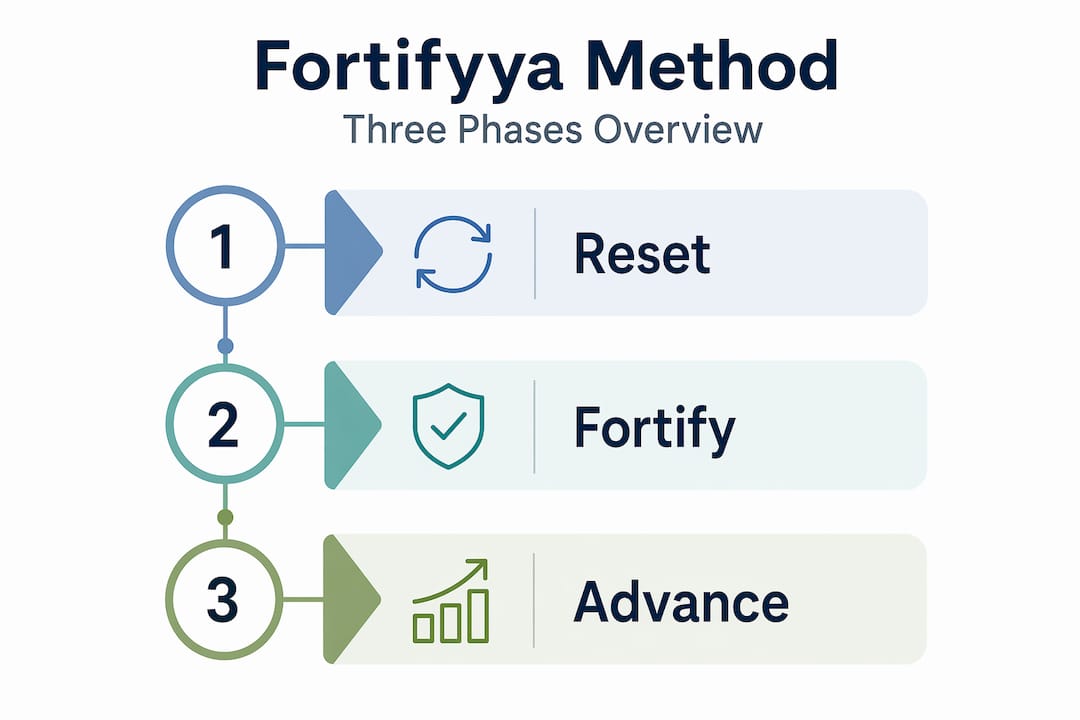
Phase breakdown:
| Phase | Primary goal | Practical examples |
|---|---|---|
| Reset | Restore structural function and baseline capacity | Breathwork protocols, corrective movement, sleep hygiene, nervous system regulation |
| Fortify | Build strength, resilience, and stress tolerance | Progressive load training, structured nutrition, stress exposure with recovery |
| Sustain | Maintain readiness and long-term recovery capacity | Performance habits, travel protocols, recovery maintenance during peak work periods |
Most executives live permanently in Fortify mode and wonder why they keep plateauing or breaking down. The Reset phase is not a sign of weakness. It is a precision tool for men whose systems have accumulated deficits they are no longer even registering consciously.
Here is how to recognize which phase applies to you right now:
- Reset signals: Sleep quality degraded for more than three weeks, baseline mood consistently lower than normal, minor physical complaints that don't resolve, reactivity increasing in professional situations.
- Fortify signals: Energy stable, sleep consistent, mood neutral to positive, able to absorb new training or work load without disproportionate fatigue.
- Sustain signals: Performing well across all key domains, goal is to protect capacity during high-demand cycles like major business launches or travel-heavy periods.
Pro Tip: Most executives try to optimize every metric simultaneously, tracking sleep, strength, VO2, stress markers, and cognitive output all at once. That approach creates noise, not clarity. Identify your current phase first, then focus exclusively on the inputs that matter for that phase. Applying holistic frameworks for vitality works best when the phase is clear rather than when you are guessing at it.
Understanding when to shift phases is equally important. You move from Reset to Fortify when baseline functions, sleep quality, breathing mechanics, and mood stability have been restored for at least two consecutive weeks. You shift to Sustain when you have achieved a performance standard you want to protect during demanding external periods. This phase awareness is one area where modern longevity approaches diverge from traditional fitness thinking. Research from practitioners like Dr. Howard Luks reinforces why long-term balance strategies prioritize structural load management over continuous intensity escalation.
Why executives lose performance: Early breakdowns and missed signals
Performance loss in high-achieving men rarely arrives as a single dramatic event. It is incremental, quiet, and almost always reversible if caught early. The problem is that the professional culture most executives operate in actively punishes acknowledging these signals. Fatigue becomes a badge. Sleep disruption becomes a war story. Mood variability gets attributed to external pressures rather than internal depletion.
Here are the early warning signs most men at this level routinely ignore:
- Sleep quality drops without an obvious cause, and duration stays the same but restoration doesn't.
- Recovery speed slows, meaning minor workouts or long travel days take noticeably longer to recover from.
- Stress tolerance decreases, showing up as lower patience thresholds, faster emotional reactivity, or poorer decision quality in the late afternoon.
- Motivation toward previously engaging work declines, not due to boredom but because the baseline fuel is depleted.
- Libido and physical drive drop without lifestyle changes to explain it.
Performance degradation in executives is often subtle and treatable through engineered recovery processes, yet most men seek solutions only after a significant breakdown. The typical fixes don't address the structural issue. A weekend retreat, an extra rest day, or a new supplement protocol addresses the surface. Structural breakdowns require structural restoration.
Fortifyya's target audience reflects this precisely. It is designed for high-performers under pressure, including executives, professionals, and law enforcement, with a focus on identifying and reversing structural breakdowns before they become performance deficits. This preventive orientation is the key difference. You are not waiting to get sick before you act on health. You are building the infrastructure that prevents the breakdown from occurring at scale.
Pro Tip: The most consistently high-performing leaders we observe act on small internal signals well before they become performance problems. They treat a week of poor sleep as diagnostic data, not an inconvenience to push through. This early-action orientation is what separates men who perform well at 60 from men who peaked at 45. Explore optimization tips for executives for specific protocols that support this proactive orientation, and consider connecting them to broader longevity strategies for a complete picture. Building this awareness is also central to how men optimize performance for lasting vitality across the 40 to 65 age range, when the cost of ignoring signals becomes significantly higher.
The sustainable executive training research also supports this: training load that exceeds recovery capacity does not create fitness. It creates fragility. The same applies to cognitive and professional performance. Sustained high output without structured recovery creates a system that is performing but breaking down underneath.
Applying the philosophy: Building durable habits and attire for daily performance
Understanding the philosophy is one thing. Living it in a schedule that includes board meetings, international travel, family demands, and strategic responsibilities requires a daily architecture. Here is what recovery-built performance looks like as a practical operating system.

Reactive fitness vs. proactive recovery-built strategy:
| Reactive fitness approach | Recovery-built performance strategy |
|---|---|
| Train hard, recover when forced | Structured recovery planned before demand |
| Optimize metrics without phase awareness | Phase-specific inputs based on current state |
| Push through fatigue signals | Act on early signals before breakdown |
| Add more habits to fix performance | Remove friction from foundational habits first |
| Performance measured by output only | Performance measured by output and recovery capacity |
The five foundational habits that carry this philosophy into daily life:
- Structured morning movement that prioritizes breath mechanics and structural activation before intensity. Ten to fifteen minutes before email or meetings.
- Sleep as a non-negotiable professional asset, not a flexible variable. Protect the first sleep cycle with a consistent wind-down protocol regardless of time zone.
- Intentional attire as a readiness signal. What you wear affects how you carry yourself, how others respond to you, and how you mentally frame the day ahead. Choosing clothing with precision reflects and reinforces executive identity.
- Breath-led stress regulation for two to three minutes before high-stakes meetings or decision-heavy blocks. This directly activates the parasympathetic nervous system and reduces cortisol-driven reactivity.
- Digital boundaries after 9 PM to protect the neurological environment for quality sleep and cognitive recovery.
The attire point is worth expanding. Discipline in how you present yourself physically is not superficial. For high-performing men, the act of choosing structured, well-made clothing is a daily commitment ritual. It sets a standard. It signals readiness to yourself before signaling it to anyone else. This is why the intersection of performance apparel and executive identity is not a lifestyle luxury. It is part of how longevity strategy for executives integrates into every layer of how you operate. When your clothing reflects precision and intentionality, it reinforces the same qualities in your decisions and your energy management throughout the day.
The mindset reframe that ties all five habits together: focus on process consistency over outcome optimization. You cannot control every performance output. You can control whether you showed up to your recovery protocols with the same discipline you apply to your business commitments. That consistency, repeated over months, is what builds a performance standard that holds at 55 the same way it did at 40.
What most leaders miss about performance longevity
Here is the uncomfortable truth most performance content avoids: drive is overrated as a sustainable mechanism. The executives who operate at the highest level for the longest periods are not the most driven men in the room. They are the most structurally sound. They have built recovery architecture that lets them sustain demand without accumulating deficits.
The mistake high-achievers make most consistently is treating recovery as a reward for performance rather than a prerequisite for it. You earn the rest day after a hard week. You deserve the vacation after the deal closes. This logic feels right in a culture that glorifies output. It is structurally incorrect. When recovery is conditional, you are always running behind your own capacity demands. The deficit compounds quietly until something forces a reset you didn't choose.
Fortifyya's emphasis on proactive structural restoration over reactive fitness is the direct inversion of this pattern. You do not fortify what is broken. You restore it first, then build on stable ground. This is not a soft philosophy. It is the approach used in Special Operations environments where performance failure has immediate and serious consequences.
The deeper reframe for ambitious men is this: your recovery capacity is a competitive asset, not a personal indulgence. The man who can absorb high demand, recover faster, and re-enter peak function more reliably than his peers has a structural edge that compounds over time. Protecting that edge through deliberate recovery investment is one of the highest-leverage activities available to you. It directly connects to how men optimize performance longevity for sustained peak output across decades rather than quarters.
Stop waiting for the breakdown to start the rebuild. The most sophisticated operators act when the system is still functional, not when it is failing.
Integrate recovery-driven performance with proven solutions
The philosophy laid out here is not theoretical. It is actionable right now, today, with the right tools and systems supporting each phase of your performance cycle.
At VIRIDOS, we build for men who take their performance architecture seriously. Every piece we create reflects the same precision that Fortifyya applies to structural restoration: deliberate, purposeful, and built for long-term function over short-term appearance. Our premium Swedish performance apparel is designed to integrate into a disciplined daily system, from morning movement through high-stakes professional environments. When your recovery-built performance philosophy extends to every layer of how you show up, including what you wear, the compounding effect on your focus, presence, and discipline is real. Explore our collection at VIRIDOS and invest in the daily signals that reinforce the standard you hold.
Frequently asked questions
What does 'born from recovery built for performance' actually mean?
It means prioritizing structured recovery as the foundation for sustainable output. Rather than chasing performance first, you restore structural function, then build on that stable base for lasting results.
How is the Fortifyya Method different from traditional fitness programs?
It begins with structural restoration rather than high-intensity training, using three sequential phases tailored to where your readiness actually sits, not where you want it to be.
Are there proven metrics for the Fortifyya approach?
No quantified benchmarks are published. The system draws from elite operational training environments rather than controlled empirical studies, making it principle-driven rather than data-benchmarked.
How can clothing and apparel support high performance?
Choosing intentionally designed, well-structured attire reinforces daily readiness cues, supports self-discipline, and signals the same precision you apply to your performance systems, starting before you walk out the door.