
TL;DR:
- High-performance teams depend on psychological safety, shared purpose, mutual accountability, complementary skills, and adaptive coordination. Leaders influence team success most through daily routines, effective coaching, and maintaining their own resilience to foster sustained performance. Regular practices like standups, post-mortems, and explicit goal alignment accelerate trust, decision speed, and learning within these teams.
A high-performance team is a group with specific roles, complementary skills, and a shared commitment to a common purpose that consistently outperforms expectations given its composition. For senior leaders, that definition carries immediate operational weight: it means results that exceed what talent alone predicts, sustained over time, not just in a single sprint.

The research is unambiguous on why this matters. Google's Project Aristotle identified psychological safety as the single strongest predictor of team effectiveness, outranking individual IQ or technical skill. Patrick Lencioni's Five Dysfunctions of a Team maps the exact failure cascade when trust collapses. Deloitte's work on "informed agility" shows that members of high-performing teams are 2.5 times more likely to report their team can change direction quickly and learn new skills continuously. At Viridos, we work with men who carry exactly this kind of organizational weight, and the pattern is consistent: personal vitality and team system quality rise and fall together.
Four signals you can observe this week:
- Meetings end with named owners and explicit deadlines, not vague consensus.
- Disagreement surfaces openly before decisions close, not in hallway conversations afterward.
- Team members cover for each other under pressure without being asked.
- Post-mortems happen after failures, and the lessons change behavior the next cycle.
Table of Contents
- What actually qualifies as a high-performance team?
- The five non-negotiables every executive must build
- How do high-performing teams behave day-to-day?
- The leader's playbook: from week one to six months
- Common failure modes and red flags to watch for
- One-page diagnostic: seven questions to ask your team this week
- Key Takeaways
- Why team systems and personal resilience are the same discipline
- Primary sources and further reading
What actually qualifies as a high-performance team?
Not every busy group is a team. The distinction matters because leaders waste significant coaching energy on working groups that were never designed for interdependence.
A genuine high-performance team is small to mid-sized, formally established, and outcome-interdependent. Every member's output affects every other member's result. A loosely coordinated function where individuals report to the same manager but work parallel tracks is a working group. A cross-functional task force assembled for a single deliverable and then disbanded is a project crew. Neither is a high-performance team, and treating them as one produces frustration, not results.
The practical rules of thumb: the team has a shared goal that no single member can achieve alone; membership is stable enough to build trust (at least several months of consistent composition); and the team has some autonomy over how it works, not just what it delivers. When those three conditions are absent, invest in clarifying structure before investing in culture.
Pro Tip: Off-sites and workshops produce insight, not capability. Capability comes from daily behavioral repetition: short routines, repeated under real conditions, that make trust and coordination habitual. Schedule the reps, not just the retreat.
The five non-negotiables every executive must build
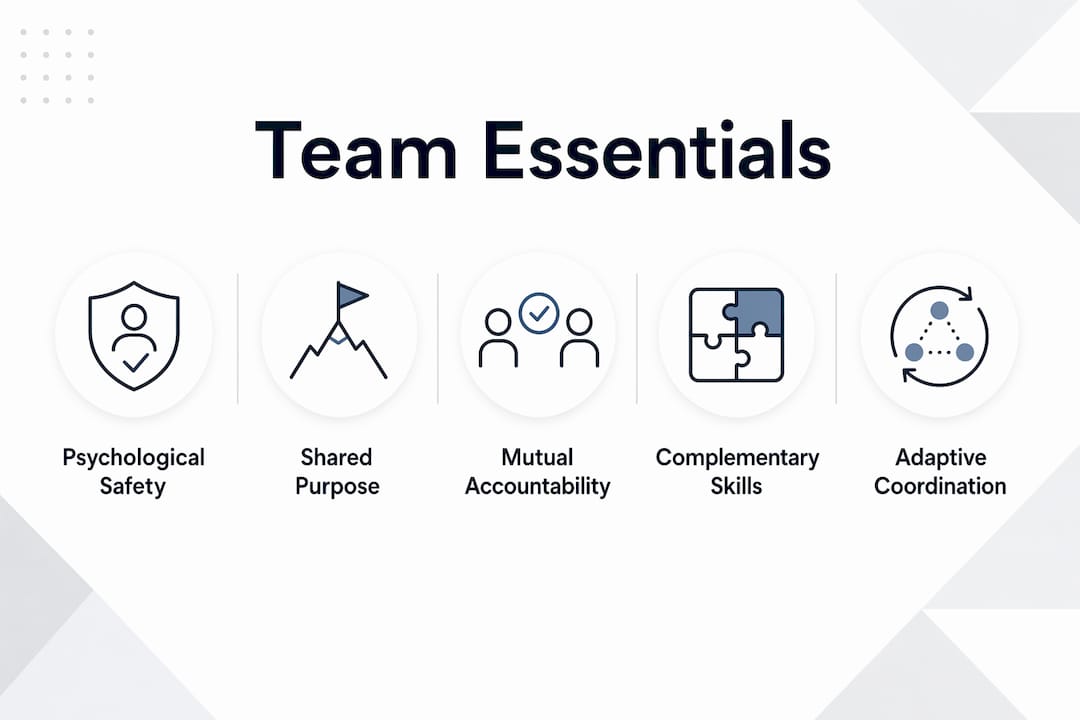
Five major research frameworks converge on the same core ingredients: psychological safety, shared purpose, mutual accountability, complementary skills, and adaptive coordination. Project Aristotle, Hackman, Lencioni, Katzenbach and Smith, and Salas all arrive at overlapping versions of this list. Here is what each means in practice.
1. Psychological safety. Members speak up, challenge assumptions, and admit errors without fear of punishment. The leader's observable action: model vulnerability first. Name your own uncertainty in a meeting before asking others to name theirs.
2. Shared purpose. The team's goal is specific, meaningful, and understood the same way by every member. Watch for misalignment when individuals describe the team's mission in materially different terms during one-on-ones.
3. Mutual accountability. Members hold each other to commitments, not just the manager. The signal: peer feedback happens without prompting, and missed commitments are addressed directly, not routed through the leader.
4. Complementary skills. The team covers analytical, interpersonal, and execution capabilities without redundancy. Hire for the gap, not the clone. McKinsey's analysis identifies trust and decision-making as top drivers of team health, and both depend on cognitive diversity at the table.
5. Adaptive coordination. The team adjusts roles and priorities in real time as conditions shift. This is what Deloitte calls "informed agility," and it is the ingredient most often absent in teams that perform well in stable conditions but fracture under pressure.
Pro Tip: Turn each ingredient into a weekly question, not an annual review item. Ask "Where did we adapt well this week?" in your Friday standup. The answer tells you more than any survey.
How do high-performing teams behave day-to-day?
Everyday behaviors reveal team health faster than any annual engagement survey. The table below maps the operational signals worth tracking, drawn from McKinsey, Gallup, and Deloitte findings.
| Signal | What to measure | Healthy indicator |
|---|---|---|
| Trust | Willingness to admit errors in group settings | Errors surface in team meetings, not just one-on-ones |
| Cadence reliability | % of commitments met on agreed timelines | Consistent delivery without manager follow-up |
| Decision clarity | Time from discussion to named owner | Decisions close in the meeting, not days later |
| Learning rate | Frequency of post-mortems and behavior change | At least one process change per quarter from a debrief |
| Backup behavior | Instances of unprompted peer support | Members cover gaps without being assigned |
| AI/tool adoption | % of members using shared tools effectively | 78% of high-performing teams report effective AI use vs. 54% for others |
Two routines that move these metrics: a 15-minute Monday standup where each member states one priority and one dependency, and a 30-minute Friday post-mortem where the team names one thing that worked and one that did not. Both are low-cost, high-signal. In 90 days, you should see cadence reliability increase and the time-to-decision shorten. If neither moves, the constraint is usually accountability structure, not effort.
The leader's playbook: from week one to six months
Manager quality explains roughly 70% of the variance in team engagement. That figure is the most important number in this guide. It means your coaching cadence, your meeting hygiene, and your hiring decisions carry more weight than any team-building program.
| Phase | Leader actions | Expected signal |
|---|---|---|
| Week 1 | Audit team structure; confirm outcome interdependence; schedule weekly one-on-ones | Clarity on who owns what; first trust conversations |
| 30 days | Establish standup and post-mortem cadence; identify skill gaps; begin peer accountability norms | Cadence reliability above 70%; first peer feedback instances |
| 90 days | Introduce cognitive diversity in hiring or role design; coach on adaptive coordination | Decision speed improves; backup behavior visible |
| 6 months | Measure against baseline; adjust coaching focus; deepen apprenticeship pairings | Sustained results above pre-intervention baseline |
Executable checklist:
- Schedule 30-minute weekly one-on-ones with each direct report. Use the first 10 minutes to listen, not report.
- Run a Monday priority standup and a Friday post-mortem. Keep both under 20 minutes.
- Define one shared team goal that no single member can achieve alone.
- Identify the team's weakest ingredient from the five above and name it explicitly.
- Hire or rotate for the cognitive gap, not the cultural fit.
Gallup's meta-analysis links top-quartile team engagement to measurable gains in productivity and profitability, including an 18% increase in sales in some measures. The ROI on coaching time is real. Budget 3–5 hours per week of leader attention in the first 90 days. External coaching or facilitation, if used, typically runs $2,000–$8,000 per engagement for a small team; internal time is the larger investment. For executive performance tools that complement this cadence, Viridos maintains a practical resource library.
Common failure modes and red flags to watch for
Most teams don't fail dramatically. They drift. The failure modes below are the ones that compound quietly until the damage is structural.
- Pervasive silence in meetings. If the same two people speak and others defer, psychological safety has already eroded. Intervene by explicitly inviting dissent before closing any significant decision.
- Finger-pointing after failures. Blame culture is the fastest way to destroy mutual accountability. Name the system failure, not the person, in every post-mortem.
- Role ambiguity. When two members believe they own the same outcome, neither does. Clarify ownership in writing, not just verbally.
- Manager-only accountability. If commitments only get met when the leader follows up, the team has not internalized mutual accountability. Peer-to-peer check-ins are the remedy.
- No learning from failure. Teams that repeat the same errors quarter after quarter have no functional post-mortem practice. This is Lencioni's inattention to results made operational.
- Assumption of alignment. McKinsey's research identifies the perception gap between what leaders believe the team values and what members actually practice as a primary failure mode. Shared measurement closes it.
One-page diagnostic: seven questions to ask your team this week
Use this table in a 15-minute weekly ritual. Assign each action to an owner and revisit it the following week.
| Action | Owner | Cadence |
|---|---|---|
| Review last week's commitments for completion | Team lead | Weekly |
| Name one decision that stalled and why | Rotating member | Weekly |
| Identify one skill gap that slowed delivery | Team lead | Monthly |
| Confirm shared goal is still understood the same way | All members | Monthly |
| Run a post-mortem on one failure or near-miss | Team lead | After each significant event |
| Assess backup behavior: who covered whom? | Team lead | Weekly |
| Check AI/tool adoption: is the team using shared systems? | Operations owner | Monthly |
Seven diagnostic questions to ask in one-on-ones or team meetings:
- What decision did we make last week that you disagreed with but didn't say so?
- Where did you feel unsupported by a teammate this week?
- Can you describe our team's primary goal in one sentence?
- Who on this team do you trust most to tell you the truth?
- What did we learn from our last failure that changed how we work?
- Where are we moving too slowly because ownership is unclear?
- What would you change about how we make decisions?
Key Takeaways
High-performance teams are built on five non-negotiable ingredients, and the leader's coaching cadence accounts for roughly 70% of the variance in whether those ingredients take hold.
| Point | Details |
|---|---|
| Define before you build | Confirm outcome interdependence and stable membership before investing in culture or coaching. |
| Five ingredients are non-negotiable | Psychological safety, shared purpose, mutual accountability, complementary skills, and adaptive coordination must all be present. |
| Manager quality drives engagement | Gallup's research shows manager quality explains roughly 70% of team engagement variance. |
| Daily reps beat workshops | Short, repeatable routines (standup, post-mortem) build the behavioral habits that sustain performance. |
| Measure what moves | Track cadence reliability, decision speed, and learning rate; adjust coaching focus at 30 and 90 days. |
Why team systems and personal resilience are the same discipline
The executives I respect most have figured out something that most leadership literature ignores: your capacity to sustain team-building habits depends directly on your own physiological and cognitive baseline. You cannot run a disciplined coaching cadence, hold space for psychological safety, and make clear decisions under pressure if your own energy system is degraded. These are not separate problems.
At Viridos, we work with men who are still fully in the arena, carrying organizational weight that does not pause for recovery. The small-batch Swedish production behind our formulation reflects the same philosophy that underlies a well-run team: precision over volume, consistency over intensity, and long-term performance over short-term output. A controlled membership model means the men who use Viridos are the same men who understand that access to quality requires discipline and intention.
Two practical integrations worth considering: align your weekly one-on-one cadence with your highest-attention window of the day, not the first open slot on the calendar. And treat recovery blocks with the same non-negotiability as board meetings. The resilience strategies that sustain your team leadership capacity are not separate from your performance program. They are the foundation of it.
Primary sources and further reading
The frameworks in this guide draw from five decades of team research. These sources are worth reading directly.
- High-performance team (Wikipedia): A well-maintained synthesis of HPT definitions, history from the Tavistock Institute through General Electric and Boeing, and the core characteristics that distinguish genuine high-performance teams from working groups.
- What Makes a High-Performing Team (QuestWorks): A 40-year research synthesis covering Project Aristotle, Hackman, Lencioni, Katzenbach and Smith, and Salas; the strongest single source for the five-ingredient framework and the case for daily behavioral practice.
- Building High Performing Teams (Deloitte Insights): The primary source for "informed agility," the 2.5x adaptability finding, and AI adoption data comparing high-performing and other teams.
- Go, Teams (McKinsey): McKinsey's analysis of the four top drivers of team health: trust, communication, innovative thinking, and decision-making.
- The Science of High-Performing Teams (Gallup): The source for the 70% manager-engagement variance finding and the meta-analysis linking engagement to productivity and profitability.
- Viridos internal resources: For further reading on sustaining elite executive performance and the high-performance mindset frameworks that complement the leader's playbook above.