
TL;DR:
- Executives implementing health coaching see a 6:1 ROI through improved productivity and cost savings.
- Health coaching is a proactive, personalized process focusing on behavior change to enhance performance.
- Long-term benefits depend on sustained commitment and integration into daily routines.
Most executives running at full capacity assume their current health routine is good enough. It probably isn't. Executive wellness programs including coaching yield a 6:1 ROI through reduced healthcare costs, higher productivity, fewer sick days, and stronger morale. That's not a marginal gain. That's a structural advantage most high-performers leave on the table because they confuse activity with optimization. This guide breaks down what health coaching actually delivers, what the research says, and how to apply it so you get measurable returns on your most important asset: your sustained capacity to perform.
Table of Contents
- What is health coaching and how does it work?
- Evidence-backed benefits for executives
- Key nuances, limitations, and comparing alternatives
- How to maximize outcomes: Application for executive performance
- A fresh perspective: What most executives overlook about health coaching
- Next steps: Tailored solutions for executive performance
- Frequently asked questions
Key Takeaways
| Point | Details |
|---|---|
| Strong ROI evidence | Health coaching for executives delivers measurable financial and productivity benefits. |
| Clinical and behavioral gains | Health coaching supports improved activity, BMI, and morale compared to standard care. |
| Nuanced effectiveness | Outcomes are strongest versus usual care and should be combined with other strategies. |
| Personalized application | Tailoring health coaching to executive needs yields the best long-term performance results. |
What is health coaching and how does it work?
Health coaching is a structured, goal-driven process where a trained professional works with you to close the gap between where your health is and where it needs to be for peak performance. It's not therapy. It's not a personal trainer. It's not your annual physical. Think of it as a performance operating system built around your biology, your schedule, and your specific demands.
Unlike standard medical care, which is reactive and episodic, health coaching is proactive and continuous. A physician diagnoses and treats. A health coach helps you build and sustain behaviors that prevent the conditions that would land you in that physician's office. The focus is on your executive vitality guide principles: sleep quality, metabolic health, stress regulation, and physical capacity.
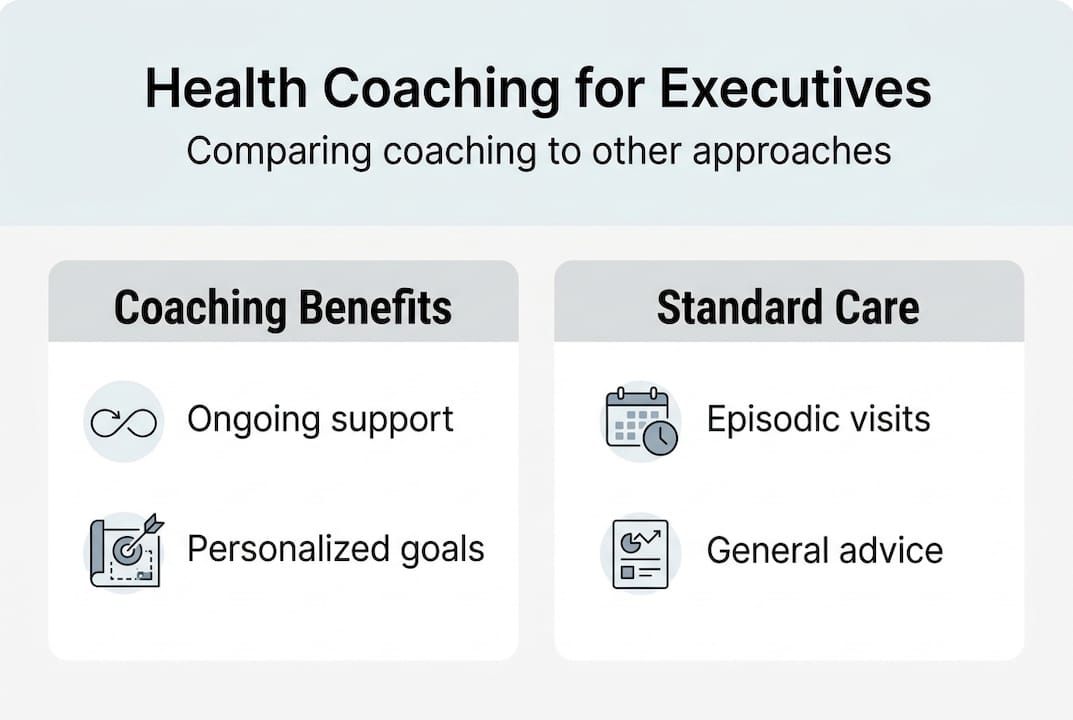
Coaches use a range of modalities depending on your goals. These include motivational interviewing, behavioral change frameworks, biometric tracking, nutrition planning, and recovery protocols. Sessions can be weekly or biweekly, in-person or remote, and are typically structured around 90-day performance cycles with measurable milestones.
Health coaching RCTs show small but consistent positive effects versus usual care: increased physical activity, reduced BMI, lower dietary fat intake, improved HbA1c (a key blood sugar marker), and stronger self-efficacy. For executives, even modest gains in these markers translate to sharper cognition and more consistent energy across demanding weeks.
| Feature | Health coaching | Standard medical care | Fitness training |
|---|---|---|---|
| Focus | Behavior and performance | Diagnosis and treatment | Physical capacity |
| Frequency | Ongoing, structured | Episodic | Session-based |
| Personalization | High | Moderate | Moderate |
| Outcome tracking | Biometric and behavioral | Clinical | Physical metrics |
| Executive relevance | Very high | Moderate | Moderate |
The methods that work best for executive populations combine data-driven tracking with accountability structures. You're not guessing whether your sleep or nutrition is affecting your output. You're measuring it and adjusting in real time.
Key modalities used in executive health coaching:
- Biometric monitoring (HRV, sleep stages, glucose)
- Behavioral goal-setting with weekly accountability
- Nutrition and metabolic optimization
- Stress and cortisol management protocols
- Recovery and sleep architecture improvement
Pro Tip: When selecting a health coach, look for certified professionals with credentials from recognized bodies like the National Board for Health and Wellness Coaching. A track record with executive clients matters more than general wellness experience. Pair this with self-optimization strategies to build a complete performance framework.
Evidence-backed benefits for executives
The case for health coaching isn't built on anecdote. It's built on outcomes data that maps directly to what executives care about: performance, cost, and resilience.
"Executive wellness programs including coaching yield a 6:1 ROI through reduced healthcare costs, higher productivity, fewer sick days, and improved morale." This is the kind of return that belongs in a capital allocation conversation, not just an HR budget.
One health coaching case study showed reduced inpatient use by 18%, emergency department visits by 12%, and a cost reduction of $139 per member per month. Those numbers reflect what happens when behavior changes at the root level rather than being managed at the crisis level.

| Metric | Improvement with coaching |
|---|---|
| ROI on wellness investment | Up to 6:1 |
| Inpatient hospital use | Down 18% |
| Emergency department visits | Down 12% |
| Monthly healthcare costs | Down $139/member |
| Productivity and morale | Measurably improved |
For long-term health strategies to stick, they need to be embedded in daily behavior. Health coaching does exactly that. It converts knowledge into habit and habit into measurable output.
Key benefits executives experience from sustained health coaching:
- Improved cognitive clarity and decision-making speed
- Reduced sick days and unplanned downtime
- Better sleep quality and recovery between high-demand periods
- Lower cardiovascular and metabolic risk markers
- Stronger stress regulation under sustained pressure
- Increased energy consistency across the full work week
The healthy aging workflow for executives at the top of their game isn't about dramatic interventions. It's about compounding small, consistent improvements in the behaviors that drive output. Health coaching is the mechanism that makes that compounding reliable.
Key nuances, limitations, and comparing alternatives
The evidence is real, but it's not without caveats. Executives who evaluate health coaching purely on ROI headlines are missing important context that affects how you should deploy it.
Expert analysis notes that effects are modest when compared to active control interventions rather than usual care. There is also high heterogeneity across studies, meaning results vary significantly based on coach quality, program design, and participant engagement. ROI claims in particular are often calculated using assumptions that don't hold in every organizational context.
| Approach | Strengths | Limitations |
|---|---|---|
| Health coaching | Personalized, behavioral, sustained | Modest vs. active interventions |
| Corporate wellness programs | Scalable, cost-effective | Low personalization, mixed outcomes |
| Executive physicals | Clinical depth, diagnostic precision | Episodic, no behavior change support |
| Personal training | Physical capacity gains | Limited metabolic and cognitive scope |
| Mindfulness programs | Stress reduction, focus | Narrow scope, limited health metrics |
This doesn't mean health coaching underdelivers. It means you need to use it correctly.
How to interpret ROI and clinical outcome data from health coaching:
- Compare results to your specific baseline, not population averages
- Track behavioral metrics alongside clinical ones (sleep, activity, dietary adherence)
- Evaluate coach quality independently from program-level data
- Use 90-day cycles to assess progress before making changes
- Treat ROI projections as directional, not guaranteed
The performance longevity guide for executives emphasizes that no single tool closes all gaps. Health coaching works best as part of a broader system that includes medical oversight, structured recovery, and lifestyle routines for vitality that reinforce daily habits.
Pro Tip: Don't build your health strategy around ROI projections alone. Use health coaching as one layer in a stacked system. When it's combined with medical monitoring and structured recovery protocols, the compounding effect is where the real performance gains emerge.
How to maximize outcomes: Application for executive performance
Knowing the evidence is one thing. Applying it to a schedule that already runs at 110% capacity is another. The executives who get the most from health coaching treat it like any other high-value investment: structured, tracked, and reviewed regularly.
Empirical benchmarks support small to moderate clinical and behavioral gains with health coaching. Effects are stronger versus usual care and weaker versus active interventions. Long-term ROI depends entirely on sustained application, not a single engagement.
Steps to build a personalized executive coaching plan:
- Start with a full biometric baseline: blood panels, HRV, sleep data, body composition
- Identify your two or three highest-impact health gaps (sleep, metabolic health, stress)
- Select a credentialed coach with documented experience in executive performance
- Set 90-day behavioral targets with weekly check-ins and data review
- Integrate coaching with your existing medical team for clinical oversight
- Review outcomes quarterly and adjust protocols based on actual data
The behaviors that move the needle most for executive performance are consistent across the research: sleep duration and quality, daily physical activity, protein-prioritized nutrition, and structured stress recovery. These aren't new ideas. The difference is that a skilled coach makes them non-negotiable and measurable.
Practical tools and strategies to sustain results:
- Wearable HRV and sleep tracking (Oura, WHOOP)
- Weekly biometric review sessions with your coach
- Structured meal timing and protein targets
- Recovery blocks built into your calendar like meetings
- Quarterly blood panels to track metabolic markers
Pro Tip: Consistency beats intensity every time. The executives who see the strongest long-term gains from health coaching are those who track the same three or four metrics week over week and make micro-adjustments based on trends. Explore elite performance strategies and executive wellness strategies to build the full system around your coaching foundation.
A fresh perspective: What most executives overlook about health coaching
Here's the uncomfortable truth: most executives who try health coaching and quit early were looking for a shortcut dressed up as a system. They wanted the ROI headline without the behavioral commitment that produces it.
The real value of health coaching doesn't show up in the first 30 days. It shows up in month six, when your sleep is consistently better, your decision-making under pressure is sharper, and you haven't had a sick week in two quarters. That's not a dramatic transformation. That's compounding, and it only works if you stay in the game long enough to let it build.
Most studies also understate the long-term potential when coaching is embedded in daily routines rather than treated as a standalone program. The executives who get the highest returns are those who integrate coaching into their operating rhythm, not those who treat it as a quarterly wellness initiative.
Choose a coach who pushes for gradual, personalized progress over dramatic short-term results. That's the signal of a professional who understands healthspan importance and knows how to build it systematically over years, not weeks.
Next steps: Tailored solutions for executive performance
If the evidence has shifted how you think about health coaching, the next move is straightforward: stop treating your health like a background function and start treating it like a core performance asset.
VIRIDOS is built for exactly this. Our membership options connect disciplined executives with premium, personalized health performance resources designed around sustained vitality and resilience. For those who want a structured, data-driven approach to daily performance tracking, the VIRIDOS performance journal gives you the framework to measure what matters. This isn't generic wellness. It's precision performance support for men who operate at the highest level and intend to keep doing so.
Frequently asked questions
What measurable ROI can executives expect from health coaching?
Executive wellness programs including coaching show a 6:1 ROI, with measurable gains in productivity, reduced sick days, and improved team morale. Results depend on program quality and sustained engagement.
How does health coaching compare to usual medical care or fitness programs?
Health coaching RCTs show consistent positive effects versus usual care across physical activity, BMI, and metabolic markers, though effects are more modest when compared to active interventions like supervised exercise programs.
Are there proven financial savings with health coaching?
Yes. One case study showed an 18% reduction in inpatient use, a 12% drop in emergency visits, and $139 lower monthly costs per member. These savings scale significantly across executive teams.
What should executives look for when choosing a health coach?
Prioritize coaches credentialed through recognized bodies like the National Board for Health and Wellness Coaching, with documented experience working with executive or high-performance populations and a methodology built around personalized, data-driven tracking.
Is health coaching suitable for long-term performance optimization?
Absolutely. Sustained application of health coaching tools produces compounding behavioral and clinical improvements, making it one of the highest-leverage investments for executives focused on long-term resilience and output consistency.