
TL;DR:
- Investing in personal growth involves deliberately developing skills, habits, and emotional awareness to enhance effectiveness in work and life. Growth is a cumulative process that benefits from consistent daily habits and active behavioral experimentation, rather than sporadic effort.
Investing in personal growth means deliberately building skills, habits, and self-awareness that improve your effectiveness at work and in life. This is not a soft concept. The PERMA model, backed by 35+ years of research, identifies emotional regulation and social relationships as the strongest predictors of longevity and life satisfaction. Human capital theory frames the same idea in economic terms: your knowledge, judgment, and adaptability are assets that appreciate with deliberate investment. For men in demanding roles, the question is not whether to grow. The question is whether you are doing it with the same discipline you apply to everything else.
Why invest in personal growth for career advancement?
Personal growth is the most direct lever you have on professional outcomes. Emotional intelligence reduces stress biomarkers linked to heart disease and insomnia, which means it protects your ability to perform under sustained pressure. That matters more than any single credential.
The confidence gained through self-knowledge drives income and career progression more reliably than hard skills alone. A professional who understands his own decision-making patterns negotiates better, leads more clearly, and recovers faster from setbacks. Hard skills get you in the room. Self-knowledge determines what you do once you are there.
The career benefits of consistent self-improvement include:
- Salary negotiation leverage. Professionals who can articulate their growth trajectory command higher compensation because they demonstrate future value, not just past performance.
- Workplace adaptability. Emotional regulation improves decision-making under ambiguity, which is the defining skill of senior roles.
- Stress management capacity. Lowering cortisol through deliberate recovery practices reduces chronic health risk and extends your effective career span.
- Leadership credibility. Higher emotional intelligence improves conflict resolution and communication, making you less reactive and more trusted by teams.
Pro Tip: Track one professional skill you are actively developing each quarter. Name it, measure it, and review it. Vague intentions produce vague results.
How does personal growth compound over time?
Personal growth is an asset, not an event. Consistent daily habits yield compounding returns in the same way financial capital does. Sporadic intensive efforts, the weekend seminar followed by months of inaction, rarely produce lasting change.
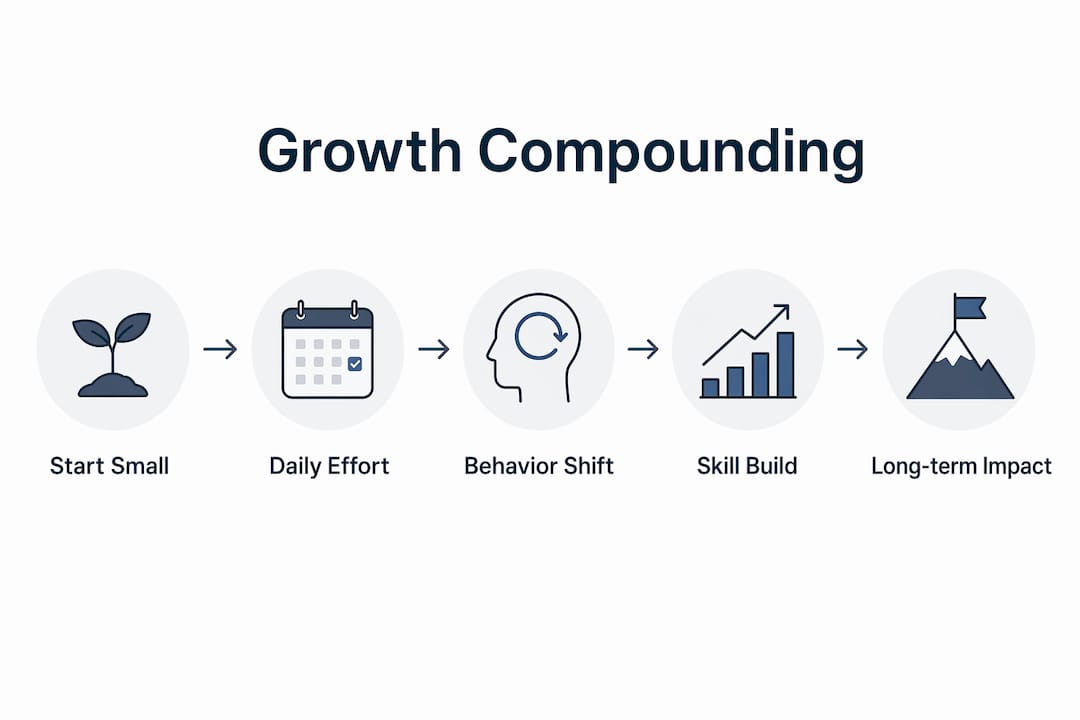
The mechanism is neuroplasticity. Consistent self-improvement shifts identity and self-perception over time, reducing cognitive dissonance and making new habits easier to sustain. Each small behavioral win reinforces the next. The compounding is real and measurable in how you think, respond, and perform.
The most common obstacles to compounding growth are perfectionism and burnout. Both stall progress by making the standard too high or the pace too fast.
- Start with one habit. A single daily practice, journaling, a 20-minute walk, or a weekly review, builds more capital than five habits started and abandoned.
- Treat rest as part of the system. Sustainable plans respect recovery and non-performance time. Growth happens during consolidation, not only during effort.
- Measure behavior, not outcomes. Track whether you showed up, not whether you achieved the result. Outcomes lag behavior by months or years.
- Review and adjust quarterly. A quarterly review catches drift before it becomes a pattern. It also surfaces what is actually working.
- Protect the long game. A decade of consistent, moderate effort produces more than two years of intensity followed by collapse.
"Small, consistent habits over years build intellectual and emotional capital far better than sporadic intensive efforts. The investment that always pays is the one you make every day."
What practical strategies support effective self-investment?
Effective personal growth requires shifting from passive knowledge consumption to active behavioral experimentation. Reading about leadership is not the same as practicing it. The gap between knowing and doing is where most self-improvement efforts fail.

Goal-setting theory by Locke and Latham demonstrates that specific, challenging goals enhance performance more than vague intentions. The practical implication is clear: write your goals down, assign timelines, and review them weekly. Ambiguity is the enemy of progress.
The following practices have the strongest evidence base for high-performing individuals:
- Journaling. Daily written reflection builds self-awareness faster than passive thinking. It externalizes mental noise and creates a record of growth you can actually review.
- Meditation and breathwork. These practices train attention and reduce reactivity. Even 10 minutes daily produces measurable changes in stress response over weeks.
- Skill acquisition. Learning a new skill, whether a language, a technical discipline, or a physical practice, builds cognitive flexibility and confidence simultaneously.
- Social environment curation. The people you spend time with set your behavioral baseline. Minimizing toxic influences and seeking out high-agency peers accelerates growth more than any solo practice.
- Healthy lifestyle routines. Sleep, nutrition, and exercise are not separate from personal growth. They are the physiological foundation that makes every other practice possible.
Pro Tip: Apply the "one percent better" standard. Identify one specific behavior to improve each week. At the end of the year, you will have made 52 targeted improvements. That is compounding in practice.
How does personal growth affect mental and physical health?
Personal development and physical health are not parallel tracks. They are the same track. Emotional regulation techniques like meditation, gratitude, and forgiveness correlate with increased life satisfaction and reduced depressive symptoms, according to research by Emmons and McCullough (2003), Kabat-Zinn (2003), and Worthington (2006). These are not soft outcomes. They are measurable changes in how the nervous system responds to stress.
Neuroplasticity extends the benefits further. Lifelong learning physically reshapes the brain, improving memory, attention, and problem-solving capacity well into later decades. The men who remain sharp and effective at 60 are not genetically lucky. They are the ones who kept learning deliberately.
| Health Domain | Personal Growth Practice | Measurable Outcome |
|---|---|---|
| Mental health | Meditation, journaling, gratitude | Reduced anxiety, lower cortisol |
| Cognitive function | Skill acquisition, reading, reflection | Improved memory and flexibility |
| Physical resilience | Exercise, sleep discipline, nutrition | Stronger immune function, mood stability |
| Emotional regulation | Mindfulness, forgiveness practices | Fewer reactive decisions, better relationships |
Physical health behaviors reinforce every other dimension. Regular exercise elevates mood, and quality sleep improves immune and cognitive function, according to the WHO (2023) and Walker (2017). Neglecting either creates a physiological drag on every growth effort you make.
The practical priorities for men focused on executive fitness and vitality are:
- Protect 7–9 hours of sleep as a non-negotiable performance input.
- Exercise at least four times per week with a mix of strength and aerobic work.
- Eat in a way that stabilizes energy across the day, not just fuels short bursts.
- Build recovery into your weekly schedule the same way you build meetings in.
Key Takeaways
Investing in personal growth produces compounding returns across career performance, mental health, and physical resilience when applied through consistent, evidence-based daily habits rather than sporadic effort.
| Point | Details |
|---|---|
| Growth is a strategic asset | Deliberate self-investment builds emotional intelligence and cognitive flexibility that compound over years. |
| Career returns are measurable | Emotional regulation reduces cortisol, improves leadership, and increases salary negotiation leverage. |
| Consistency beats intensity | Daily habits outperform sporadic intensive efforts by building identity-level change through neuroplasticity. |
| Health and growth are linked | Sleep, exercise, and nutrition are physiological inputs that determine how well every growth practice works. |
| Goal-setting accelerates progress | Specific, written goals with timelines produce measurably better outcomes than vague intentions. |
What most men get wrong about personal growth
Most men treat personal growth as a project with a finish line. They read the book, attend the program, and wait to feel different. Growth does not work that way. It is a quiet, cumulative process that shows up in how you handle a difficult conversation on a Tuesday morning, not in a dramatic transformation you can point to.
The other common error is confusing consumption with development. Listening to podcasts and reading books builds knowledge. It does not build capability. Applying growth requires active behavioral experimentation and feedback loops. You have to do something differently, observe what happens, and adjust. That cycle is where real development occurs.
I have also seen high-performing men burn out from treating growth as another performance metric to maximize. They stack habits, track every variable, and push through fatigue until the whole system collapses. Sustainable growth respects recovery. Rest is not a reward for effort. It is part of the process. The men who grow most over a decade are not the most intense. They are the most consistent.
The goal is not optimization. The goal is building executive resilience that holds under real conditions, year after year, without requiring a reset.
— Joakim
A structured way to track your growth
Personal growth without a tracking system is intention without accountability. The Viridos Performance Journal is built for exactly this purpose: a structured daily record of habits, reflections, and progress that creates the feedback loop growth requires.

Consistent reflection and progress tracking dramatically improve habit formation and accountability over time. The Performance Journal gives that process a physical form, designed for men who take their development as seriously as their professional output. For those building a longer-term framework, the Viridos longevity performance strategy integrates personal growth principles with sustained vitality and performance across decades.
FAQ
What does investing in personal growth actually mean?
Investing in personal growth means deliberately building skills, habits, and emotional awareness to improve your effectiveness at work and in life. It is a sustained, active process, not passive consumption of content.
How long does it take to see results from personal development?
Behavioral changes typically show measurable effects within weeks for stress and mood, and within months for career and relationship outcomes. Compounding returns on intellectual and emotional capital accumulate over years, not days.
Why is emotional intelligence important for personal growth?
Emotional intelligence improves communication, conflict resolution, and decision-making under pressure. Research shows it also reduces stress biomarkers linked to chronic health conditions, making it a core professional and physical asset.
Can personal growth improve physical health?
Physical health and personal development reinforce each other directly. Practices like meditation reduce cortisol, exercise elevates mood, and quality sleep improves cognitive function, all of which support sustained growth and performance.
What is the biggest mistake people make with self-improvement?
The most common mistake is treating growth as a project rather than a practice. Sporadic intensive efforts rarely produce lasting change. Consistent daily habits, even small ones, build compounding returns that intensive bursts cannot match.