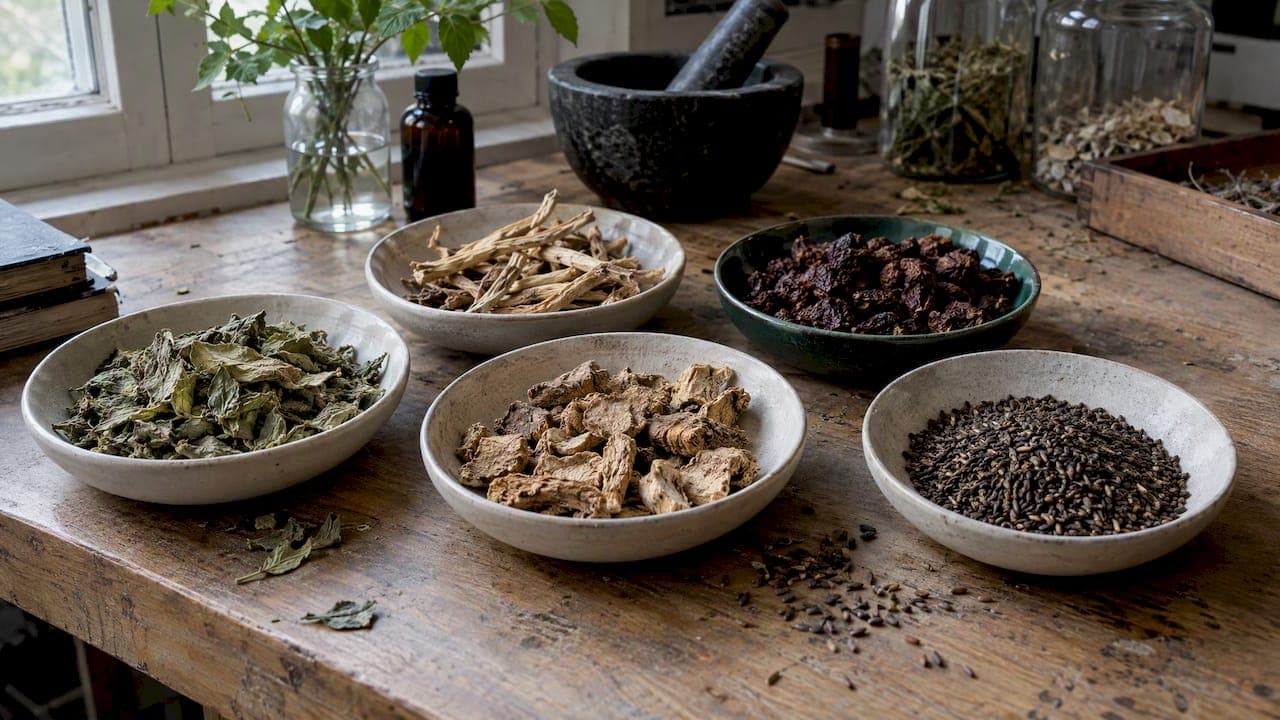
Some herbs show task-specific signals for working memory or accuracy, but the overall evidence base is mixed, and product quality matters more than a long ingredient list. Sage and Bacopa monnieri carry the clearest human data, while regulators including Livsmedelsverket warn that supplement quality varies widely. Read the trial data before you buy, verify the product, and see a clinician if cognitive problems persist.
TL;DR:
- A 2025 analysis of 27 trials involving 2,334 people found no extract significantly beat placebo for attention, and favorable rankings do not prove efficacy.
- Bacopa’s memory findings are modest and variable, often take eight to twelve weeks to emerge, and include reported nausea or increased stool frequency.
- A trial of 94 people found a 600 mg sage combination improved working memory and accuracy at 120 and 240 minutes, and after 29 days.
- Request an independent certificate of analysis for the specific batch, and consult a clinician before using herbal extracts with cardiac medication or anticoagulants.
Table of Contents
- What systematic reviews and trials actually show about herbs and cognition
- Five herbs with the most human data, and what their trials found
- Why "natural" does not mean safe, and what Swedish guidance requires
- How to use a cognitive herb responsibly, step by step
- Where herbs fit inside a serious performance routine
- The VIRIDOS approach to quality and verified performance support
- FAQ
- Sources
What systematic reviews and trials actually show about herbs and cognition
Executives evaluating a performance intervention deserve the same rigor they apply to a balance sheet. The highest-quality evidence on herbal cognitive enhancers comes from systematic reviews and network meta-analyses, and the picture they paint is disciplined rather than dramatic.

A 2025 network meta-analysis of 27 trials and 2,334 participants across 19 natural extracts found that no single extract significantly outperformed placebo on attention measures. Some extracts ranked favorably for specific cognitive domains using SUCRA-based statistical ranking, a method that orders treatments by probability of effectiveness. A ranking is not proof of benefit: it tells you which candidates deserve closer attention, not which ones work.
Trial-level detail explains why the aggregate picture stays muted:
- Acute effects (measured in hours) and chronic effects (measured over weeks) are different claims that require separate evidence.
- Most trials use small samples, rarely exceeding a few hundred participants.
- Extracts, doses, and plant parts vary enormously between studies labeled with the same species name.
- Risk-of-bias problems are common, including unclear blinding and selective outcome reporting.
A related review of herbal and nutritional medicines in older adults examined 21 studies and found that while 14 reported improvement in at least one cognitive domain, 14 were also rated high risk of bias, often the same studies doing both. The practical conclusion for a disciplined reader: treat a single positive trial as hypothesis-generating, never as settled science. Evidence quality, not ingredient novelty, should drive your decisions.
Five herbs with the most human data, and what their trials found
Cognitive clarity is not one thing. It spans attention, working memory, processing speed, and executive function, the capacity to plan, prioritize, and execute under pressure. The herbs below are the ones with the most human trial data against these domains, ranked roughly by strength of evidence base rather than popularity.
- Bacopa monnieri. This herb carries the largest body of human memory research of any botanical nootropic. Clinical data analyses report modest, heterogeneous improvements in memory-related outcomes across multiple randomized trials, with gastrointestinal side effects, including nausea and increased stool frequency, reported consistently. Effects depend heavily on extract standardization, dose, and trial duration, often requiring eight to twelve weeks before signals emerge.
- Salvia officinalis (sage). A randomized, placebo-controlled trial with 94 participants tested a specific sage combination at 600 milligrams and found improvements in working memory and accuracy both acutely, measured at 120 and 240 minutes after dosing, and after 29 days of continued use. This is one of the more consistent acute-effect findings in the herbal cognition literature, though it applies to the specific combination tested, not to sage generally.
- Ginkgo biloba. Widely studied in older adults, Ginkgo appears frequently in the systematic review of cognitive aging interventions, but results are mixed and study quality varies considerably. Some trials report domain-specific improvement; others find no meaningful difference from placebo.
- Spearmint extract (standardized). Isolated trials report task-specific benefits on measures of attention and working memory, but the evidence base remains narrow. Standardization and dose matter enormously here, since unstandardized spearmint preparations have not been tested against the same outcomes.
- Standardized ginseng extracts. Trial evidence is limited and signals are inconsistent across studies, making ginseng a weaker candidate than Bacopa or sage for anyone prioritizing verified outcomes.
Pro Tip: Match the product to the exact extract and dose used in the trial you are relying on. A different extraction method or a lower dose is a different intervention, even if the label says the same plant name.
Why "natural" does not mean safe, and what Swedish guidance requires
Plant-based does not mean risk-free. Livsmedelsverket has repeatedly flagged contamination, undeclared ingredients, and banned compounds in plant supplements sold on the Swedish market, including pyrrolizidine alkaloids, a class of plant toxins with documented liver risks. Swedish market surveillance treats these as ongoing concerns, not historical footnotes.
A quality gap exists between what a label claims and what a product contains, and that gap is the primary safety risk in this category, not the herbs themselves. Before you add any herbal product to your routine, confirm the following:
- A certificate of analysis (COA) from independent, third-party testing is available for the specific batch.
- Ingredient and dose labeling matches the active compound and concentration studied in trials.
- You are not stacking multiple unverified cognitive formulas that could compound contamination or interaction risk.
Pregnant or breastfeeding women face particular risk from botanical toxins, a concern Livsmedelsverket's extended review addresses directly. Anyone on cardiac medication or anticoagulants should consult a clinician before starting any herbal extract, since botanical compounds can interact with prescription drugs in ways that are poorly studied.
How to use a cognitive herb responsibly, step by step
Discipline in supplementation looks like discipline anywhere else: verify before you commit, then measure the result.
- Select a product that matches the trial formulation. Look for the same extract, standardization marker, and dose used in the studies above, not a generic version of the same plant.
- Set a realistic trial window. Sage-type acute effects show up within hours; Bacopa-type effects typically require four to twelve weeks of consistent use before you can judge them fairly.
- Keep a simple performance log. Track focus, recall, and output quality weekly so you are measuring a real signal, not a mood.
- Check for interactions before you start. Our guide to drug interaction risk walks through the checks worth running against any prescription medication.
- Avoid stacking multiple formulas at once. Our five-step framework for combining supplements safely explains why verification matters more than variety.
- Treat COA absence as disqualifying. If a manufacturer cannot produce independent testing for a specific batch, deprioritize the product regardless of its claims. Our four-week COA protocol gives a practical verification sequence.
Pro Tip: A symptom log beats memory. Write down one measurable outcome before you start and review it honestly at the four-week mark.
Where herbs fit inside a serious performance routine
We see herbs as adjuncts, never as substitutes for the fundamentals that actually carry performance longevity: sleep architecture, nutrition quality, and recovery discipline. A standardized extract with solid trial data can support a routine already built on those foundations; it cannot replace them. Our guide to nutrition and performance and our overview of evidence-backed herbs go further into building an integrated routine.
— Joakim
The VIRIDOS approach to quality and verified performance support
We built our membership around the same standard this article asks of any herbal product: verify first, claim second. We produce our batches in small runs with Swedish oversight, applying traceability and quality controls that disciplined professionals should seek in supplements.

- Small-run Swedish production with consistent quality control across every shipment.
- Membership oversight rather than open retail, keeping access and formulation standards tight.
- A focus on cognitive and performance support built for men who already protect their sleep, training, and nutrition.
If that standard matches what you are looking for, review our Member and Professional plans starting at $99 per month, or read more in our Performance Journal before you apply.
This article is general information, not a substitute for advice from a qualified doctor. Consult a qualified healthcare professional about your own circumstances before acting on anything here.
FAQ
What are some examples of cognitive impairments?
Common cognitive difficulties include problems with attention, working memory, processing speed, and executive function, the set of skills involved in planning and decision-making. 1177 advises seeking medical assessment when these problems are persistent or worsening rather than occasional.
What should you eat to support memory?
No single food or herb reliably improves memory on its own; overall nutrition quality and consistency matter more than any single ingredient. A broader look at nutrition and performance, including energy-supporting food choices, is covered in evidence-based nutrition resources alongside our own nutrition and performance guide.
What are the levels of cognitive function?
Cognitive function is typically described across domains rather than fixed levels: attention, working memory, processing speed, and executive function are the most commonly assessed. Clinical resources such as 1177 use these domains to guide assessment and track change over time.
What are common signs of cognitive difficulty?
Typical signs include trouble concentrating, slower recall, difficulty organizing tasks, and reduced mental stamina under sustained demand. Persistent or worsening symptoms warrant a conversation with a clinician rather than self-treatment with supplements, as 1177 recommends.
Are herbal supplements for cognitive clarity regulated for safety?
In the Swedish market, Livsmedelsverket monitors supplement quality and has found contamination, undeclared substances, and banned compounds in some plant-based products. Checking for independent third-party testing, detailed in our third-party testing checklist, is the practical way to manage this risk before purchase.
Sources
- Effects of natural extracts in cognitive function of healthy adults: a systematic review and network meta-analysis
- The effectiveness of Bacopa monnieri (Linn.) Wettst. as a nootropic, neuroprotective, or antidepressant supplement: analysis of the available clinical data
- Risker med kosttillskott — Livsmedelsverket