
TL;DR:
- Resilience across psychological, organizational, and financial domains predicts sustained high performance better than sheer effort alone. Executives who systematically audit, integrate, and reinforce these areas, including their networks, achieve long-term resilience and success. Building and maintaining this multi-domain system is essential for sustained elite performance and competitive advantage.
Most high-achieving executives believe that grinding harder is what separates them from the pack. But entrepreneurial resilience rather than sheer willpower is what actually predicts sustained performance. The truth is more nuanced and, frankly, more actionable: peak performance is built through a recursive, multi-domain system that spans your psychology, your organization, your finances, and your network. This article breaks down exactly how that system works and gives you the frameworks to put it into practice.
Table of Contents
- What drives peak entrepreneur performance?
- Psychological capital: The entrepreneurial edge
- Organizational and financial resilience: Beyond mindset
- Multiplying resilience through network engagement
- Why most advice on entrepreneur performance falls short
- Unlock your performance edge with VIRIDOS
- Frequently asked questions
Key Takeaways
| Point | Details |
|---|---|
| Multi-domain resilience wins | Successful entrepreneurs integrate psychological, organizational, and financial resilience strategies for lasting performance. |
| PsyCap protects well-being | Building psychological capital buffers stress and burnout, supporting sustained executive energy and motivation. |
| Network effects matter | Entrepreneurs with broad stakeholder networks convert resilience into greater personal and business success. |
| Stack interventions for results | Combining mindset, structural routines, and cash flow tactics leads to bigger, more durable gains than standalone efforts. |
What drives peak entrepreneur performance?
To understand what truly separates durable high-performers from those who flame out, we need to move past the conventional "mindset first" narrative. Research now confirms that resilience is not a single trait you either have or you don't. It's an integrated process.
Entrepreneurial resilience in startups shows that resilience is best modeled as a recursive, multi-domain process spanning psychological, organizational, and financial mechanisms. What that means in practice: you can't just meditate your way to resilience, and you can't just restructure your balance sheet and call it done. You need all three working together, reinforcing each other in a continuous loop.
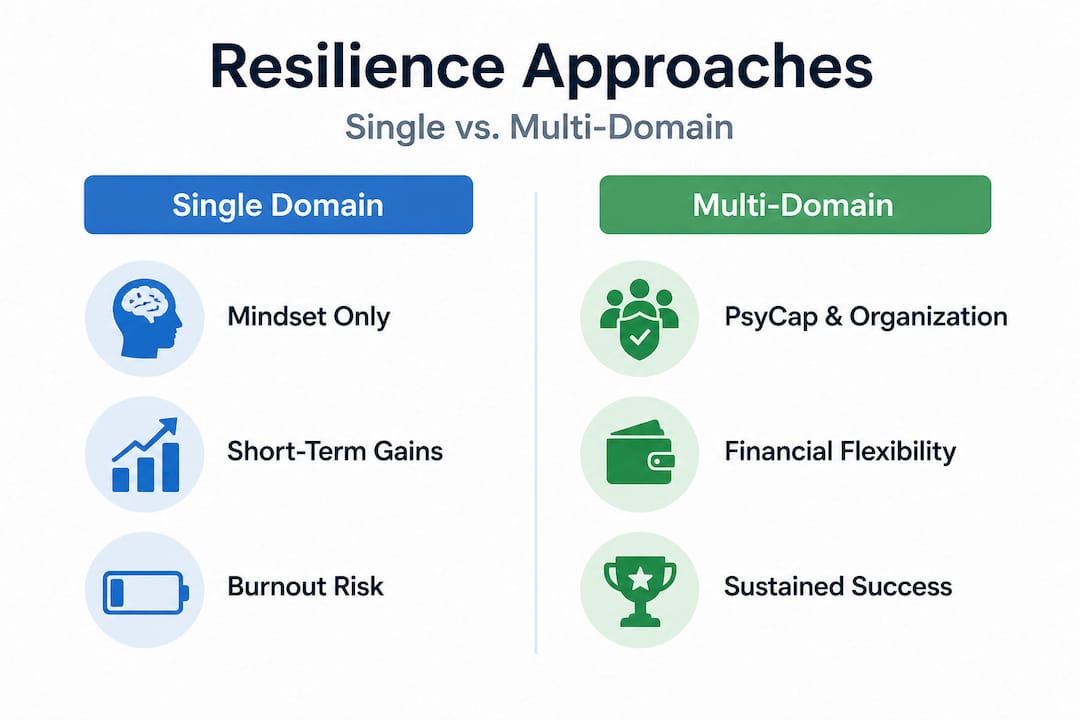
Executives who rely on resilient performance strategies across multiple domains consistently outperform those who focus on one area. Here's a side-by-side breakdown of what integrated resilience looks like versus the common single-domain approach:
| Dimension | Single-domain focus | Multi-domain integration |
|---|---|---|
| Psychological | Mindset hacks, journaling only | PsyCap building, burnout monitoring, coaching |
| Organizational | Reactive restructuring | Proactive sense-giving, modular team design |
| Financial | Expense cuts in crisis | Ongoing cash flow flexibility, resource reallocation |
| Network | Ad hoc networking | Systematic stakeholder engagement protocols |
The gap between those two columns is where performance is won or lost.
One more critical insight: individual resilience in entrepreneurs correlates with success and is amplified by a larger stakeholder network. That means your resilience doesn't exist in a vacuum. It compounds with the quality and breadth of the people around you.
What high-performing executives do differently, distilled to essentials:
- They audit all three domains (psychological, organizational, financial) on a regular cadence, not just when there's a crisis
- They treat network engagement as a resilience tool, not just a business development activity
- They use performance frameworks that integrate well-being and organizational strategy instead of keeping them in separate silos
- They build feedback loops that catch early warning signs before small stressors become major disruptions
If you've been relying on one or two of these levers, you're leaving significant performance on the table.
Psychological capital: The entrepreneurial edge
Once you accept that resilience spans multiple domains, the next logical question is: where do you start? For most executives, the right entry point is the internal one. Your psychological state is the foundation everything else is built on.
Psychological capital, commonly abbreviated as PsyCap, refers to four specific psychological resources: hope, optimism, resilience, and self-efficacy (the belief in your own ability to execute). These aren't feel-good concepts. They're measurable, developable, and directly linked to sustained performance. Research published in BMC Psychology confirms that PsyCap buffers the negative effects of burnout on entrepreneurs' psychological well-being. In other words, building these four resources acts as a kind of performance insurance policy.
Here's what each dimension looks like in practice:
- Hope: The ability to identify multiple pathways to a goal and stay motivated when one route closes. This is strategic thinking at its most adaptive.
- Optimism: A realistic but positive orientation toward outcomes. High-performing founders don't deny risk; they approach it with confident problem-solving.
- Resilience: The capacity to recover quickly from setbacks and adapt under pressure. This is not passive bouncing back. It's active repositioning.
- Self-efficacy: Confidence rooted in demonstrated competence. The more you do difficult things successfully, the more you trust yourself to handle the next difficult thing.
The relationship between burnout and PsyCap is a feedback loop you want to understand clearly. High burnout depletes PsyCap. And lower PsyCap makes you more vulnerable to burnout. If you don't interrupt that cycle early, it becomes self-reinforcing. This is exactly why early detection of stress and workload overload is so important. You can't build psychological capital when you're already in a burnout spiral.
"The executives who sustain the highest levels of performance are not those who work the hardest. They're the ones who manage their internal resources with the same discipline they apply to their business."
Pro Tip: Track your own burnout indicators on a weekly basis using a simple 1 to 10 scale across three dimensions: energy, motivation, and emotional patience. If two or more dimensions consistently score below 5, treat it as an operational signal requiring immediate intervention, not just personal discomfort.
Practical executive vitality tips for building PsyCap include structured recovery blocks built into your weekly schedule, working with a coach who understands executive performance (the health coaching benefits in this context are well documented), and intentionally designing environments that reinforce positive feedback rather than only flagging failure. For more on the motivational architecture behind this, the research on leader motivation methods provides a useful operating framework.
Organizational and financial resilience: Beyond mindset
Strong PsyCap gives you inner stamina. But unless your organization and finances are also built to flex, your psychological edge will eventually hit structural limits. This is where most high-performers stall.
Research on entrepreneurial resilience in startups confirms that resilience operates recursively via organizational and financial channels including experimental responsiveness, sense-giving, resource reconfiguration, and temporal elasticity. Let's translate each of those into something concrete:
- Experimental responsiveness means your organization has the capacity to test, learn, and pivot quickly without waiting for perfect information. Build this by creating low-cost pilot systems for new initiatives before full commitment.
- Sense-giving refers to your ability to shape how your team interprets ambiguity and uncertainty. During disruption, leaders who give clear, grounded narratives keep their teams aligned and moving. This is not spin. It's strategic communication.
- Resource reconfiguration is the ability to reallocate people, capital, and attention rapidly in response to changing conditions. This requires pre-built flexibility in contracts, team structures, and supplier relationships.
- Temporal elasticity means knowing when to slow down and consolidate versus when to accelerate. High performers recognize that timing itself is a resource.
On the financial side, the executives who sustain the longest performance curves are those who treat cash flow management as a resilience mechanism, not just an accounting function. Having 90 to 120 days of operating reserves means you have the optionality to weather disruption without making reactive decisions that damage long-term performance. Resource flexibility in your financial structure, like variable cost arrangements and staged investment commitments, gives you room to maneuver when conditions shift.

| Resilience lever | Operational tactic | Performance outcome |
|---|---|---|
| Sense-giving | Weekly narrative briefings during uncertainty | Reduced team anxiety, maintained velocity |
| Resource reconfiguration | Cross-trained teams, flexible vendor terms | Faster adaptation to disruption |
| Cash flow buffer | 90-120 day operating reserve | Decision-making from strength, not fear |
| Experimental responsiveness | Staged pilots before full resource commitment | Lower downside risk, faster learning |
Pro Tip: Run a quarterly resilience audit across all four organizational channels. Map your current state against your target state in each area. The gaps you find are your highest-priority performance investments, not motivational programs or productivity tools.
For executives managing high-stress operating environments, executive stress optimization resources offer practical protocols that bridge the psychological and organizational sides of this equation. The full picture of resilience tactics for professionals in demanding roles is worth reviewing as a companion to the frameworks covered here.
The critical point is this: stacked interventions that align your mindset, your organizational structure, and your cash flow management consistently outperform single-domain solutions. None of these three areas is optional if you're serious about long-term performance.
Multiplying resilience through network engagement
Your internal resilience and organizational systems are essential. But there's a third amplifier that most executives dramatically underutilize: their stakeholder network.
The evidence here is direct. Resilience's payoff for entrepreneurs grows with the breadth of their stakeholder networks. Put simply: the same level of individual resilience produces better outcomes for executives who have broader, more engaged networks. Your network is a performance multiplier, not just a business development tool.
"In a crisis, your network is your most liquid asset. It provides information, resources, and emotional grounding that no internal system can replicate."
Why does network breadth matter so much? Three reasons:
- Information flow: Broad networks expose you to early signals of market shifts, talent opportunities, and competitive dynamics before they become obvious. This gives you a timing advantage that directly impacts decision quality.
- Emotional support and perspective: High-performing executives face a specific isolation problem. Their team looks to them for stability, which limits honest two-way communication. A strong peer network of founders and executives provides the candid feedback and sounding-board function that's difficult to find internally.
- Coordination during crises: When conditions deteriorate rapidly, executives with strong networks can mobilize resources, partnerships, and introductions in days rather than months. This is a genuine operational advantage.
Practical strategies for building network-driven resilience:
- Block two hours per week specifically for network activation. Not general networking events but direct, high-value conversations with people in adjacent domains who can challenge your thinking.
- Build a personal board of five to seven advisors covering domains including finance, organizational design, health optimization, and market intelligence. Review their input quarterly alongside your business metrics.
- Create reciprocal value. The strongest networks are built on consistent give-and-take, not one-sided relationship management.
- Use crisis simulation exercises to identify network gaps before you need them. Who would you call if your largest client left tomorrow? If you don't have an immediate answer, you have a resilience gap.
For more structured approaches to building this kind of durable high-performance system, the executive resilience strategies framework provides a detailed operational guide.
Why most advice on entrepreneur performance falls short
Here's the uncomfortable reality: the self-improvement industry has made a fortune selling one-dimensional solutions to a multi-dimensional problem. Mindset retreats, productivity systems, and financial strategy sessions each capture a piece of the equation. But they are rarely designed to work together, and that's precisely where the value gets lost.
The research is clear. Breakthrough performance doesn't come from optimizing a single domain. It comes from running psychological, organizational, financial, and network interventions simultaneously and letting them reinforce each other in a recursive loop. That's not a complication. It's an enormous advantage if you're willing to operate that way.
Most executives miss the compounding effect of well-cultivated networks entirely. They treat their professional relationships as secondary to their internal performance habits. But as the data shows, network breadth multiplies the return on your individual resilience. Every hour invested in building and maintaining high-quality relationships has a leveraged payoff that isolated performance work simply doesn't produce.
The other major gap is the failure to treat these frameworks as operational disciplines rather than one-time initiatives. Running a multi-domain resilience audit once is interesting. Running it quarterly and acting on the results systematically is transformative. The executives who sustain elite performance over decades are those who have institutionalized these habits into their personal operating systems.
For a complete picture of what this looks like in practice, wellness optimization insights for executives outline how to integrate each of these domains into a coherent, daily practice without adding friction to an already demanding schedule.
Unlock your performance edge with VIRIDOS
The multi-domain resilience model covered in this article is exactly the operating philosophy behind VIRIDOS. Built for executives and founders who demand precision in their performance systems, VIRIDOS brings together science-backed resources, curated routines, and a premium executive community designed to support every layer of the framework you've just read.

Whether you're looking to sharpen your psychological capital, build organizational robustness, or activate a stronger peer network, the tools are ready when you are. Start with the Performance Journal to operationalize your daily resilience practice with structure and intentionality. For access to the full ecosystem of executive resources, protocols, and community, the VIRIDOS Membership is where high-agency men build the systems that sustain long-term performance. The science is clear. The only remaining question is how you apply it.
Frequently asked questions
What is the best way to build resilience as an entrepreneur?
The most effective approach is to integrate psychological self-regulation, organizational adaptation, and financial flexibility routines simultaneously, since resilience operates as a recursive, multi-domain process rather than a single skill.
How does burnout affect performance and how can it be managed?
Burnout directly lowers psychological well-being and depletes PsyCap resources; research confirms that burnout negatively affects well-being and that early stress intervention is the most effective protective strategy.
Does having a strong professional network really improve performance?
Yes, and the effect is larger than most executives assume. A stronger stakeholder network directly amplifies the positive impact of individual resilience on entrepreneurial outcomes.
What are early signs of burnout in high-performing executives?
The most reliable early indicators are persistent fatigue that sleep doesn't resolve, declining motivation for work that previously engaged you, and a noticeable drop in patience or emotional bandwidth during routine interactions.