
TL;DR:
- Founder performance depends more on interaction of traits like dependability, motivation, and adaptability than on personality alone.
- Older founders must focus on systematizing decision-making, delegation, and trust structures to sustain high-level performance amidst increasing complexity.
Most founders in their 40s and 50s still operate on a core belief: that pushing harder, logging more hours, and grinding through pressure is what separates high performers from the rest. That belief is not just wrong, it is quietly costing you decision quality, energy, and long-term vitality. Research on entrepreneur performance and resilience shows that sustained founder performance is far more predictable, and far more structured, than hustle mythology suggests. The real drivers are measurable, trainable, and, importantly, optimizable even as the complexity of your role grows.
Table of Contents
- What really drives founder performance?
- From trait edge to sustainable resilience
- Decision quality: The overlooked driver of founder energy and performance
- Systematize, delegate, and track: Practical frameworks for founders
- The missing link: Why most founder performance advice fails older executives
- Ready to apply these frameworks? Enhance your founder performance with expert guidance
- Frequently asked questions
Key Takeaways
| Point | Details |
|---|---|
| Composite traits matter | The strongest predictor of founder performance is a mix of work styles, motivation, and adaptability. |
| Decision systems protect energy | Delegating and systematizing decisions reserves attention for high-impact choices. |
| Calibrate, don’t polarize | Flexibly adapting interpersonal and work style is more resilient than rigidly sticking to one extreme. |
| Audit and track decisions | Regularly reviewing your decision load helps prevent overload and preserves executive function. |
| Trust structures drive results | Building reliable organizational and trust frameworks supports peak performance under pressure. |
What really drives founder performance?
The popular narrative around founder success centers on passion, grit, and raw intelligence. But structured research tells a more nuanced and far more useful story. The Founder Institute, drawing on 85.1% predictive accuracy from a composite Founder Score, demonstrated that performance can actually be modeled using structured trait dimensions, work-style assessments, and cognitive processing profiles. That is not a minor finding. It means founder performance is not a mystery to be discovered through suffering. It is a system to be understood and optimized.
"Founder performance is not an accident of personality. It is a product of measurable trait interactions, decision architecture, and the ability to calibrate under pressure."
What this research surfaces is that no single trait dominates. It is not the most extroverted founder, the most conscientious one, or even the most risk-tolerant one who consistently outperforms. It is the founder whose traits interact well under specific conditions. Work style, motivation, and problem-solving processes all blend together to produce edge, or undermine it, depending on how they are balanced.
Here is what actually matters in the composite picture:
- Dependability and follow-through under ambiguity, not just under structure
- Motivation architecture, meaning intrinsic drive that is self-sustaining across cycles of low feedback
- Problem-solving adaptability, especially the ability to reframe when initial approaches stall
- Interpersonal calibration, knowing when to push and when to yield without losing authority
For founders past 40, the complexity of accountability deepens. You are no longer just managing execution. You are managing a board, a leadership team, investor expectations, regulatory pressure, and personal health simultaneously. At this level, raw effort is a diminishing asset. Calibration becomes your most valuable performance lever.
From trait edge to sustainable resilience
Once you understand what your foundational trait stack looks like, the next question is durability. How do you sustain performance as responsibilities multiply and the margin for error shrinks? The answer lies in how proven resilience strategies for leaders frame the interplay between personality dimensions and work style under increasing load.
Research confirms that trait-level edge is less about isolated personality strengths and more about how dependability, motivation, and problem-solving interact across different pressure environments. A founder who is extremely agreeable, for example, may build strong early culture. But when that agreeableness becomes a fixed style rather than a flexible tool, it can produce brittle teams that avoid conflict and avoid accountability. The trait becomes a liability precisely because it was never calibrated to context.
"The most resilient founders are not the most consistent in personality. They are the most consistent in judgment, regardless of which personality mode the moment requires."
This is a meaningful distinction for men in high-responsibility executive roles. It means the high-responsibility executive edge does not come from being a particular type of person. It comes from being able to read the moment and shift accordingly, while keeping decision quality intact.
Comparing calibrated vs. fixed founder styles:
| Dimension | Fixed style founder | Calibrated style founder |
|---|---|---|
| Interpersonal approach | Always directive or always agreeable | Adjusts based on team need and stakes |
| Stress response | Doubles down on default behavior | Modifies approach to fit the pressure |
| Team effectiveness | Declines under ambiguity | Holds or improves under ambiguity |
| Decision speed | Slows under uncertainty | Maintains rhythm through structure |
| Long-term resilience | Degrades with complexity | Scales with experience |
Pro Tip: Audit your last five high-stress decisions. Did you default to your most comfortable behavior, or did you consciously adapt your style to what the situation needed? That gap, between default and deliberate, is exactly where performance can be recaptured.
Building interpersonal flexibility does not require becoming someone else. It requires developing a clear internal map of when directness serves better than warmth, when autonomy outperforms close oversight, and when you need to slow down to protect judgment rather than accelerate to demonstrate productivity.

Decision quality: The overlooked driver of founder energy and performance
Most founder performance conversations focus on output, revenue, team size, or market velocity. Far fewer focus on decision quality as a primary energy metric. Yet senior-leader decision quality degrades significantly when leaders operate in high-frequency, unpredictable reaction mode. This is not a willpower problem. It is a system design problem.
The key insight is that decision fatigue is driven far less by the magnitude of a single decision and far more by the relentless frequency and unpredictability of all decisions. A founder making fifty low-stakes calls throughout a chaotic day is more depleted than one who makes five high-stakes calls in protected windows. Volume is the enemy, not weight.
For executive stress optimization, this means that your calendar architecture is not a scheduling preference. It is a performance variable. The design of your workday either protects your highest-quality judgment or erodes it systematically, regardless of how disciplined you are.
Here is what a practical decision-protection framework looks like:
- Map your reaction mode by logging all decisions for three to five business days, categorizing each as routine, tactical, or strategic.
- Identify the reactive traps, the low-value interruptions disguised as urgent decisions, and build explicit handoff systems for them.
- Design judgment windows of two to three focused hours, protected from reactive inputs, where your highest-stakes calls happen.
- Create trust frameworks by giving key team members explicit decision authority within defined parameters, reducing upward escalation.
- Debrief decision quality weekly, not just outcomes, to identify where your judgment windows were most compromised.
The leverage here is significant. When you consistently protect your highest-quality decision moments, executive motivation strategies become more effective because you are operating from a fuller cognitive tank rather than a depleted one. Your clearest thinking returns. Your instincts sharpen. And the energy you previously burned on low-value reactive decisions becomes available for the calls that actually compound.
Decision fatigue impact at different load levels:
| Decision volume per day | Fatigue onset | Judgment quality by end of day |
|---|---|---|
| Under 20 decisions | Minimal | High |
| 20 to 40 decisions | Moderate | Moderate |
| 40 to 70 decisions | High | Low |
| Over 70 decisions | Severe | Very low |
These are not theoretical gradients. Leaders in high-growth companies routinely operate above the 70-decision threshold without recognizing the compounding cost to judgment quality.
Pro Tip: Block your two highest-focus hours before any reactive input arrives. Treat those blocks with the same seriousness as a board meeting. Everything else adapts around them, not the other way around.
Systematize, delegate, and track: Practical frameworks for founders
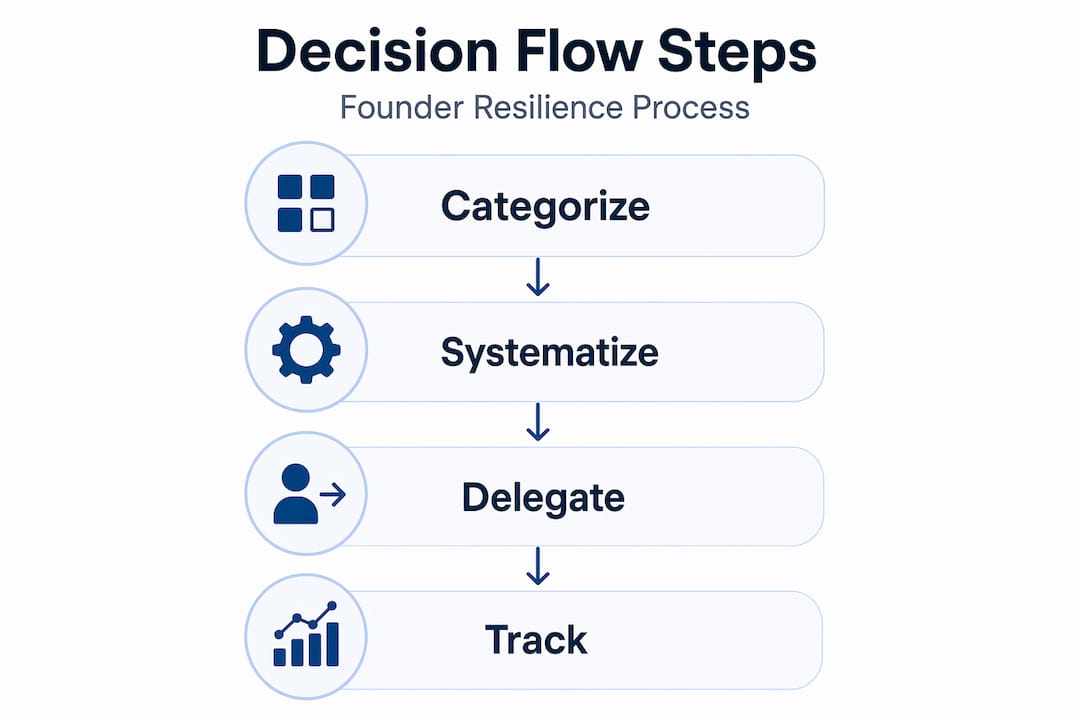
Understanding decision fatigue is one thing. Building systems that prevent it is another. The practical mechanics of reducing decision fatigue involve turning routine and tactical decisions into systematized processes and delegating them explicitly, rather than letting them drift back to you through organizational inertia.
Start with categorization. Spend one week tracking every decision you touch. Group them:
- Routine decisions: recurring, low-stakes, predictable outcomes (scheduling, vendor approvals under threshold, format choices)
- Tactical decisions: mid-level, moderate stakes, require judgment but not your unique judgment specifically
- Strategic decisions: high stakes, long-horizon implications, require your most refined thinking
Once categorized, the path is clear. Systematize routine decisions entirely through policy, automation, or standing delegation. Push tactical decisions to trusted operators with defined authority. Reserve your best judgment windows exclusively for strategic calls.
For energy support for executives, this architecture does more than save time. It preserves the neurological conditions required for high-quality thinking. Every decision you hand off is energy you retain for compound-return work.
Beyond categorization, build review rhythms:
- Weekly: Which decisions crept back to you that should not have? What system failed?
- Monthly: Are your trust frameworks expanding as your team's capability grows?
- Quarterly: What new categories of decisions have emerged and not yet been systematized?
Vitality strategies for professionals consistently point to this kind of structural pruning as a core driver of long-term performance. Not adding more routines or more supplements, but actively removing cognitive drag from your daily operating environment. The founders who sustain performance into their 50s and beyond are almost universally those who have built sophisticated delegation architectures, not those who work harder at carrying everything themselves.
Pro Tip: Conduct a monthly "decision audit." List every type of decision you personally made in the past 30 days. For each one, ask honestly: was this the best use of my judgment? This single practice will reveal your biggest performance leaks faster than any productivity app.
The missing link: Why most founder performance advice fails older executives
Here is a perspective that most performance guides skip entirely. Almost every framework aimed at founder performance treats complexity as something to power through. Work the system, optimize the habits, build the routines, and endurance will carry you. For founders under 35, this sometimes works, because the accountability complexity is still manageable and recovery is faster.
But past 40, and especially past 50, the nature of complexity shifts. It is no longer linear. It is layered. Board dynamics, investor relationships, key executive trust, regulatory exposure, personal health, and multi-year strategic bets are all running simultaneously, each demanding a piece of your judgment. The founders who struggle in this phase are not struggling because they lost endurance. They are struggling because complexity-tax is silently stacking, and no single performance habit addresses the structural root.
The real insight, backed by organizational design research, is that pulling more information upward does not improve decisions. Creating trust structures that protect your judgment bandwidth does. That is a fundamentally different architecture. It means building a leadership layer you genuinely trust, delegating with precision, and then guarding the decision windows you retain with discipline.
The second piece most advice misses: advanced founders get farther by pruning networks and commitments than by expanding them. The instinct is always to add. Add advisors, add information channels, add board observers, add learning inputs. But at high complexity, every addition is a tax on attention. The leaders who maintain edge into their 60s are usually those who have become ruthless about what they stop doing, not just disciplined about what they continue.
Executive stress management at the highest levels is really organizational design work. Build the scaffolding of interpersonal trust and structural clarity that insulates your best judgment. Then protect it the way you would protect any high-performing asset, consistently, deliberately, and without apology.
Ready to apply these frameworks? Enhance your founder performance with expert guidance
For founders serious about translating these principles into daily operational advantage, the path forward requires more than articles and frameworks. It requires tools and support built specifically for the demands you face.

VIRIDOS offers a premium membership experience designed for exactly this profile: seasoned founders and executives who want structured, science-backed support for vitality, performance longevity, and sustained resilience. From curated strategies to expert-developed resources, VIRIDOS Membership for executive performance gives you the precision tools that match your level of accountability. You have done the hard work of building something significant. The next phase is about sustaining the judgment and energy that compound returns require. Discover founder performance solutions built for men who operate at the highest level.
Frequently asked questions
What is the most predictive trait for founder performance?
Research shows performance is best predicted by a composite trait interaction, including work style, motivation, and flexibility under ambiguity, rather than any single isolated personality dimension.
How can founders reduce decision fatigue?
Delegating routine choices, systematizing processes, and blocking protected focus time for high-stakes decisions are proven strategies supported by decision fatigue research.
Can older founders maintain high performance against younger competition?
Yes. By calibrating their trait stack, systematizing workflows, and using trust-based leadership structures, experienced founders can sustain and often surpass performance because their judgment quality compounds with experience.
Is making more decisions always better for founder performance?
No. The frequency and unpredictability of decisions drive fatigue far more than their individual size, so fewer, higher-quality decisions consistently produce better outcomes than high-volume reactive decision-making.