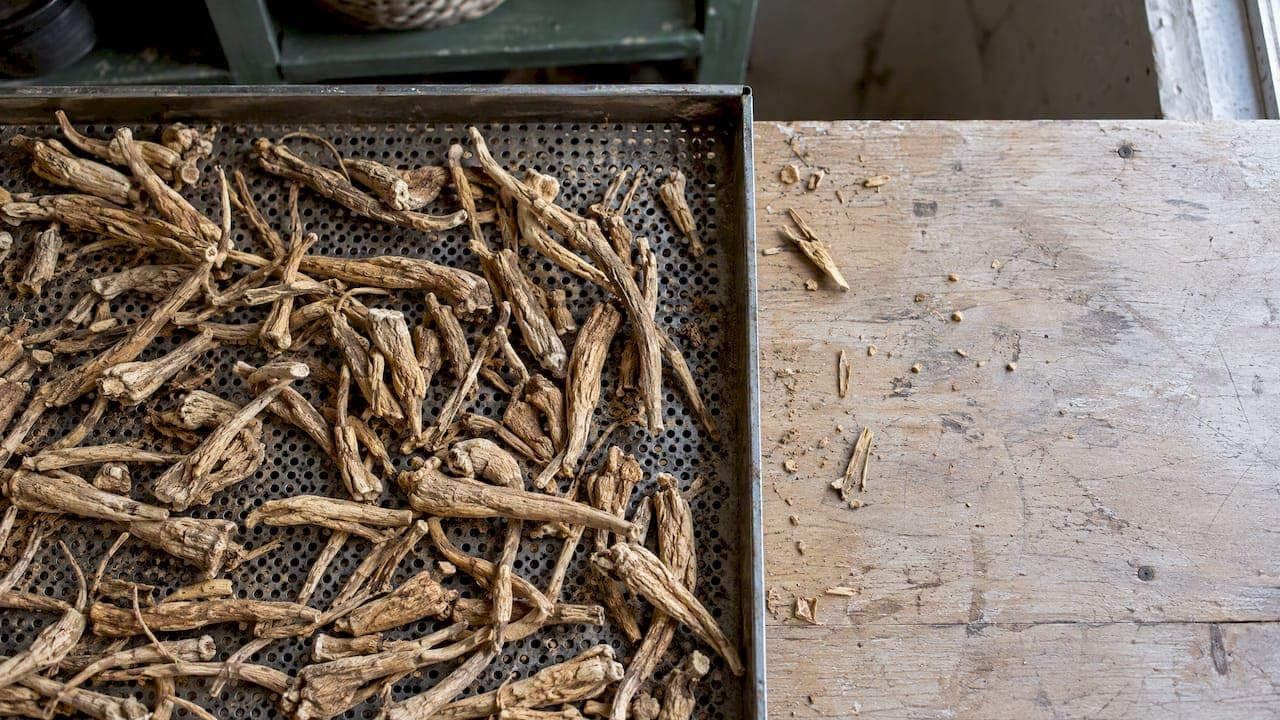
"Androgenic adaptogens" is a search phrase more than a scientific category. Adaptogens are herbs and fungi traditionally used to support resilience under stress. Androgen-related compounds are a separate topic: plant constituents studied for their relationship with androgen signaling. The two overlap in a small number of ingredients, and the honest position is that the evidence is ingredient-specific, uneven, and strongest where claims are modest. This guide separates what is established from what is marketed, so you can judge a formulation on its merits.
TL;DR
- An adaptogen is a stress-resilience concept, not a hormone-raising category. Each ingredient has to be evaluated on its own, as the Merck Manual notes.
- Ashwagandha has the most male-focused human data, but the trials are small and short, and its safety is under EU review.
- Extract type, standardization and dose change the result. A product label matters more than an ingredient name.
- In Sweden, supplements do not need pre-market approval. The seller carries the safety responsibility, so scrutinize the producer.
- Sleep, training, nutrition and a blood panel come before any supplement.
Table of Contents
- What "adaptogen" actually means
- Where adaptogens and androgen signaling overlap
- What the research shows
- Safety and regulation in Sweden
- Forms: capsule, tea, tincture, spray
- How to evaluate a product
- The foundations come first
- Our perspective
- Membership at VIRIDOS
- FAQ
- Sources
What "adaptogen" actually means
The term describes herbal and nutritional products said to promote adaptability, resilience and survival under stress, according to a 2020 academic review of the concept's evolution. The classical definition is demanding. An adaptogen should be innocuous with minimal physiological disorder, act nonspecifically against a wide range of adverse factors, and possibly normalize disturbed function.
That definition has two consequences for anyone reading product claims.
- It is about resilience, not stimulation. A true adaptogen is not defined by a noticeable jolt. If a product feels like a stimulant, it is behaving like one.
- It says nothing about hormones. Nothing in the definition requires an effect on testosterone or any androgen. When a brand pairs the two ideas, it is making a second claim that needs its own evidence.
Substances commonly called adaptogens include ashwagandha, Panax ginseng, eleuthero, rhodiola, schisandra, maca, holy basil, cordyceps, reishi and others, according to the Merck Manual. The list is a convention, not a regulated class.
Where adaptogens and androgen signaling overlap
Readers searching for androgenic adaptogens usually want one of three things: steadier energy under load, support for drive and libido, or help maintaining strength as they age. Those are different goals, and different ingredients are discussed for each.
| Goal | Ingredients most often discussed | Evidence character |
|---|---|---|
| Stress resilience, recovery | Ashwagandha, rhodiola, ginseng | Human trials exist, mixed quality |
| Vitality, sexual well-being | Ashwagandha, maca, ginseng | Small trials, short durations |
| Androgen-related signaling | Select plant compounds (phytoandrogens) | Mostly preliminary, formulation-dependent |
The distinction matters. Adaptogens are defined by what they may do for the stress response. Phytoandrogens are defined by their relationship to androgen pathways. Our own writing on combining adaptogens and phytoandrogens one at a time argues for introducing them separately, so you can tell what is doing what.
What the research shows
Stress, fatigue, focus
Reviews report possible anti-fatigue, attention, mood and stress-response effects, with proposed involvement of the hypothalamic-pituitary-adrenal axis and neuroendocrine-immune signaling. But much of the mechanistic evidence comes from laboratory or animal work, as a review of effects on the central nervous system makes clear.
The human picture is more cautious. A systematic review of adaptogens and depression-related outcomes found moderate risk of bias among included studies and called for further work on which plants, doses and protocols are most effective. Its authors also stress that herb-drug interactions and extract standardization need particular attention.
The Merck Manual's professional summary is blunt: evidence is limited and often of low quality, and supplements do not make up for poor nutrition or lack of physical activity.
Male vitality and hormones
This is the question behind the keyword, and it deserves precision. Ashwagandha has the most male-specific data. In a randomized, double-blind, placebo-controlled trial of 50 healthy men, a standardized root extract was associated with a 17% rise in serum testosterone (72 ng/dl) against a 2% change in the placebo group, alongside improvements on a sexual-function questionnaire.
Read that result for what it is:
- Small sample. Fifty men cannot represent every man in his fifties with a demanding job.
- One extract. The result belongs to a specific standardized preparation, not to "ashwagandha" as a category. A 2025 academic paper makes the general point: a plant extract's composition and dose can produce varying pharmacological activity.
- Short duration. It tells you little about years of use.
- A lab value is not an outcome. A higher number on a blood test is not the same as better performance, recovery or health.
For most other herbs sold on "testosterone support" claims, the human evidence is thinner still. We cover that landscape in our plant-based guide to serum testosterone support and in what the evidence says about ergogenic aids.
Why one ingredient cannot vouch for another
Because adaptogens are very different substances, each must be evaluated alone. Research cannot validly establish that the whole category works, since ingredients, extracts, doses and outcomes all differ. Treat any sentence beginning "adaptogens are proven to..." as a red flag.
Safety and regulation in Sweden
This is where disciplined buyers should spend the most attention.
Who is responsible. Livsmedelsverket, the Swedish Food Agency, states that food supplements do not need pre-market approval like medicines. The company that sells or manufactures a supplement is responsible for demonstrating that it is safe for consumers. In practice, a supplement is only as trustworthy as the producer's documentation.
Plants are not automatically safe. The agency warns that chemical composition can vary between and within plants and that supplements may contain substances that have not been risk-assessed.
Ashwagandha specifically. As of the agency's 2025 information, ashwagandha was among twelve commonly used supplement substances or plants under EU review, and Livsmedelsverket said it had not performed its own risk assessment and was awaiting that review. A Norwegian assessment summarized by Sweden's SBU-linked service reports that long-term safety is not established, with reported adverse effects including gastrointestinal and neurological symptoms, possible thyroid effects and acute liver injury. Check the current status before you commit to long-term use.
Medicines. Livsmedelsverket advises adults not to overdose on supplements, not to combine them with medicines without consulting a doctor, and not to use them instead of medicines. Läkemedelsverket adds a practical rule: tell every healthcare professional about every supplement and natural product you take, because users commonly underestimate interactions and fail to report them.

If you take medication for blood pressure, blood sugar, thyroid function, mood or sleep, or have a liver condition, speak to your physician before adding any adaptogen. Do the same if you are scheduled for surgery or a hormone test.
Forms: capsule, tea, tincture, spray
Adaptogens can be added to food or beverages, taken as capsules or tinctures, and some dried plants are steeped as tea, according to the Cleveland Clinic. Format affects consistency more than most buyers realize. A tea depends on how long you steep it and how the plant was grown. A capsule depends on the extract inside it. A sublingual spray is metered, so each dose is the same, which is why we favor it for precision. It is a delivery philosophy, not a guarantee of any outcome, and it does not change the need for the checks above.
How to evaluate a product
Before you buy anything marketed around androgenic adaptogens, work through this list.
- Is the ingredient named, with its part and extract type? "Proprietary blend" with no amounts tells you nothing.
- Is the dose stated per serving? You cannot compare to a trial without it.
- Does a human study exist for this extract? Not for the plant in general.
- Is the claim modest? Support, maintain, sustain are honest verbs. Cure, fix and reverse are not.
- Who is accountable? Under Swedish rules the seller carries the burden of showing safety. Ask for batch information and production details.
- Have you tested first? A baseline blood panel, ordered through your physician, gives any later change a reference point. Our zinc and androgens protocol explains the test-first logic over 8 to 12 weeks.
- Change one variable at a time. Otherwise you cannot know what worked.
The foundations come first
No adaptogen compensates for the inputs that drive male vitality after 40: sleep, resistance training, adequate protein and energy, body composition, alcohol, and managed workload. Our pieces on training and testosterone and on keeping strength and libido while intermittent fasting cover those levers in detail. If you want the broader framework, the 2026 self-optimization guide sets out how to sequence them.
For the herbs themselves, 8 weeks to strength and vitality reviews evidence-backed options for executives, and why adaptogens matter for executive resilience explains the stress-response logic.
Our perspective
We built VIRIDOS for men who are still in the arena: founders, executives and investors who carry responsibility and intend to keep performing for decades. That audience is exactly the one most often sold exaggeration, and we think it deserves the opposite.
Our position is simple. First, adaptogens and phytoandrogens are different questions, and we keep them apart in how we write and how we recommend using them. Second, evidence has to stay inspectable: what is known, how it was reasoned, and where uncertainty remains. We would rather tell you a result comes from 50 men than let it stand as a universal promise. Third, small-batch Swedish production exists so that composition is controlled and each batch can be accounted for. Consistency is the entire point of a precision formulation.
We support professional judgment; we do not replace it. Your physician, your data and your discipline do the real work. A supplement is one carefully chosen input among many.
— Joakim
Membership at VIRIDOS
VIRIDOS is a plant-derived performance supplement for men, delivered as a precision oral spray. Access is controlled: applicants are reviewed individually, and cohorts are limited so production stays small-batch and Swedish.

There are two plans. Member is $99 per month. Professional is $299 per month. You can compare both on the pricing page or read how approval works on the membership page. Nothing here is a medical product, and it is not intended to diagnose, treat or replace care from your physician.
FAQ
Are there adaptogens that raise testosterone?
Some small trials of specific ashwagandha extracts report higher serum testosterone in healthy men compared with placebo, but the samples are small and the durations short. There is no evidence that adaptogens as a class do this. Ask your physician to measure rather than assume.
What is the most powerful adaptogen?
There is no reliable ranking. Adaptogens are very different substances, so each must be judged on its own ingredient, extract, dose and intended effect. The best choice depends on your goal, your health and your medications.
Is ashwagandha safe to take long term?
Long-term safety has not been established, and reported adverse effects include gastrointestinal and neurological symptoms, possible thyroid effects and acute liver injury. In Sweden, ashwagandha was awaiting EU review as of Livsmedelsverket's 2025 information. Speak to your doctor before using it, especially alongside medication.
Do adaptogens replace sleep, training or nutrition?
No. Professional guidance is clear that supplements do not make up for unhealthy nutrition or lack of physical activity. Treat them as a minor, optional layer on top of sound fundamentals.
Can I take adaptogens with medication?
Not without medical advice. Livsmedelsverket advises against combining supplements with medicines without consulting a doctor, and Läkemedelsverket recommends telling every healthcare professional about every supplement you use.
Sources
- Evolution of the adaptogenic concept from traditional use (2020)
- Adaptogens, Merck Manual Consumer Version
- Effects of adaptogens on the central nervous system
- Adaptogens on depression-related outcomes: a systematic review
- Two sides of the same coin for health: adaptogenic plants (2025)
- Ashwagandha randomized controlled trial in adult males, Health Science Reports (2022)
- Växtbaserade kosttillskott, Livsmedelsverket
- Risker med kosttillskott, Livsmedelsverket
- Sikkerhet ved bruk av Ashwagandha, Svelic
- Det du äter och dricker kan påverka dina läkemedel, Läkemedelsverket
- What are adaptogens, Cleveland Clinic