
TL;DR:
- Holistic wellness addresses interconnected physical, emotional, mental, spiritual, social, and environmental dimensions.
- Consistent small habits in nutrition, movement, breathwork, and social connections enhance executive performance and longevity.
- Building systemized routines and environmental cues promotes sustainable health improvements over time.
Most high-performing executives treat their body the way they treat a struggling business unit: intervene when something breaks, fix the immediate problem, and move on. But healthy lifestyles aligned with holistic principles can add up to 7 to 8 years of disease-free life expectancy at age 65. That is not a marginal gain. That is a full strategic cycle. The men who understand this stop chasing symptom relief and start building whole-person systems. This guide breaks down what holistic wellness actually means for executives, which practices move the needle, and how to integrate them without overhauling your schedule.
Table of Contents
- Defining holistic wellness: Beyond fixing symptoms
- The core dimensions of holistic wellness for executives
- Methodologies that deliver: Evidence-backed holistic practices
- Putting holistic wellness into action: Building your executive gameplan
- Why holistic wellness may be the executive edge you're missing
- Support your wellness journey with science-backed executive resources
- Frequently asked questions
Key Takeaways
| Point | Details |
|---|---|
| Whole-person focus | Holistic wellness optimizes all dimensions of health instead of treating isolated symptoms. |
| Evidence-based methods | Lifestyle changes like exercise, nutrition, and mind-body practices are scientifically backed to boost longevity and performance. |
| Executive application | Integrating holistic strategies drives sustainable energy, clarity, and resilience for demanding roles. |
| Practical starting points | Small, consistent changes compound to deliver measurable outcomes even for the busiest executives. |
Defining holistic wellness: Beyond fixing symptoms
The word "holistic" gets misused constantly. Spa weekends. Juice cleanses. Meditation retreats that feel more like vacations than investments. Strip away the noise and the definition is precise: holistic wellness addresses interconnected physical, emotional, mental, spiritual, social, and environmental dimensions rather than isolated symptoms. It is a systems-level approach to health, not a collection of wellness trends.
Conventional medicine excels at acute intervention. Chest pain? Treat the heart. Chronic stress? Prescribe a sleep aid. The problem is that these interventions rarely address why the chest pain or the insomnia appeared in the first place. Holistic wellness asks the upstream question. It looks at how your nutrition affects your mood, how your relationships affect your cortisol, and how your sense of purpose affects your immune function. For executives, this matters because performance degradation rarely has a single cause.
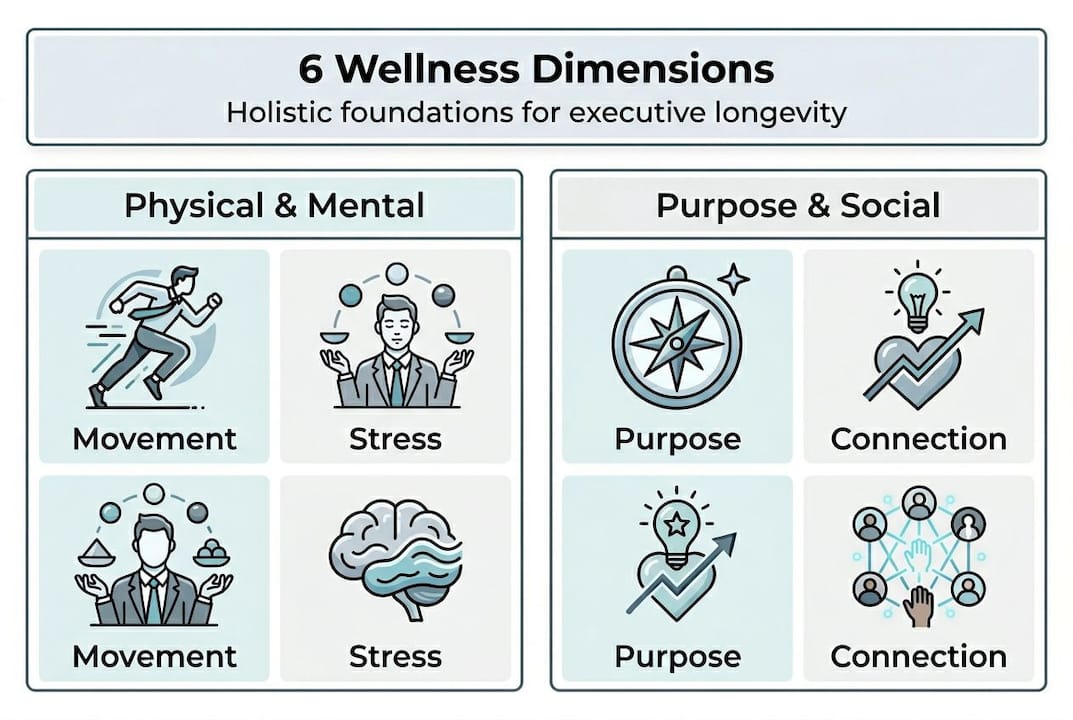
The six core dimensions work together like a portfolio:
- Physical: Movement, nutrition, sleep, and recovery
- Emotional: Stress regulation, self-awareness, and resilience
- Mental: Cognitive load, focus, and continuous learning
- Spiritual: Purpose, values alignment, and meaning
- Social: Quality of relationships, trust networks, and connection
- Environmental: Workspace design, nature exposure, and sensory inputs
| Approach | Focus | Time horizon | Goal |
|---|---|---|---|
| Conventional medicine | Symptom relief | Short-term | Fix the problem |
| Holistic wellness | Root causes | Long-term | Prevent and optimize |
| Executive performance coaching | Output metrics | Medium-term | Improve results |
"The greatest mistake in the treatment of diseases is that there are physicians for the body and physicians for the soul, although the two cannot be separated." — Plato
Most executives optimize one or two dimensions and wonder why they still feel flat. You can train hard and eat well but still burn out if your social connections are shallow and your work feels meaningless. Explore holistic performance frameworks to see how leading executives structure this across all six dimensions.
The core dimensions of holistic wellness for executives
Knowing the six dimensions is one thing. Understanding how each one directly fuels your performance is where the real leverage lives.

Core dimensions include physical nutrition and movement, emotional stress management, spiritual purpose, intellectual learning, and social relationships, and each one has a direct line to executive output. Sleep is not just recovery. It is memory consolidation, emotional regulation, and glucose metabolism. When sleep quality drops, decision quality drops with it. The research on this is not subtle.
| Wellness dimension | Executive outcome | Warning sign when neglected |
|---|---|---|
| Physical | Energy, endurance, hormonal balance | Fatigue, weight gain, low testosterone |
| Emotional | Decision quality, composure under pressure | Reactive choices, irritability |
| Mental | Strategic clarity, creativity, focus | Brain fog, distraction, poor memory |
| Spiritual | Motivation, drive, long-term resilience | Cynicism, disengagement, burnout |
| Social | Stress buffering, trust, team performance | Isolation, conflict, poor judgment |
| Environmental | Focus, recovery, sensory regulation | Chronic tension, poor sleep, anxiety |
The social dimension is consistently underrated by high-performing men. Strong relationships are not soft assets. They are a measurable buffer against cortisol spikes and cardiovascular risk. Men with robust social networks recover faster from high-stress periods and make fewer impulsive decisions under pressure.
Pro Tip: Emotional regulation is a trainable skill, not a personality trait. Executives who practice even 10 minutes of daily breathwork or body scanning report sharper decision-making in high-stakes situations within 3 to 4 weeks. It is the cheapest performance upgrade available.
Physical vitality is the foundation, but it cannot carry the whole structure alone. Pair it with executive fitness strategies and build in healthy lifestyle routines that reinforce every dimension simultaneously.
Methodologies that deliver: Evidence-backed holistic practices
Strategy without method is just intention. Here are the practices that consistently produce results for executives who are serious about performance longevity.
Methodologies include lifestyle changes, mind-body practices, complementary therapies, and preventive strategies focusing on root causes, and the most effective ones share a common trait: they address multiple dimensions at once.
The top four evidence-backed methods for executives:
- Nutritional precision: Shift from caloric thinking to nutrient density. Plant-forward eating combined with time-restricted feeding (intermittent fasting) reduces systemic inflammation, stabilizes blood glucose, and improves mitochondrial efficiency. This is not a diet. It is fuel management.
- Structured movement: Pain-free, consistent movement beats intense, sporadic training every time. Zone 2 cardio, mobility work, and resistance training form the triad that protects joints, preserves muscle mass, and regulates hormones as you age past 45.
- Breathwork and mindfulness: Breath-based practices directly regulate the autonomic nervous system. Box breathing, coherent breathing, and brief body scans lower cortisol, improve heart rate variability, and sharpen focus. Five minutes before a board meeting is not woo. It is neuroscience.
- Social investment: Scheduled, intentional connection with high-trust relationships is a practice, not a byproduct of a busy life. Treat it like a training block.
Pro Tip: Habit stacking is the highest-ROI system for busy executives. Attach a new holistic practice to an existing anchor habit. Breathwork after your morning coffee. A 20-minute walk after your first meeting. Protein-first eating before every meal. Small shifts, compounded over 90 days, produce outsized results.
For a structured approach to building these habits, explore executive wellness optimization and the healthy aging workflow built specifically for men in demanding roles.
Putting holistic wellness into action: Building your executive gameplan
Healthy lifestyles aligned with holistic principles add measurable years of healthy life expectancy, but the gap between knowing and doing is where most executives stall. Here is how to close it.
Your five-step executive playbook:
- Audit your six dimensions. Score each one from 1 to 10. Honesty here is the whole game. Most executives discover two or three dimensions sitting at 3 or 4 while they have been pouring energy into the one or two they already do well.
- Pick your lowest-scoring dimension. Do not try to fix everything at once. Choose the weakest link and design one specific habit around it. One change, executed consistently, beats six changes abandoned within two weeks.
- Set a 90-day horizon. Holistic wellness does not produce results in 10 days. Commit to a quarter. Measure energy levels, sleep quality, focus duration, and stress recovery speed, not just body weight or gym attendance.
- Build environmental triggers. Put your running shoes next to your desk. Keep a water bottle visible. Set a phone-free window in the evening. Your environment shapes behavior more reliably than willpower does.
- Schedule a monthly review. Treat your wellness metrics the same way you treat a quarterly business review. What improved? What stalled? What needs a different approach?
The highest-ROI habits for time-pressed executives:
- Sleep protection: 7 to 8 hours, consistent schedule, dark and cool room
- Daily movement: 30 minutes minimum, any form that is sustainable
- Protein-first nutrition: anchors blood sugar and reduces afternoon energy crashes
- One genuine social connection per week: a real conversation, not a networking event
- Five minutes of breathwork: morning or pre-meeting
For a broader framework, the high-performance living guide and strategies for balancing work and health give you the scaffolding to make this stick.
Why holistic wellness may be the executive edge you're missing
Here is the uncomfortable truth: most executives already know what they should be doing. They have read the books, attended the retreats, and hired the coaches. The problem is not information. It is the belief that high performance and whole-person health are competing priorities rather than compounding ones.
Conventional executive culture still rewards visible sacrifice. Early mornings, late nights, skipped meals, and zero recovery time are worn as badges. But while strong correlations exist between holistic practices and outcomes, the real insight is this: the men who sustain elite performance into their 50s and 60s are not the ones who pushed hardest. They are the ones who built systems that made sustainable performance the path of least resistance.
The greatest ROI in your health is not found in urgency. It is found in the quiet, daily investment that most high-achievers dismiss as too simple to matter. Explore optimizing performance longevity to see what that looks like in practice.
Support your wellness journey with science-backed executive resources
Moving from theory to consistent practice is where most executives need structure, not more information. VIRIDOS builds resources specifically for high-agency men who want measurable results without the noise.

The Performance Journal gives you a precision tool for tracking energy, focus, and recovery across all six wellness dimensions, turning daily habits into visible data. For men who want curated frameworks, accountability, and access to premium content built around executive longevity, the VIRIDOS Membership delivers exactly that. If you are serious about sustained edge, the next step is not another article. It is a system that works while you do.
Frequently asked questions
What are the six dimensions of holistic wellness?
The six dimensions are physical, emotional, mental, spiritual, social, and environmental health, all working together to support overall well-being and sustained performance.
How is holistic wellness different from traditional health approaches?
Holistic wellness treats the entire person and addresses long-term root causes rather than isolated symptoms, making it fundamentally different from conventional reactive medicine.
Can holistic wellness actually extend my life expectancy?
Healthy lifestyles aligned with holistic principles can add 7 to 8 years of disease-free life expectancy at age 65, according to current research.
What is the 3-formula for executive holistic health?
The 3-formula combines pain-free movement, plant-based nutrition with intermittent fasting, and breath-based mindfulness for a practical, high-impact daily framework.