
TL;DR:
- Scientific curiosity enhances brain health, cognitive reserve, and executive longevity in high-performing men.
- Structured curiosity practices, like daily questions and weekly novelty exposure, reinforce neural resilience.
- Genuine curiosity reduces fatigue, preventing burnout and supporting sustained executive performance.
Most executives optimize sleep, nutrition, and exercise with military precision, yet completely overlook one measurable driver of brain health and performance longevity: scientific curiosity. This is not about being generally inquisitive. Research confirms that curiosity positively correlates with brain health metrics like the Functional Assessment of Brain Health Questionnaire (FA-BHQ), showing stronger positive associations with more brain regions than fatigue's negative associations. For men in demanding executive roles, curiosity is not a soft personality trait. It is a physiological lever you are either pulling or ignoring.
Table of Contents
- The science behind curiosity and wellness
- Structured methods for cultivating scientific curiosity
- Balancing curiosity, fatigue, and work pressure
- Integrating curiosity into executive wellness routines
- Why scientific curiosity is the real longevity lever for executives
- Unlock your executive performance with next-level curiosity
- Frequently asked questions
Key Takeaways
| Point | Details |
|---|---|
| Curiosity boosts brain health | Scientific curiosity stimulates key brain regions and improves cognitive reserve, supporting executive wellness. |
| Structured routines drive longevity | Implementing daily curiosity-building practices promotes sustained performance and reduces age-related decline. |
| Healthy balance prevents burnout | Differentiating intrinsic curiosity from work stress is vital for maximizing wellness and avoiding fatigue. |
| Practical integration is essential | Embedding curiosity into executive wellness routines delivers measurable improvements and long-term benefits. |
The science behind curiosity and wellness
Scientific curiosity, at its core, is a deliberate, intrinsically motivated drive to seek out new information and experiences. It is distinct from general openness or professional ambition. When researchers measure it as a stable personality trait, sometimes called "trait curiosity," they find consistent and measurable links to how the brain ages, performs, and recovers.
Cognitive reserve (CR) is the brain's resilience against aging and neurological stress. Think of it as your cognitive savings account. The larger the reserve, the longer your brain performs at a high level even under pressure, sleep debt, or age-related changes. Trait curiosity predicts higher cognitive reserve proxies, meaning curious executives are systematically building a larger buffer against cognitive decline compared to peers who never develop this habit.
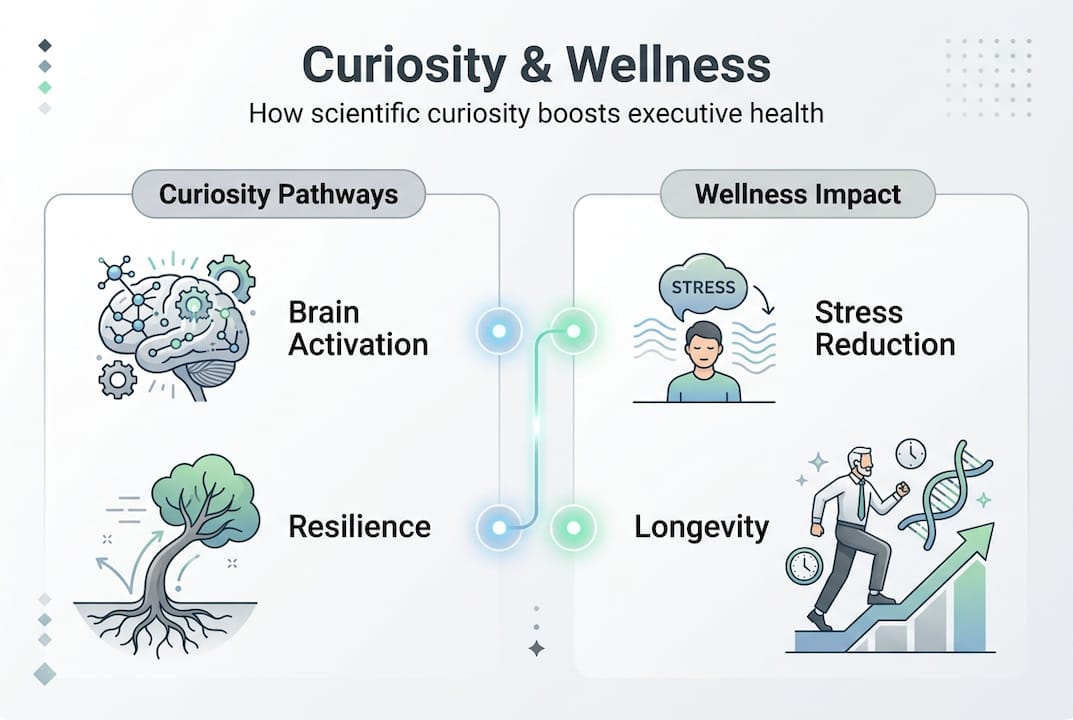
Neuroplasticity, the brain's ability to reorganize and form new neural connections, works in close partnership with curiosity. When you actively seek out unfamiliar ideas, challenge assumptions, or explore domains outside your expertise, you stimulate the same neural pathways associated with learning, adaptability, and executive function. This is not metaphorical. It is structural.
Major benefits of scientific curiosity for executives include:
- Stronger cognitive reserve linked to long-term performance longevity
- Reduced perceived fatigue during high-stakes decisions
- Better emotional regulation under work pressure
- Improved pattern recognition across complex business problems
- Greater neuroplasticity supporting faster adaptation to change
- Higher scores on brain health assessments measuring functional aging
These benefits compound over time. A man who cultivates scientific curiosity at 45 is making deposits into a cognitive account that pays dividends well into his 60s and beyond. For a deeper look at how these mechanisms tie into physical capacity, executive fitness and vitality frameworks show how cognitive and physical health reinforce each other.
The research data makes the comparison striking:
| Metric | High curiosity | High fatigue |
|---|---|---|
| Brain regions positively impacted | Multiple regions across FA-BHQ | Fewer positive associations |
| Cognitive reserve proxy scores | Consistently higher | Significantly lower |
| Functional brain health score | Strong positive correlation | Negative mediation effect |
| Long-term executive function | Sustained through aging | Declines faster |
"Curiosity is not just a character trait. For high-performing men, it is a measurable biological asset that protects the brain from the same fatigue and decline that sidelines their peers."
When you stack curiosity against fatigue as competing forces acting on brain health, curiosity wins on nearly every metric. The science supporting performance frameworks grounded in cognitive health consistently confirms this.
Structured methods for cultivating scientific curiosity
Understanding the science is useful. Applying it is where performance is built. The challenge for executives is that curiosity, left unstructured, gets crowded out by deliverables, meetings, and constant reactive work. You have to build it deliberately, the same way you schedule strength training or board prep.
For executives aged 40 to 65, cultivating scientific curiosity via structured methods builds cognitive reserve, enhances neuroplasticity, counters fatigue, and promotes both longevity and sustained performance output. Importantly, curiosity training yields 65% better executive function in those who adopt it alongside multiple complementary lifestyle factors, making it a force multiplier rather than a standalone fix.
Here is a proven sequence for building curiosity into your operating rhythm:
-
Set a daily question ritual. Before your first meeting, write one question you genuinely do not know the answer to. It can come from your industry, biology, history, or physics. The domain matters less than the genuine uncertainty it represents. This activates curiosity as a deliberate cognitive state.
-
Schedule novelty exposure weekly. Block 90 minutes per week for structured exposure to a field outside your expertise. Read a primary research paper, attend a lecture, or have a structured conversation with an expert in an adjacent domain. Novelty is the raw material curiosity metabolizes.
-
Apply curiosity to post-mortem analysis. When a project fails or underperforms, resist the urge to assign blame and move on. Instead, frame the analysis as a genuine inquiry: "What did we not understand about this system?" This transforms reactive problem-solving into active curiosity.
-
Use leisure strategically. Unstructured reading, hiking, building things with your hands, or learning an instrument are not merely restorative. They generate the low-stakes exploration that primes the brain for higher-stakes curiosity. Many top-performing executives specifically use leisure to feed curiosity without the performance pressure of work settings.
-
Track your curiosity inputs monthly. Keep a brief log of new domains explored, questions investigated, and knowledge gaps identified. Measurement creates accountability and reveals whether you are actually diversifying your intellectual inputs or just consuming familiar information in new formats.
These methods pair directly with wellness optimization strategies designed for executives carrying significant cognitive and organizational load.
Pro Tip: Pair your curiosity practice with a restorative anchor, such as a 20-minute walk or a brief breathwork session, immediately before your daily question ritual. The cognitive clarity from a calm nervous system dramatically amplifies the quality of questions you generate and the insight you extract. This is especially important for performance tips for executives over 40, where stress recovery speed becomes a competitive variable.
The key mistake executives make is treating curiosity as a reward for finishing other work. It should be scheduled first, not last. When curiosity is always the thing you will get to after the deliverables are done, it never happens.
Balancing curiosity, fatigue, and work pressure
There is an important distinction that most high performers miss entirely. Not all intellectual intensity is curiosity. Driving yourself through a 70-hour week under the internal story that you are being "intellectually curious" about every challenge is a rationalization for overwork, not genuine curiosity. The outcomes are fundamentally different.

Fatigue mediates negatively between curiosity and brain health: high curiosity is linked to less fatigue and better FA-BHQ scores. The direction matters. Genuine curiosity reduces fatigue over time because it generates intrinsic motivation that makes cognitive effort feel energizing rather than draining. Extrinsic pressure, even pressure that looks like curiosity from the outside, produces the opposite physiological response.
The distinction matters clinically. Excessive work pressure mimicking "scientific curiosity" can lead directly to burnout, chronic health deterioration, and in extreme cases, fatal outcomes. This is not hyperbole. The research community has documented cases where the cultural glorification of intense intellectual drive masked dangerous levels of occupational stress.
Here is how to tell the difference in your own behavior:
Signs of healthy curiosity:
- The activity feels energizing even when it is cognitively demanding
- You pursue it without external deadlines or accountability
- It generates more questions than answers, and that excites you
- You can stop without anxiety when energy runs low
- You return to it refreshed after rest
Signs of unhealthy curiosity driven by pressure:
- You frame overwork as "learning" or "exploration"
- You feel guilty when you are not researching, reading, or analyzing
- The activity feels obligatory rather than genuinely interesting
- Rest creates anxiety rather than recovery
- You cannot recall the last time you pursued something purely because it fascinated you
| Factor | Curiosity-driven wellness | Work-driven burnout |
|---|---|---|
| Primary driver | Intrinsic interest and exploration | External pressure and performance anxiety |
| Effect on fatigue | Reduces chronic fatigue over time | Accelerates fatigue and stress markers |
| Brain health outcome | Positive FA-BHQ scores, better CR | Cognitive decline risk, reduced resilience |
| Sustainability | Builds over decades | Collapses within years |
| Recovery response | Curiosity resumes naturally after rest | Rest does not restore baseline energy |
Managing this boundary is a serious executive skill. Relevant work-health balance strategies give you frameworks for maintaining the distinction under real organizational pressure.
Pro Tip: Create a weekly check-in question for yourself: "Is what I am calling curiosity generating energy or consuming it?" Honest answers to this one question, tracked over four to six weeks, will reveal whether your intellectual intensity is working for or against your brain health. This is the type of behavioral audit that health coaching for executives typically surfaces in the first month of engagement.
Integrating curiosity into executive wellness routines
Curiosity as an abstract value changes nothing. Curiosity built into daily structure changes everything. The men who actually benefit from the cognitive reserve and brain health outcomes described earlier are not those who find it intellectually interesting. They are the ones who treat curiosity like a training discipline with specific inputs, outputs, and tracking.
Research provides a compelling mechanistic reason for this approach. Curiosity overpowers cognitive effort avoidance, meaning people consistently exert more cognitive effort when they are genuinely curious about the outcome. This is a powerful finding for executives. You do not have to force willpower when curiosity is present. The motivation generates itself. Your job is to create the conditions where curiosity operates reliably.
Additionally, trait curiosity predicts higher cognitive reserve proxies, with the effect being strongest in middle-to-older adults. The window from 45 to 65 is where this investment pays the highest return. This is precisely your timeframe.
Here is how to embed curiosity systematically into your wellness routine:
-
Anchor curiosity to an existing daily practice. Attach your question ritual or novelty reading to something you already do consistently, such as your morning coffee, your post-workout cooldown, or your evening wind-down. Habit stacking reduces friction dramatically.
-
Create a "wonder list" and review it weekly. Keep a running document of things you are genuinely curious about but have not investigated yet. Review it every Sunday and commit one item to active exploration during the coming week. This creates a backlog of genuine intellectual interest that prevents curiosity from running dry.
-
Design curiosity into team interactions. Use one question in every key meeting that you genuinely do not know the answer to. This serves both organizational and personal functions. It models intellectual honesty and keeps your curiosity practice active within your core work context.
-
Schedule a monthly "learning audit." Review what new domains you explored, what questions you asked, and what mental models you updated. If the audit reveals you consumed information only in familiar categories, treat it as a signal to restructure your inputs.
-
Integrate curiosity with physical recovery. Long walks, cold exposure, and unstructured physical activity create ideal conditions for your best curiosity to surface. Many executives report that their most generative questions arise not at a desk but during physical recovery activities.
Ways to measure curiosity and wellness improvements:
- Track changes in self-reported energy levels across a four-week curiosity program
- Monitor cognitive reserve proxies using validated questionnaires with your physician
- Note frequency of novel domain exposure per month
- Assess quality of sleep, as curiosity-related fatigue reduction often improves sleep onset and depth
- Use performance journaling to capture decision quality improvements and pattern recognition gains
These executive longevity strategies benefit enormously from systematic tracking. What you measure, you protect. Connecting curiosity to measurable wellness outputs transforms it from a lifestyle choice into a performance metric, which is where it belongs in an executive's operating system. For building the energy foundation that makes sustained curiosity possible, optimizing personal energy remains a core upstream lever.
Why scientific curiosity is the real longevity lever for executives
Most conventional executive wellness advice focuses on sleep, exercise, nutrition, and supplementation. These are legitimate. But they address the body's hardware while largely ignoring the software update that changes everything: a structured, sustained curiosity practice. The research on this is clear enough that continuing to omit it from executive wellness programs is simply a gap in the model, not a defensible position.
Here is the contrarian reality. A man who takes every supplement, trains six days a week, and sleeps eight hours but never cultivates genuine scientific curiosity is leaving significant cognitive aging protection on the table. Curiosity training, as the research shows, yields measurably better executive function in those who adopt it alongside other lifestyle factors. The word "alongside" matters. Curiosity is additive in a way that additional supplements or marginal sleep optimization rarely is.
Our view at VIRIDOS is that curiosity belongs in the same category as VO2 max or HRV: a measurable, trainable biomarker of executive longevity. The men who will still be operating at full capacity at 65 are already treating it that way. The complete guide to executive vitality builds on exactly this foundation.
Unlock your executive performance with next-level curiosity
The science is clear and the methods are practical. Now it comes down to structure and accountability, and that is exactly where VIRIDOS is built to help.
The Performance Journal gives you a precision tool for tracking your daily curiosity practice, question rituals, and cognitive wellness progress alongside your physical performance data. The VIRIDOS Methodology integrates curiosity cultivation directly into a science-backed executive performance framework, developed with the same rigor you apply to your best business decisions. And the VIRIDOS Membership connects you with a community of high-agency men who take performance longevity seriously, with the resources and accountability structure to match.
Frequently asked questions
How does scientific curiosity improve executive wellness?
Scientific curiosity strengthens multiple brain regions, boosts cognitive reserve, and counters fatigue, producing measurable improvements in brain health scores and sustained executive function well into later decades.
What are practical ways to cultivate scientific curiosity daily?
Daily questioning rituals, weekly novelty exposure outside your domain, and structured leisure routines are proven approaches. Cultivating scientific curiosity via structured methods builds cognitive resilience and counters the fatigue that erodes performance under sustained executive pressure.
Is there a risk of burnout from too much curiosity-driven work?
Yes. Excessive work pressure disguised as curiosity bypasses the intrinsic motivation that makes genuine curiosity restorative, creating burnout risk that looks identical to overwork because it is overwork.
How can executives measure their curiosity-driven wellness progress?
Track energy levels, cognitive reserve proxy scores, domain diversity in your learning inputs, and sleep quality across four to eight weeks. Curiosity training yields 65% better executive function when paired with other lifestyle factors, making combined tracking the most accurate measure of real progress.